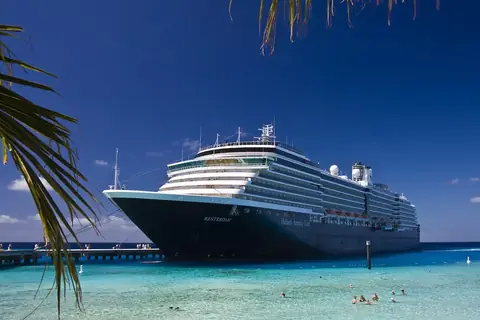
There is an entire genre of internet video devoted to people running down a pier toward a ship that is already pulling away. It is played for comedy. What the comments never mention is how ordinary most of those passengers were — not drunk, not reckless, not lost. They simply looked at a clock that was telling the truth about the wrong place.
Two clocks, one deadline
Your ship runs on ship time: a single reference clock for the voyage that governs all-aboard, excursion departures, dinner reservations and the closing of the gangway. It is deliberately stable, because a floating hotel of three thousand people cannot re-plan itself every time the ground beneath it changes.
Your phone runs on network time: it syncs to whatever cell tower it finds and updates silently, without announcement or apology. Walk down the gangway and your lock screen may quietly become the port’s clock.
Ninety-nine port days a year, they agree, and nobody thinks about it. Then comes the itinerary where they don’t.
Where Japan itineraries diverge
Japan has one time zone, so within it — Yokohama to Kagoshima, Hakodate to Kobe — ship and shore agree, and this trap stays shut.
It springs open at the borders:
| Country on your itinerary | Local time | Risk |
|---|---|---|
| Japan | UTC+9 | None — the reason most Japan-only cruisers never meet this problem |
| Korea (Busan, Incheon, Jeju) | UTC+9 | None on the clock, but ships crossing sometimes announce other adjustments — read the program |
| Taiwan (Keelung) | UTC+8 | One hour behind Japan. A ship holding Japan time makes your phone read one hour early |
| Hong Kong / China | UTC+8 | Same trap, and often mid-repositioning voyages where clocks move on sea days |
Read that Taiwan row again, because it is the one that bites on our itineraries. If your ship keeps Japan time while you’re ashore in Keelung, your phone says 15:00 when the ship says 16:00. An all-aboard of 17:00 ship time feels like two hours away and is actually one. Passengers have lost ships to exactly this arithmetic — including, more than once, on the Jiufen return road when the traffic decided to be Taiwanese about it.
The other direction is worse
There is a crueller version. Ships sometimes advance or retard the clock overnight on a sea day, announced in a small line of the daily program that everybody skims. You wake, you go ashore, your phone re-syncs to the port and shows you a time that matches your memory of yesterday — and it is your memory, not your phone, that is wrong.
This is why every experienced cruiser you meet has the same fossilised habit: they read the deadline off the paper program, and they never do the mental arithmetic twice.
The thirty-second immunisation
- Read all-aboard from the printed daily program, not from anything with a battery. Ships print it because they know about this problem.
- Set a manual alarm for 90 minutes before all-aboard. Not the return time — the start heading back time. On our timed plans that margin is already banked; the alarm is what makes you obey it.
- On any itinerary that crosses into Taiwan, Hong Kong or China, ask guest services one question: “Is ship time the same as shore time here today?” You will get a clear answer in five seconds, and you will not be the first person to ask.
- Photograph the daily program’s all-aboard line with your phone. Now the wrong clock and the right deadline live on the same screen.
Why we bother printing this
Every plan on this site ends at the gangway with an hour to spare, because the whole point of timing a port day from the berth is that you never have to sprint. That work is wasted if the clock you’re racing is the wrong one.
So: know your ship time, trust the paper, set the alarm ninety minutes out. Then go and enjoy the volcano, the market, the shrine at opening — with the one certainty that makes all the rest of it relaxing.
The passengers in those videos would have been fine with a thirty-second check. Be the passenger who made it.