
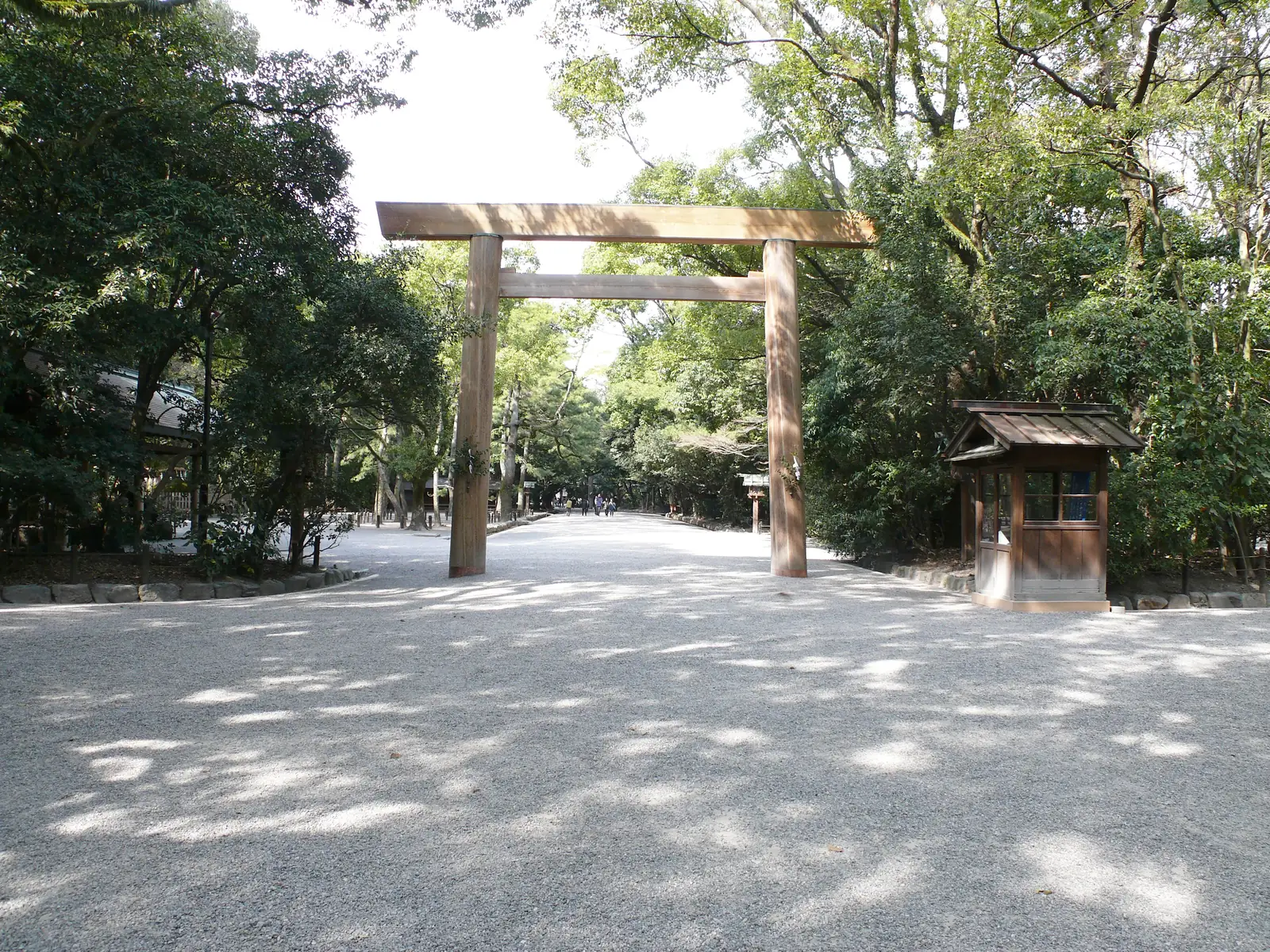
Atsuta Jingu and the Kusanagi sword
A shrine built around one of the three imperial treasures, and a museum of the swords you can see
One of the three sacred treasures of the Japanese throne is held at a shrine about 14 km by road from the berth. It is not on display. The new museum next door holds about 450 other swords.
Atsuta Jingu stands in a forest in the south of Nagoya. The city puts the grounds at about 190,000 square metres, most of it trees. The shrine counts about nine million visitors a year. Its chief deity, Atsuta-no-Okami, is Amaterasu, the sun goddess, represented by the sacred sword Kusanagi-no-tsurugi.
The sword in the story
The Kusanagi is one of the three sacred treasures that stand for the imperial throne, with a mirror and a jewel. The shrine tells its founding this way. Prince Yamato Takeru left the sword with his wife, Miyasuhime, and died on his travels. Miyasuhime chose this site to enshrine it. The shrine dates that to 113 and counts more than 1,900 years of history.
The Nihon Shoki, the court chronicle, adds a theft. In 668 a monk from Silla named Dogyo stole the sword. In 686 it was returned to Atsuta. The shrine still marks the return. On the evening of 4 May the lights in the grounds are turned off and the people taking part laugh aloud at four places, in the Eyodo Shinji. On 5 May a portable shrine is carried to the west gate, at the site of the old Chinko Gate.
On the evening of 4 May the lights go out and the people taking part laugh aloud.
Nobunaga's wall and the camphor tree
In 1560 Oda Nobunaga prayed here for victory before the Battle of Okehazama. He won, and gave the shrine an earthen wall as thanks. The Nobunaga-bei is made of earth and lime mixed with oil, with tiles laid thick along it. The shrine counts it among Japan's three great earthen walls, with those at Nishinomiya Shrine and Sanjusangendo in Kyoto. You pass it on the way to the main sanctuary.
North of the water basin stands the Okusu, a camphor tree said to be more than 1,000 years old and, by tradition, planted by Kobo Daishi. Near the south pond is the Nijugocho bridge, named for its 25 stone slabs and called the oldest stone bridge in Nagoya.
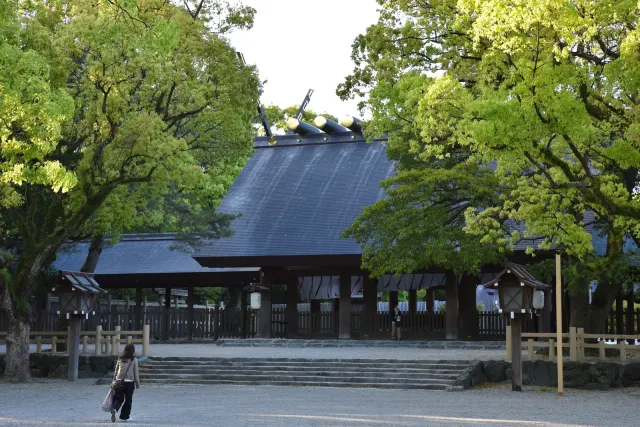
The main sanctuary was rebuilt in 1893 in the Shinmei style, the style of Ise. Before that it followed the local Owari style. Air raids damaged the shrine in 1945, and it was rebuilt in 1955.
The swords you can see
The Kusanagi-kan opened on 3 October 2021, as part of the shrine's project to mark the Reiwa enthronement. It holds about 450 Japanese swords offered to the shrine. The cases are glass on every side, so you see both faces of a blade. Two huge odachi are on permanent display, linked to a father and son who fought at the Battle of Anegawa in 1570. The larger, Suenoaoe, has a blade of 221.5 cm and is 303 cm long overall. In one corner you can feel the weight and length of full-size replicas.
The older Treasure Hall holds more than 6,000 items given by the imperial family, shoguns, lords and private donors. The shrine says 177 of them are designated National Treasures or cultural properties. Each building is ¥500 for adults, or ¥800 for both, with the combined ticket sold until 15:30. Both are open 9:00–16:30, last entry 16:00. From 30 October to 24 November the Treasure Hall has a special display of contemporary Tokai swordsmiths; a corner exhibition follows from 27 November.
On a cruise day
From Kinjo Pier take the Aonami Line to Nagoya, then the Meitetsu line to Jingu-mae, three minutes from the shrine. A route planner gives about eight minutes for that leg by limited express. A taxi from the berth is about 13.9 km, roughly ¥6,200 by our estimate before traffic. The grounds are free and their hours are not published.
Lunch is in the grounds or near them. Miya Kishimen serves flat kishimen noodles inside the grounds, 9:00–16:30 every day. Atsuta Horaiken's Jingu-ten, by the south gate, is closed on Tuesdays, so it is shut on 10 November. Its Honten, the main shop, is open on Tuesdays.
How it happened
- 113The sword is enshrined
The shrine's date for the Kusanagi coming to Atsuta, after Yamato Takeru's death
- 668Stolen
The Nihon Shoki records the theft by a monk from Silla named Dogyo
- 686Returned
The sword comes back to Atsuta; the 4 and 5 May rites remember it
- 1560Nobunaga's wall
Oda Nobunaga gives an earthen wall in thanks for Okehazama
- 1893Shinmei style
The main sanctuary is rebuilt in the style of Ise
- 1945Air-raid damage
Several buildings burn
- 1955Rebuilt
The post-war reconstruction is completed
- 2021The Kusanagi-kan opens
3 October; about 450 offered swords, two great odachi on permanent display
Where this becomes real on your port day
Aonami Line to Nagoya, Meitetsu to Jingu-mae, three minutes on foot. Allow an hour and a half for the grounds and the Kusanagi-kan, and lunch on kishimen inside. Both museums are open on all three Jade calls.
The vocabulary of Atsuta Jingu
- Kusanagi-no-tsurugi 草薙神剣
- The sacred sword held at Atsuta, one of the three treasures of the imperial throne. It is not on display.
- Sanshu no jingi 三種の神器
- The three sacred treasures: a sword, a mirror and a jewel.
- Nobunaga-bei 信長塀
- The earthen wall Oda Nobunaga gave after his victory at Okehazama in 1560.
- Okusu 大楠
- The great camphor tree north of the water basin, said to be over 1,000 years old.
- Eyodo Shinji 酔笑人神事
- The 4 May evening rite for the sword's return: lights out, and laughter at four places.
- Kusanagi-kan 草薙館
- The sword museum opened in 2021, with about 450 swords offered to the shrine.
FAQ
Can you see the Kusanagi sword at Atsuta Jingu?
No. The Kusanagi is the sacred object of the shrine and is not displayed. The Kusanagi-kan museum shows swords offered to the shrine over the centuries, including two huge odachi on permanent display.
How much are the Atsuta Jingu museums?
The grounds are free. The Treasure Hall and the Kusanagi-kan are ¥500 each for adults, or ¥800 for both; the combined ticket is sold until 15:30. Both open 9:00–16:30, last entry 16:00.
How do I get to Atsuta Jingu from the cruise port?
Aonami Line from Kinjo-futo to Nagoya (24 min, ¥360), then Meitetsu to Jingu-mae, three minutes on foot. A taxi from the berth is about 13.9 km, roughly ¥6,200 by our estimate before traffic.
Is Atsuta Jingu open on Tuesday 10 November 2026?
Yes. The grounds have no published closing day, and by their closing rules the Treasure Hall and the Kusanagi-kan are open. Atsuta Horaiken's Jingu-ten is closed on Tuesdays; its Honten is open.
More from Nagoya
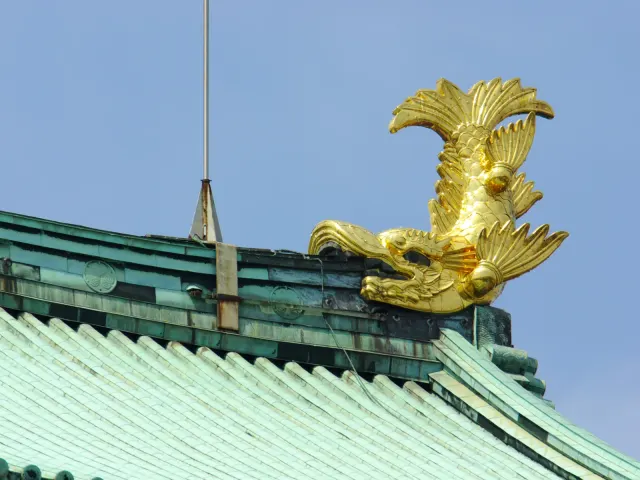
Two golden fish, a keep you cannot enter and a palace rebuilt from Edo-period plans
Read →
Eel in three rounds, pork in dark miso, and toast with red beans at breakfast
Read →
A loom-maker's brick plant, a car company and Japan's busiest cargo port
Read →
Ieyasu's bequest, a wedding set from 1639, the Tale of Genji scrolls and a lord's retirement garden
Read →