
A definition, not a recipe
The only rule is that it must be made after you order it
There is no Sasebo burger recipe. There is a definition: made after the customer has ordered, by a Sasebo business, with fresh raw vegetables and the shop’s own sauce. Everything else is up to the shop — which is why dozens of certified places all produce something different, and why arguing about which is best is a local sport.
The hamburger arrived here with the United States Navy in the years after 1946. Local shops learned to make them for American sailors, using whatever was available, and kept making them long after the novelty wore off.
By the 1990s Sasebo had a large number of independent burger shops with no shared standard and no collective identity. Some were excellent and some were not, and none of them were known outside the city.
The certification
Joint promotion began in 2001, and the Sasebo Burger Business Cooperative was founded in 2010. The official definition is deliberately loose: the burger is made after the order is taken, by a business headquartered in Sasebo, with fresh raw vegetables and an original sauce. No specified patty weight, no required bun, no fixed recipe.
That looseness is the strategy. A prescriptive standard would have produced a chain product; a rule about process produced dozens of genuinely different burgers, all of which take a quarter of an hour to arrive.
Expect to wait fifteen minutes. If it comes faster than that, it is not a Sasebo burger, whatever the sign says.
What they are actually like
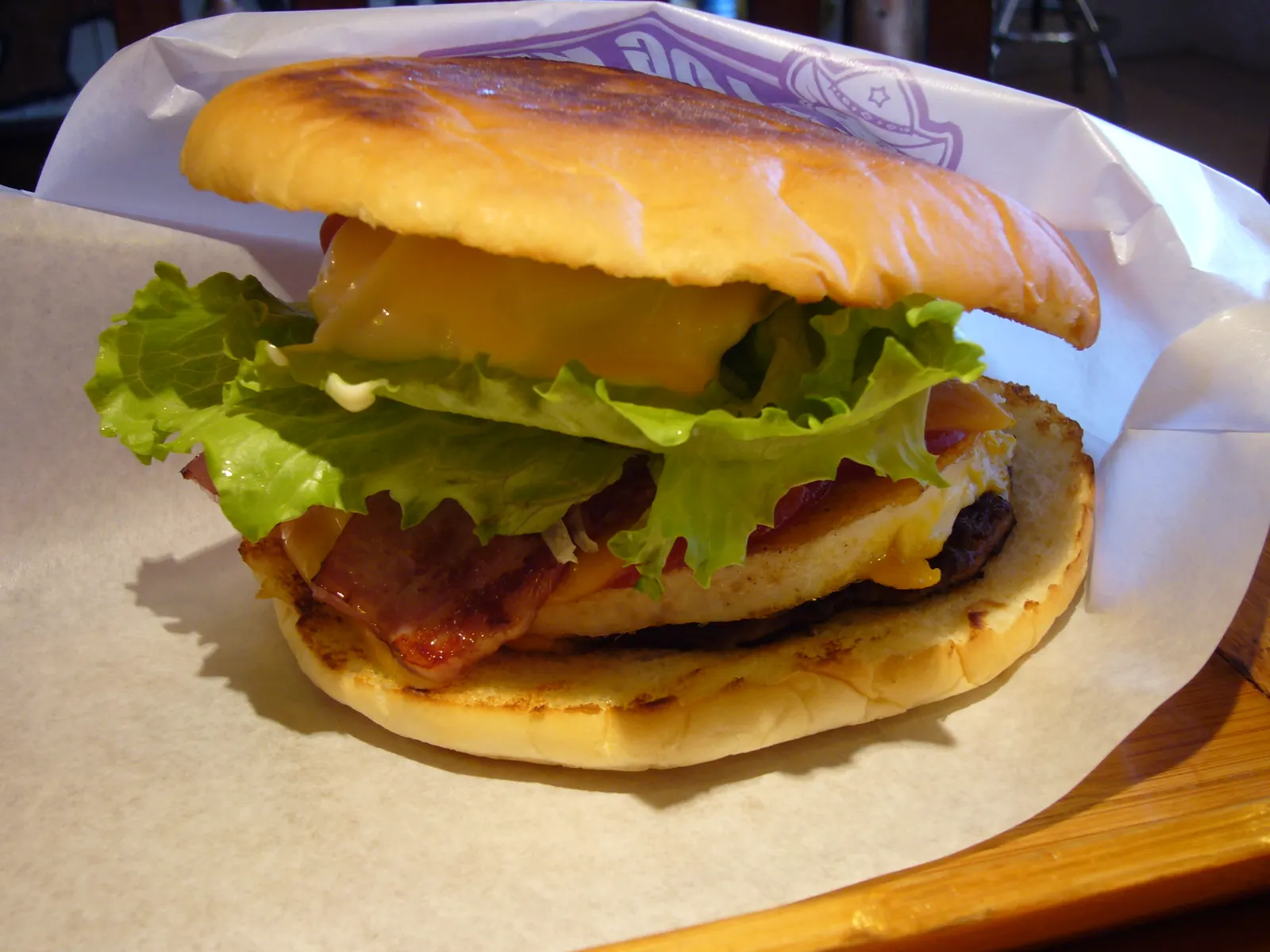
Large, untidy, and generous — a thick hand-formed patty, bacon and fried egg on many of them, a lot of shredded lettuce and mayonnaise, and a bun that has usually been toasted on the same griddle. They are closer to an American diner burger of the 1950s than to anything contemporary.
The classic order is a bacon-egg burger, and it is genuinely difficult to eat without both hands and a plan.
And the other thing this city invented
Lemon steak: thin slices of beef seared very hot on a plate, finished with a lemon and soy sauce, and then rice tipped into the remaining sauce at the end. It was created in Sasebo in the 1950s and is served almost nowhere else in Japan.
Between the two, this is a city that took American food, misread it usefully, and produced something that only exists here.
How it happened
- 1946–The US Navy arrives, and so does the hamburger
Local shops learn to make them
- 1950sLemon steak is invented here too
Thin beef, lemon and soy, rice to finish
- 1990sDozens of independent shops, no standard
And no reputation outside the city
- 2001Joint promotion begins
A cooperative follows in 2010; the rule is process, not recipe
- todayDozens of certified shops, all different
And a fifteen-minute wait
Where this becomes real on your port day
Order a bacon-egg burger and wait the fifteen minutes. Anything faster is not the real thing.
The vocabulary of the burger
- Sasebo burger 佐世保バーガー
- Certified by process: hand-made, after you order.
- Lemon steak レモンステーキ
- Thin beef, lemon soy, and rice in the sauce at the end.
- Ninteiten 認定店
- A certified shop. Look for the sticker.
- Yonkacho 四ヶ町
- The arcade the shops cluster around.
FAQ
What makes a Sasebo burger official?
Process, not recipe. The official definition: made after the order is taken, by a business headquartered in Sasebo, with fresh raw vegetables and an original sauce. Joint promotion began in 2001; the Sasebo Burger Business Cooperative was founded in 2010. There is no specified patty weight or bun — which is why the more than 25 shops all produce something different.
How long does a Sasebo burger take?
About fifteen minutes, because it is built after you order. If it arrives faster than that it is not made to the certification, whatever the sign says. The shops cluster around the covered arcade, five minutes from the cruise berth.
More from Sasebo

Four thousand people in 1886. A naval base in 1889. Two navies today.
Read →
A coastline that drowned, and a name that gave up counting
Read →
Two hundred and fifty years of hiding, and then a brick church built by hand
Read →
Korean potters, a domain’s secret kiln, and children painted on white porcelain
Read →