
A century of gardening
Borrowed scenery, 1,400 hand-pruned pines, and a grievance about rankings
Ritsurin is seventy-five hectares, took over a century to build, borrows an entire mountain as its backdrop, and is not on the official list of Japan’s Three Great Gardens. Kagawa has never quite got over this, and the practical result is that you can walk it in peace.
Work began in the early 1600s under a local lord and continued under the Matsudaira family, who held Takamatsu for eleven generations. The garden was not finished until 1745 — around a hundred and twenty years of continuous work by successive rulers.
It opened to the public in 1875 and is designated a Special Place of Scenic Beauty, the highest national classification, which covers only a handful of gardens.
The mountain is part of the garden
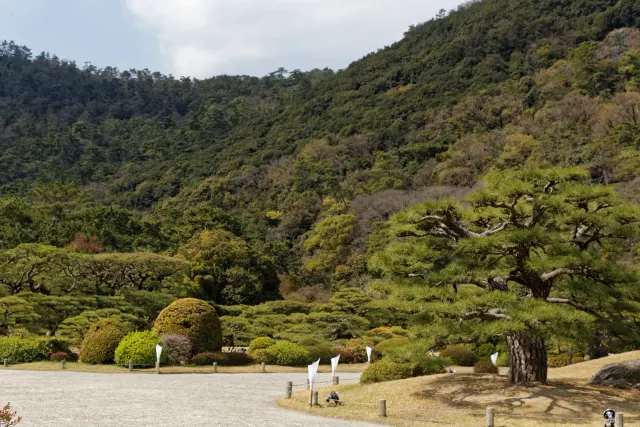
Behind the south pond stands Mount Shiun, and it is treated as a component of the composition rather than a view beyond it — shakkei, borrowed scenery. Sightlines were designed so the mountain closes the picture from specific points, and the planting is maintained to keep those lines open.
That is the difference between Ritsurin and a large park. Every position you are invited to stand in was chosen.
Around 1,400 pines are pruned by hand, year round, by a permanent team. You will see them on ladders. That labour is the garden.
The rankings argument
Japan’s Three Great Gardens are Kenroku-en in Kanazawa, Koraku-en in Okayama and Kairaku-en in Mito. Ritsurin is larger than all three — Kenroku-en is about eleven hectares — and is frequently rated above them in visitor surveys, including by foreign guidebooks.
It is not on the list because the list was drawn up in the Edo period on a different basis. Kagawa mentions this. Repeatedly.
How to walk it
There are two circuits. The south garden is the older, formal, pond-and-pine composition and holds the classic views; the north garden is looser and was remodelled later. If you have an hour, do the south.
Kikugetsu-tei, the teahouse over the south pond, serves matcha for a few hundred yen. Sitting on tatami at the water with the mountain behind is the intended experience, and almost nobody stops.
How it happened
- early 1600sWork begins under a local lord
On the slope below Mount Shiun
- 1642–The Matsudaira take Takamatsu
Eleven generations continue the garden
- 1745Completed, after ~120 years
Six ponds, thirteen hills, 75 hectares
- 1875Opened to the public
Now a Special Place of Scenic Beauty
- always~1,400 pines, pruned by hand
By a permanent team, year round
Where this becomes real on your port day
Walk the south circuit and stop at Kikugetsu-tei for matcha. Almost nobody sits down, and that is the point of it.
The vocabulary of the garden
- Shakkei 借景
- Borrowed scenery. Mount Shiun is part of the composition.
- Kaiyu-shiki 回遊式
- A strolling garden, composed to change as you move.
- Kikugetsu-tei 掬月亭
- "Scooping the moon." The teahouse over the south pond.
- Tokubetsu meishō 特別名勝
- The highest scenic designation. Few gardens hold it.
FAQ
Is Ritsurin one of Japan’s Three Great Gardens?
No, and Kagawa minds. Ritsurin is about seventy-five hectares against Kenroku-en’s eleven, took roughly 120 years to complete, and is frequently rated above the official three in visitor surveys. The list was drawn up in the Edo period on a different basis, and the practical result is that Ritsurin is far quieter.
Which part of Ritsurin Garden should I walk?
The south circuit if you have an hour — it is the older, formal composition and holds the classic pine-and-bridge views with Mount Shiun borrowed as the backdrop. Stop at the Kikugetsu-tei teahouse over the pond for matcha; almost nobody does, and it is the experience the garden was designed around.
More from Takamatsu
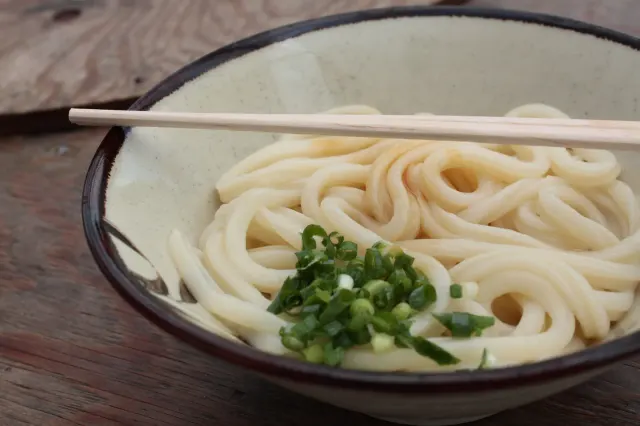
A prefecture that eats more noodles than anywhere in Japan, because it could not grow rice
Read →
Depopulated, industrially damaged, and then rebuilt around museums
Read →
Seven hundred and eighty-five steps, and dogs sent up them on their owners’ behalf
Read →
Three thousand islands, tidal races, and the families who taxed everyone who passed
Read →