Miyajima is the common name of Itsukushima, an island in Hiroshima Bay in the Seto Inland Sea, part of Hatsukaichi City in Hiroshima Prefecture. Itsukushima Shrine, on its north shore, is a World Heritage site. Mount Misen rises behind it. Hiroshima Port is about 15 km to the east.
Tender or Zodiac. There is no cruise berth: ships anchor off the island and land by tender (Ponant) or Zodiac (Noble Caledonia). The pier they use is not published; the ferry terminal piers are where scheduled ferries land.
At the terminal
None for cruise passengers. The island's ferry terminal serves the ferries to Miyajimaguchi. Facilities for tender passengers are not published.
If this is your first Japanese port, everyone goes through face-to-face immigration before going ashore; there is no terminal building here, so it is done on board or on the quay. Allow 30 to 60 minutes after the ship clears. What happens at your first Japanese port
From the ship to each place: how, how long, how much
The pier the ship’s tenders use is not published; figures are from the ferry terminal
Along the shore to the shrine entrance: 831 m, about 10 min, flat. The foot of the torii, when the tide is under 100 cm: 755 m, about 9 min
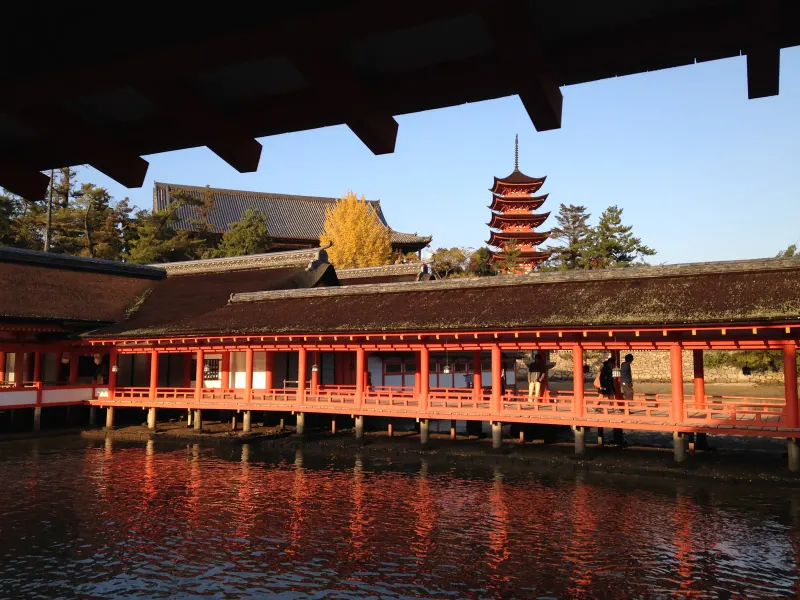
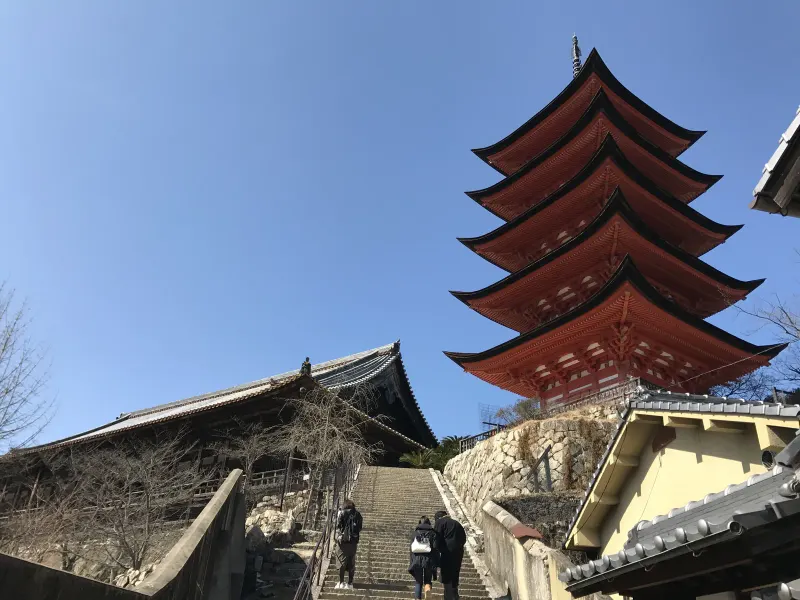
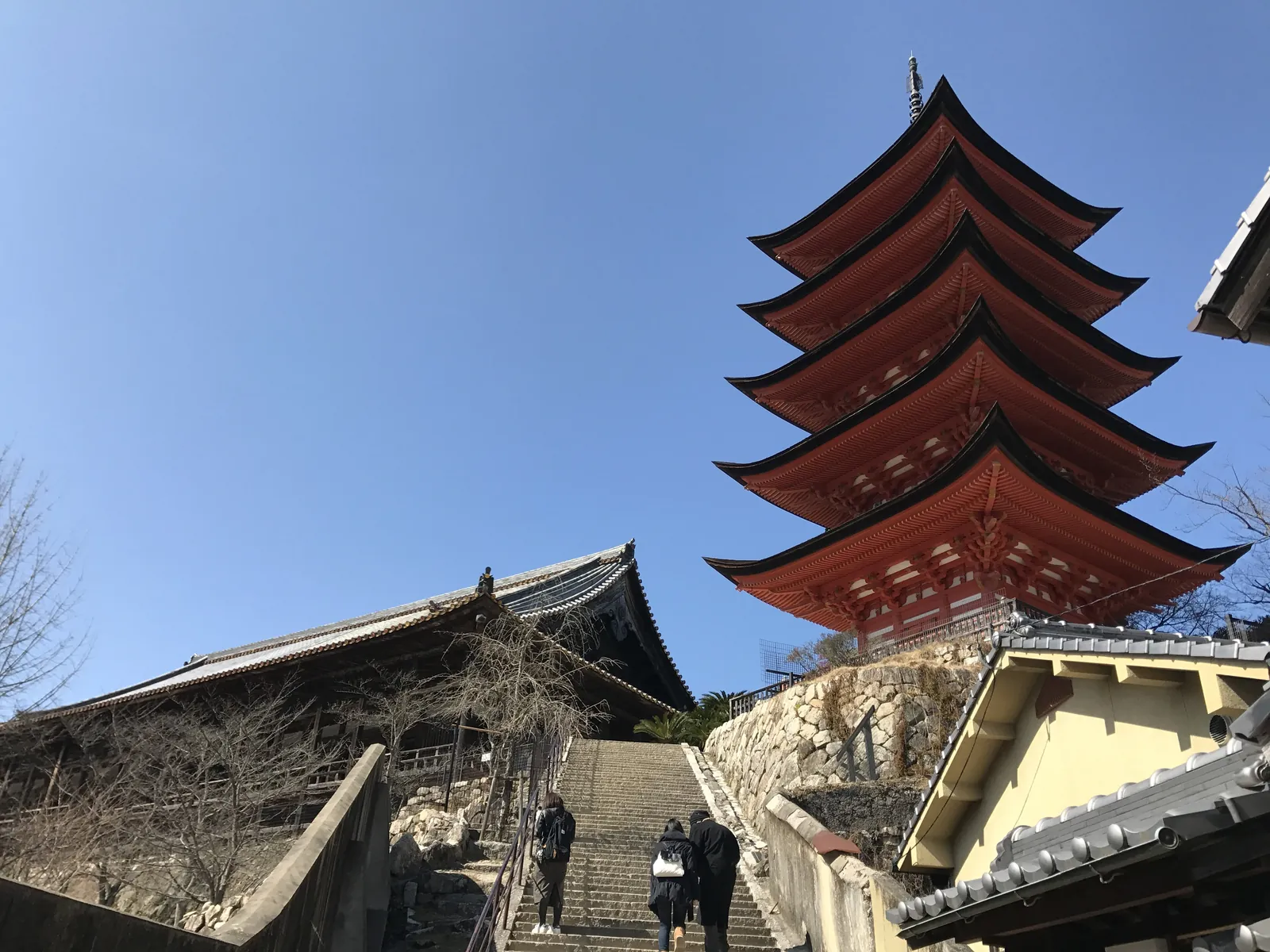
Senjokaku and the Five-storied Pagoda: 730 m, about 9 min, with steps
Shrine ¥300 · with the Treasure Hall ¥500 · Senjokaku ¥100 · Shrine 6:30–18:00 from 1 Mar to 14 Oct; to 17:30 until 30 Nov; to 17:00 in Dec · Senjokaku 8:30–16:30
Our estimates from map routing at 80 m a minute. Ponant gives 20 minutes from its tender landing to the gate, at a group’s pace.
Ferry terminal → Momijidani Station: 1,566 m, about 20 min, uphill through Momijidani Park. From the shrine exit 995 m, about 15 min
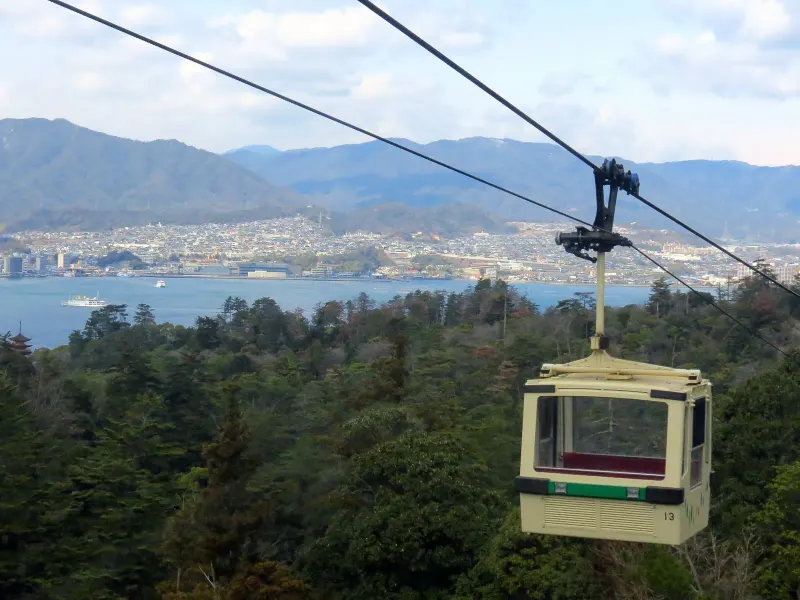
Momijidani → Kayatani, 8-seat gondolas, about 10 min; change; Kayatani → Shishiiwa, 35-seat car, about 4 min, every 5–15 min
Shishiiwa Station → the summit: a mountain path of about 1 km; allow 30 min each way
Adult ¥2,000 return, ¥1,100 one way · child ¥1,000 / ¥550 · cards, transit IC and PayPay at Momijidani Station only · Up 9:00–16:00, last car down 16:30 (as posted 13 Nov 2026; hours vary by day) · online booking required on the busy days the operator lists
The operator runs a free shuttle bus from the park entrance stop to the station, about every 20 min from 9:50, not 12:10–13:10. No strollers or wheelchairs on the ropeway; it stops in high wind or thunder.
From the ferry terminal: JR West Miyajima Ferry or Miyajima Matsudai Kisen, about 10 min
At Miyajimaguchi: JR Sanyo Line and the Hiroden tram to Hiroshima
¥200 each way (child ¥100) · coming back to the island the ¥100 visitor tax is added · About every 15 min
Only worth it on a long call. High-speed boats also run from the island to Hiroshima Port, about 25 min, and to the Peace Park, about 50 min (Hatsukaichi City’s access page).
A morning call: the gate, the shrine and Daisho-in
Fits a morning call of about six hours at the anchorage, such as 06:00–12:00: all-aboard 11:30, back at the landing by 10:30. Shift the clock to your arrival.
Times assume a 06:00 arrival and a 12:00 departure: ashore from 06:30, back at the landing by 10:30. The ship sets the real tender times; use those.
06:30Tender ashore. Note the name of the pier and the time of the last boat before you walk off.
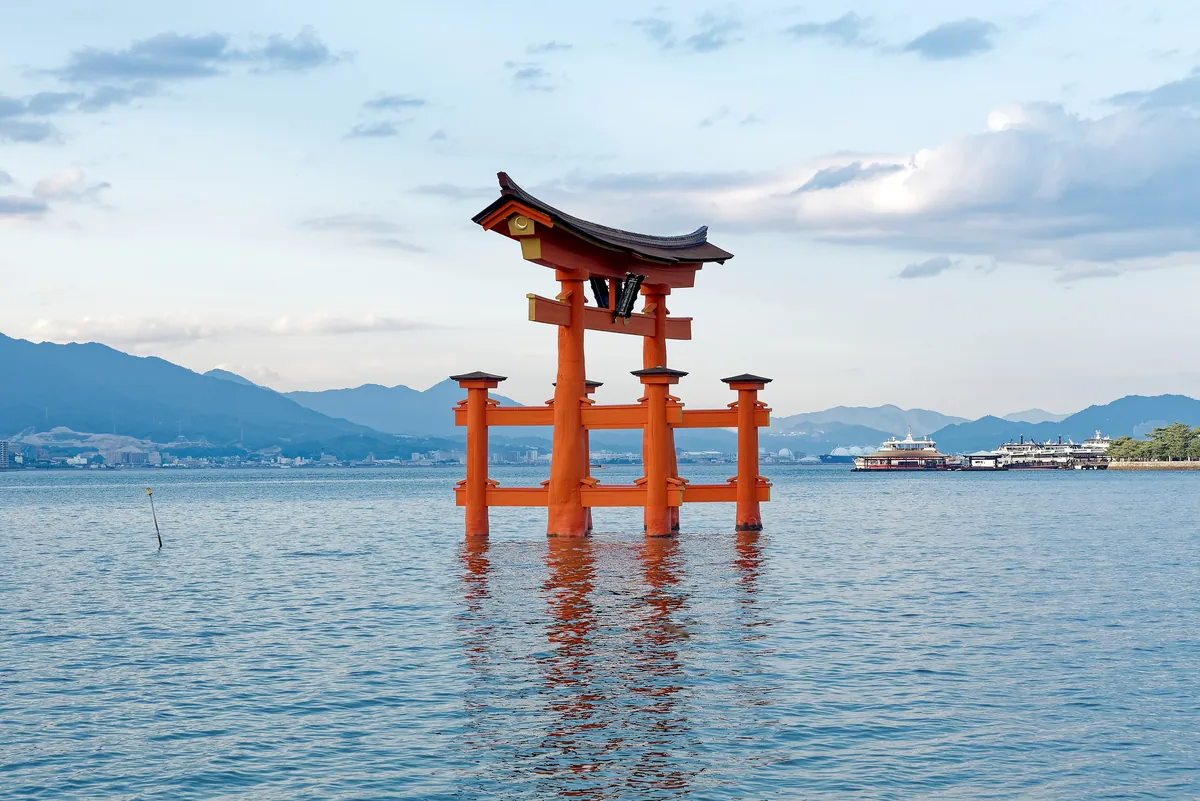
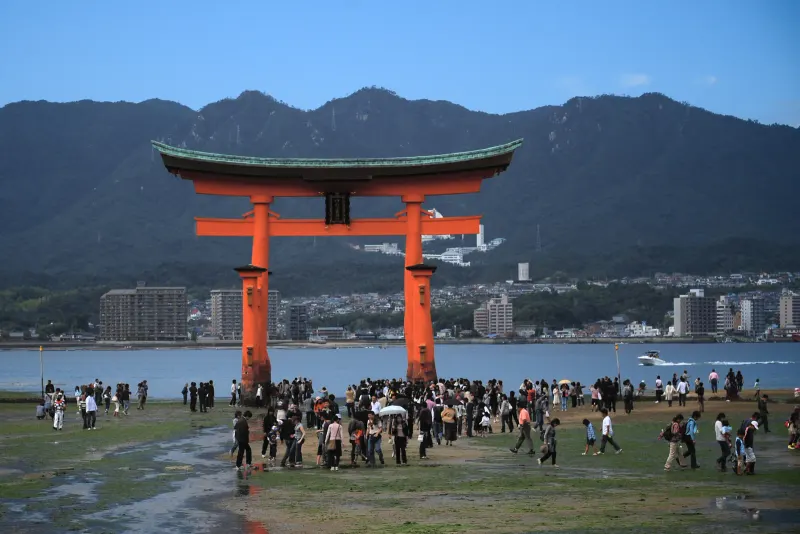
06:45Walk the shore to the great torii, about 9 minutes from the ferry terminal. Above about 250 cm the gate stands in water; check the tide table for your morning.
07:00Itsukushima Shrine, open from 06:30, ¥300. It opens hours before the shops and the ropeway.
07:45Walk 7 minutes from the shrine exit to Daisho-in; the gates open at 08:00.
08:45Walk back past the shrine and up the steps to Senjokaku and the Five-storied Pagoda, ¥100, open from 08:30.
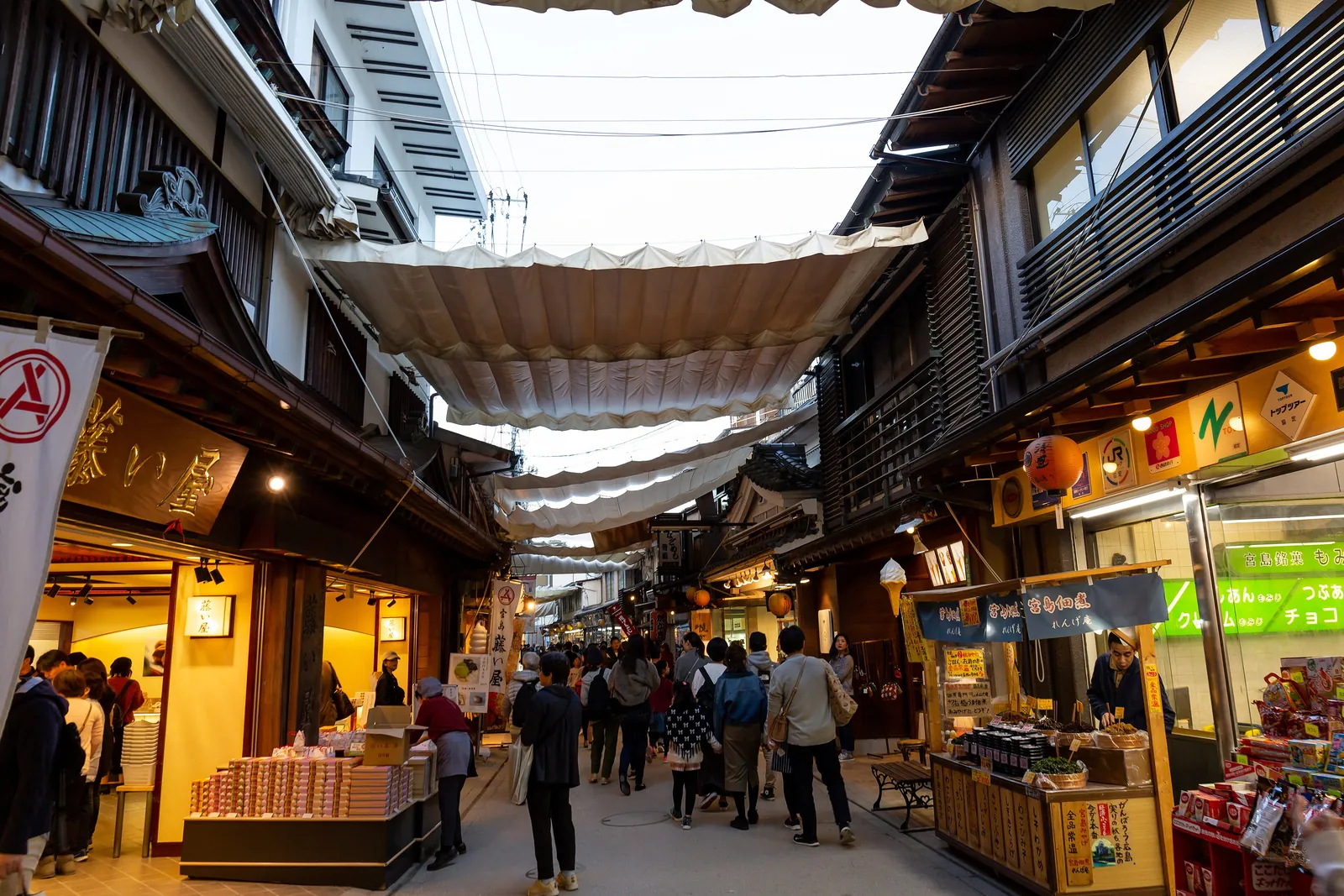
09:30Fujiiya on Omotesando opens: momiji manju to eat warm or take back. The oyster shop opens at 10:30, too late for this call.
10:00Walk about 7 minutes back to the ferry terminal and on to your landing pier.
10:30At the landing, an hour before an 11:30 all-aboard.
From your ship, the 4 stops in order, and back, by their map pins. A phone takes three stops between start and end, and none on a train or bus, so the day opens in parts.
An afternoon and evening call: the gate on sand, then in water
Fits an afternoon-and-evening call such as 13:30–22:30, on a day the tide is under 100 cm in mid-afternoon and over 250 cm by early evening: check the tide table.
Times assume 13:30 arrival and 22:30 departure: ashore from 14:00. Shops and sights close between 16:30 and 18:00, so the afternoon is the working part of the day.
14:00Tender ashore. Note the pier and the time of the last boat.
14:10Walk out to the great torii. Low water at Hiroshima is at 14:36, 76 cm, and Miyajima runs slightly earlier. The flat is wet sand and weed: wear shoes that can get dirty.
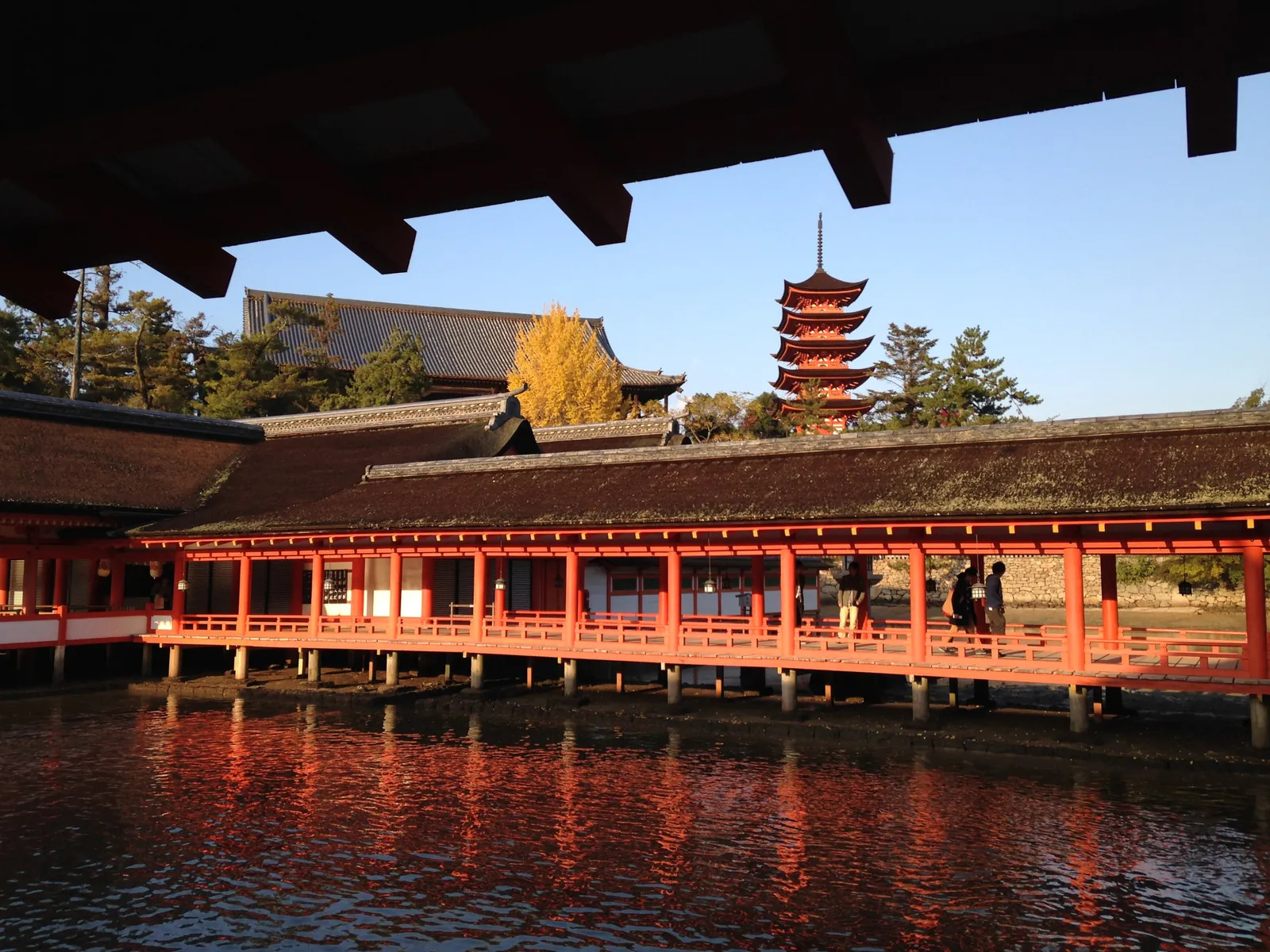
14:50Itsukushima Shrine, ¥300, open to 18:00. At this hour the corridors stand over sand.
15:30Senjokaku and the Five-storied Pagoda, ¥100; the hall closes at 16:30.
16:00Grilled oysters at Yakigaki no Hayashi; last order 16:30. It is a Saturday, so the shop is open.
16:45Omotesando: Fujiiya is open to 17:30. The aquarium is closed until 31 March.
18:40Back on the shore by the great torii as the tide passes 250 cm: the gate and the shrine appear to float. High water at Hiroshima is at 20:31.
19:15At the landing, well before the last boat. All-aboard for a 22:30 departure is about 22:00.
A wet day on a call of 4.5 hours or more. The shrine’s corridors are roofed but open at the sides, and Senjokaku is a roofed hall; the ropeway stops in high wind or thunder. About 2.5h ashore; none, everything is on foot. Shrine with the Treasure Hall ¥500, Senjokaku ¥100. Times count from when you step off the ship.
+0:00Land by tender or Zodiac. Decks and steps are wet: take the ship’s umbrella
+0:15Itsukushima Shrine: the corridors are roofed. From 6:30; buy the ¥500 ticket that includes the Treasure Hall
+0:55Treasure Hall, beside the shrine exit. 8:00–17:00
+1:20Senjokaku, the large roofed hall above the shrine. 8:30–16:30, ¥100
+1:45Omotesando: Fujiiya’s tea room, or oysters at Yakigaki no Hayashi. Tea room 9:30–17:00; oysters 10:30–17:00, closed Wednesdays
Tick the places in the order you want them. The map numbers them and draws the way from your ship and back; the buttons open the same route in Google Maps, in parts a phone can draw.
Start from a model day:
A morning call
06:45
1. The great toriiPhoto: そらみみ / CC BY-SA 3.0
07:00
2. Itsukushima Shrine
07:45
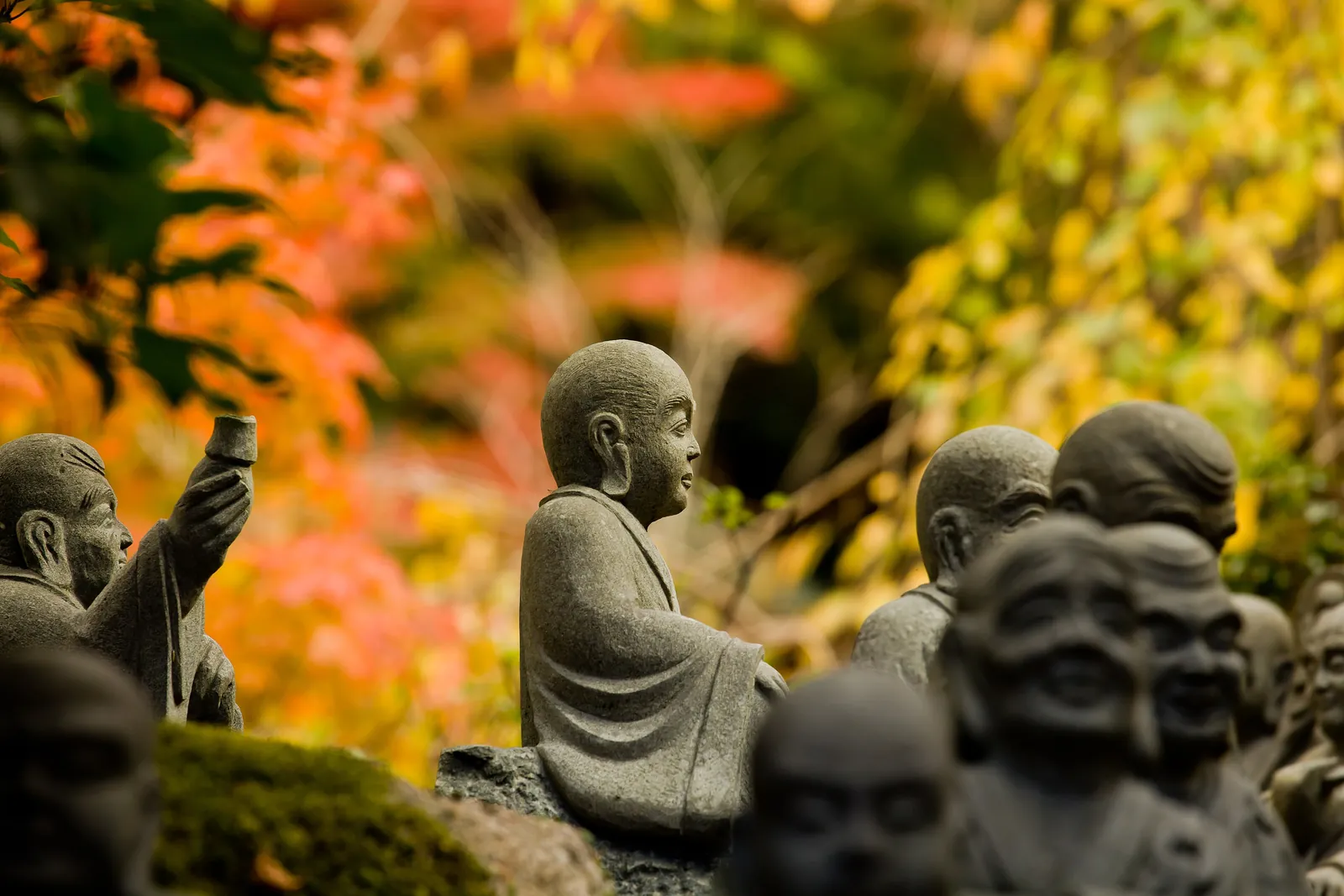
3. Daisho-inPhoto: Freedom II Andres / CC BY 2.0
08:45
4. Senjokaku and the Five-storied PagodaPhoto: そらみみ / CC BY-SA 4.0
There is no bookable tour for Miyajima in our catalogue. The days above are the plan: public transport, timed from the gangway.
Before you go
Cash, Wi-Fi, toilets, steps: the practical answers
Cash, cards, ATM
The shrine, Senjokaku and small shops are cash. The ropeway takes cards, transit IC cards and PayPay at Momijidani Station only. An ATM near the landing is not confirmed: bring yen from the ship.
Wi-Fi and SIM
No Wi-Fi is published for the landing. Buy an eSIM before sailing.
Toilets
Use the ship before the tender. Public toilets on the walking routes are not listed on the pages we checked.
Luggage
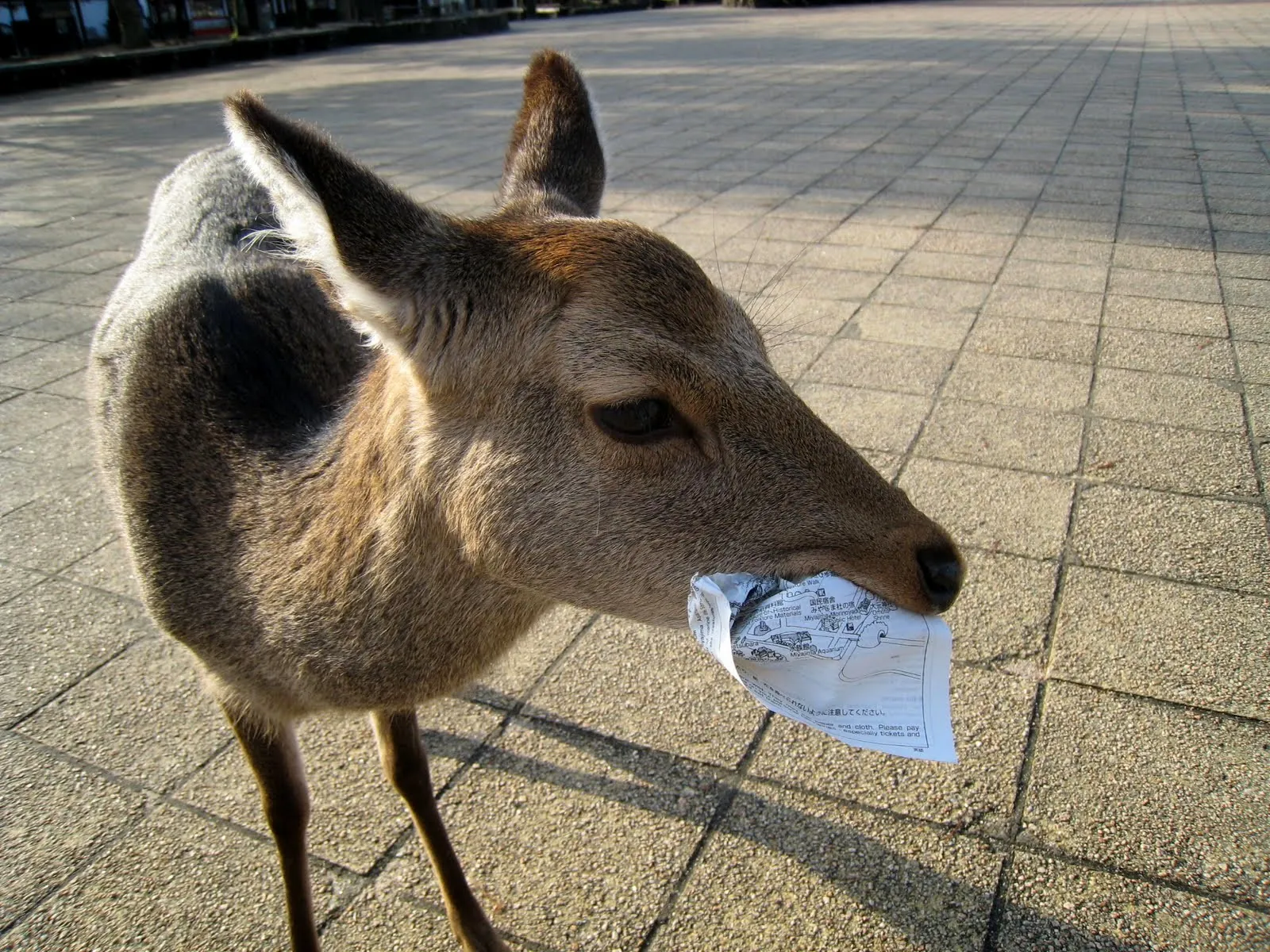
Carry a small bag only. Keep paper maps and tickets inside it: the deer eat paper.
Steps and slopes
The shore walk to the shrine is flat. Senjokaku is up steps, the ropeway takes no wheelchairs or strollers, and the summit is a mountain path. Tender and Zodiac boarding is the ship's call.
English
The shrine, the ropeway and the Tourist Association have English pages. The tide tables are in Japanese; the table in this guide gives the figures.
Pharmacy, hospital
Dial 119 for an ambulance and 110 for police; the JNTO Japan Visitor Hotline, 050-3816-2787, answers in English 24 h.
With children
Shrine ¥100 for primary and junior-high pupils; ropeway ¥1,000 return for primary-school children; the aquarium is closed until 31 March 2027.
Two things to eat in Miyajima, and where
Dish
Where, price, hours
Grilled oysters, steamed in the closed shell over the grill
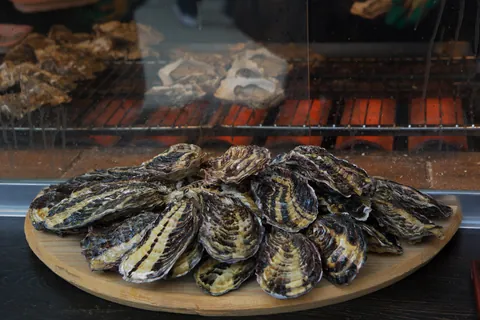
The pickYakigaki no Hayashi, on Omotesando, about 7 min on foot from the ferry terminal10:30–17:00, last order 16:30; closed WednesdaysThe shop dates itself to 1948 and calls itself the first grilled-oyster shop.
Momiji manju: maple-leaf cakes filled with bean paste
The pickFujiiya Miyajima Honten, on Omotesando09:30–17:30 (may change); tea room 09:30–17:00Open an hour before the oyster shop, so it fits a morning call.
Mistakes to avoid
Expecting a quay.There is no cruise berth. You go ashore by tender or Zodiac, and the sea state and the ship decide when.
Reading high tide as floating and low tide as walkable.The Tourist Association says both are wrong. The numbers are 250 cm and 100 cm, and many tides reach neither.
Planning the ropeway on a morning call.The first car goes up at 09:00 and the station is 20 minutes uphill from the ferry terminal. On a call that sails at 11:30 it does not fit with the shrine.
Turning up at the ropeway on a busy day without a booking.The operator requires online booking on the days it lists; in November 2026 it listed every Saturday and Sunday.
Carrying a paper map in your hand.The deer eat paper, plastic and cloth. Keep maps and tickets in a closed bag and do not feed them.
Counting on oysters before noon on a Wednesday.Yakigaki no Hayashi opens at 10:30 and is closed on Wednesdays.
Walking off without the name of the pier.The landing pier is not published, and the island has several. Note which one you used and when the last boat leaves.
Miyajima cruise port questions
Do cruise ships dock at Miyajima?
No. Small expedition ships anchor off the island and land by tender or Zodiac. Large ships that offer a Miyajima excursion are docked at Hiroshima Port.
Which ships call at Miyajima in 2027?
On the cruise lines' own pages: Le Soléal five times (20 March, 1 April, 7 and 11 May, 1 October), National Geographic Resolution four (27 May, 8 and 20 June, 1 July), Heritage Adventurer three (19 April, 12 May, 13 June) and Island Sky three (6 and 25 May, 4 June).
Where do the tenders land at Miyajima?
It is not published. Ponant gives a 20-minute walk from its tender landing to the gate. The ferry terminal is about 10 minutes from the shrine at a normal pace.
How far is Itsukushima Shrine from the landing?
From the ferry terminal, 831 m and about 10 minutes on foot along the shore. The route is flat.
Will the torii be floating when my ship calls?
Check the tide table in this guide. The shrine and gate appear to float above 250 cm; below 100 cm you can walk to the gate. On Le Soléal's 7 May and 1 October calls the tide passes 250 cm at about 07:30 and stays above it to the end of the call; on 11 May only from about 10:50. Tides are predictions, so treat the times as a guide.
Can I walk out to the torii?
Only when the tide is below 100 cm. Among Le Soléal's 2027 calls that happens on 20 March, from about 13:40 to 15:30.
What time does Itsukushima Shrine open?
At 06:30 all year. It closes at 18:00 from 1 March to 14 October, 17:30 until 30 November and 17:00 in December. Adult ¥300.
How long does the Miyajima Ropeway take?
About 10 minutes on the first leg and 4 on the second, with a change between. From the landing to the Shishiiwa lookout and back, allow two and a half hours; with the summit, four.
Do I need cash on Miyajima?
Yes. The shrine and Senjokaku are small cash fees. The ropeway takes cards at its lower station only.
Is there a visitor tax for Miyajima?
Yes: ¥100 per visit for anyone arriving by boat, since 1 October 2023. How it is collected from a ship's tender passengers is not stated by the city; ask the ship.
Is Miyajima the same call as Hiroshima?
Usually the same day but a separate stop. Le Soléal and Island Sky spend part of the day alongside at Hiroshima Port and part at anchor off Miyajima. Heritage Adventurer and National Geographic Resolution name both places on the same day; their pages do not say where the ship lies for each.
Read on
Miyajima in depth: the places, the history, the myths
1,844 words · 15 chapters
Why Miyajima is worth the tender ride
Miyajima is one shore with one view: a vermilion gate standing in the sea in front of a shrine built over the tide. Big ships reach it by coach and ferry from Hiroshima. A small ship anchors off the island and puts you ashore ten minutes' walk from it.
Behind the shrine are a temple at the foot of the mountain, a ropeway to a lookout over the Inland Sea, and a shopping street of oysters and maple-leaf cakes. All of it is walked.
This guide is for passengers who land on the island itself. If your ship is alongside at Hiroshima Port, use the Hiroshima guide: the ferry day from there is a different plan.
Where the ship anchors and where you land
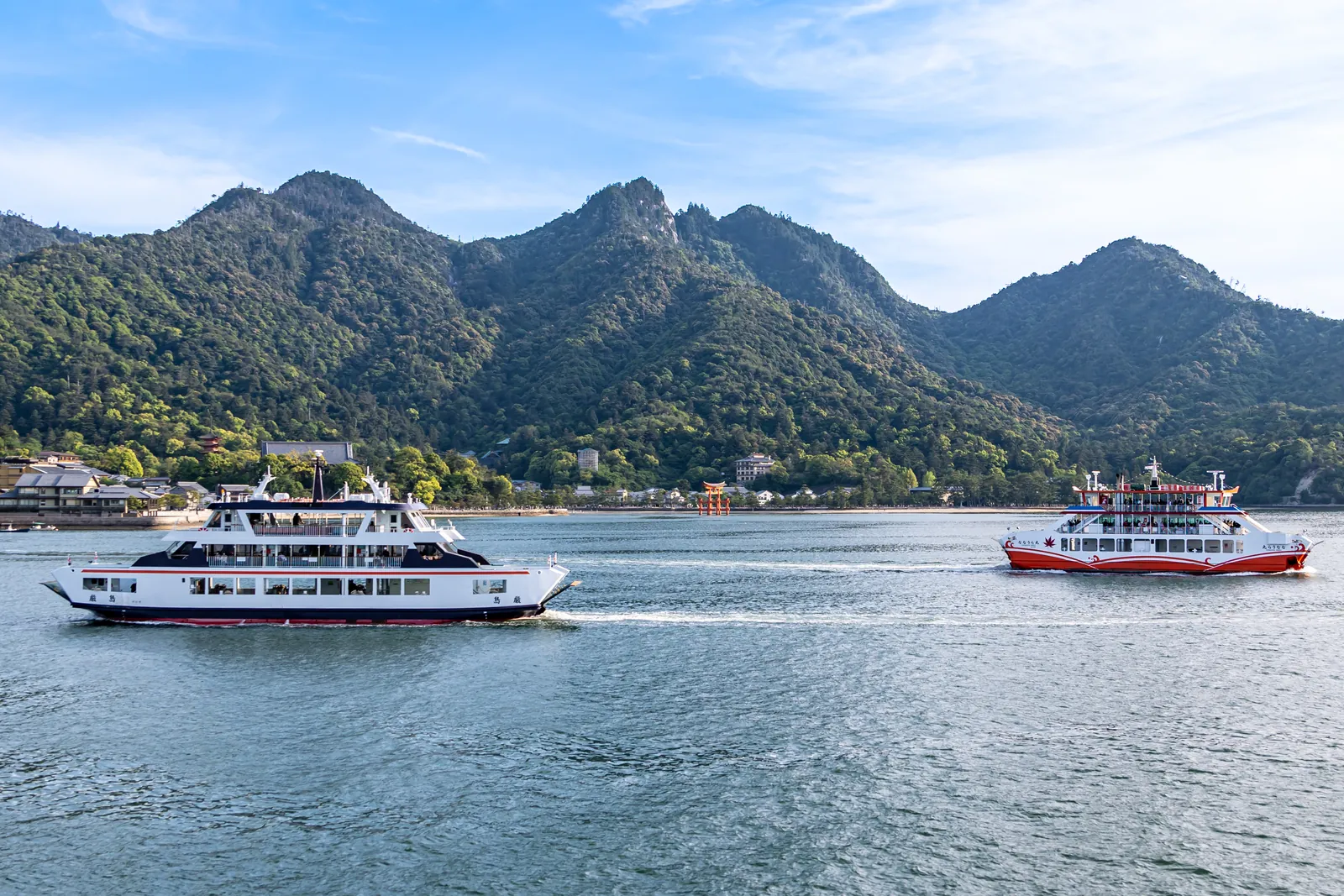
Miyajima and Mount Misen seen from the sea, with two ferries and the torii on the shorePhoto: Naokijp / CC BY-SA 4.0
Miyajima has no cruise berth. The ships that call are small: Le Soléal, National Geographic Resolution, Heritage Adventurer and Island Sky. Ponant says Le Soléal lands by tender and Noble Caledonia says Island Sky uses its Zodiacs; the other two lines do not say how guests land.
Hiroshima Prefecture's call list for Hiroshima Port shows how the day works. It names Miyajima as the previous or next port, with the ship alongside in Hiroshima for the other half of the day.
No cruise line or authority names the pier the boats use. Ponant's excursion notes give a 20-minute walk from the tender landing to the gate. The island's ferry terminal is 831 m from the shrine entrance, about 10 minutes at a normal pace.
Distances and walking times in this guide are our estimates from map routing, measured from the ferry terminal.
From the ferry terminal
Distance
On foot
Yakigaki no Hayashi, Omotesando
549 m
~7 min
Senjokaku and the pagoda
730 m
~9 min, steps
Foot of the torii (tide under 100 cm)
755 m
~9 min
Itsukushima Shrine entrance
831 m
~10 min
Daisho-in
1.4 km
~20 min
Momijidani Station (ropeway)
1.6 km
~20 min, uphill
The tide on each 2027 call
The Miyajima Tourist Association gives two numbers. Above a 250 cm tide the shrine and the gate appear to float. Below 100 cm you can walk out to the gate. In between, the water round the gate is too shallow for the floating view and too deep to walk.
The figures below are the Japan Meteorological Agency's predictions for Hiroshima, 15 km away. The association uses the same station and says Miyajima runs slightly earlier. Heights are in centimetres.
Call
Ship, time at anchor
High
Low
The gate
Sat 20 Mar
Le Soléal 13:30–22:30
20:31, 313
14:36, 76
On sand about 13:40–15:30; in water from about 18:40
Thu 1 Apr
Le Soléal 06:00–12:00
06:28, 258
12:57, 159
Just afloat until about 07:30, then neither
Mon 19 Apr
Heritage Adventurer
08:31, 333
14:44, 35
In water in the morning; on sand about 13:05–16:20
Thu 6 May
Island Sky, afternoon
09:15, 322
15:33, 6
On sand about 13:15–17:25
Fri 7 May
Le Soléal 06:00–11:30
09:50, 322
04:03, 89
In water from about 07:30
Tue 11 May
Le Soléal 07:45–12:30
12:36, 281
07:02, 139
In water from about 10:50
Wed 12 May
Heritage Adventurer
13:36, 265
08:05, 148
In water about 12:25–14:35
Tue 25 May
Island Sky, afternoon
11:53, 282
18:19, 61
In water about 10:10–13:20; on sand from about 16:35
Thu 27 May
NG Resolution, morning
13:24, 256
07:56, 151
Mid-tide all morning
Fri 4 Jun
Island Sky, afternoon
08:42, 310
15:09, 7
On sand about 12:45–17:05
Tue 8 Jun
NG Resolution, morning
11:48, 311
06:09, 124
In water from about 09:25
Sun 13 Jun
Heritage Adventurer
17:29, 282
11:00, 102
Low at 11:00; in water from about 15:45
Sun 20 Jun
NG Resolution, morning
09:56, 302
04:28, 138
In water about 07:40–11:40
Thu 1 Jul
NG Resolution
06:26, 283
13:06, 58
On sand about 11:20–14:40
Fri 1 Oct
Le Soléal 05:00–12:00
10:12, 390
04:00, 30
In water from about 07:25
How to read it: find your call, then lay your own hours ashore over the last column. The windows are our readings of the agency's hourly heights for Hiroshima; the association says Miyajima runs slightly earlier, so arrive a little before a window opens.
A row that gives no window, such as 27 May, means the tide reaches neither number while you are ashore. Tides are predictions: wind and air pressure move them on the day. The association's own table, in Japanese, gives the hourly heights for any date.
Only Ponant publishes clock times. The other three lines give a day-by-day plan, so "morning" and "afternoon" here come from their own descriptions; where a line gives no part of the day, the whole day's tides are shown.
The shrine and the gate
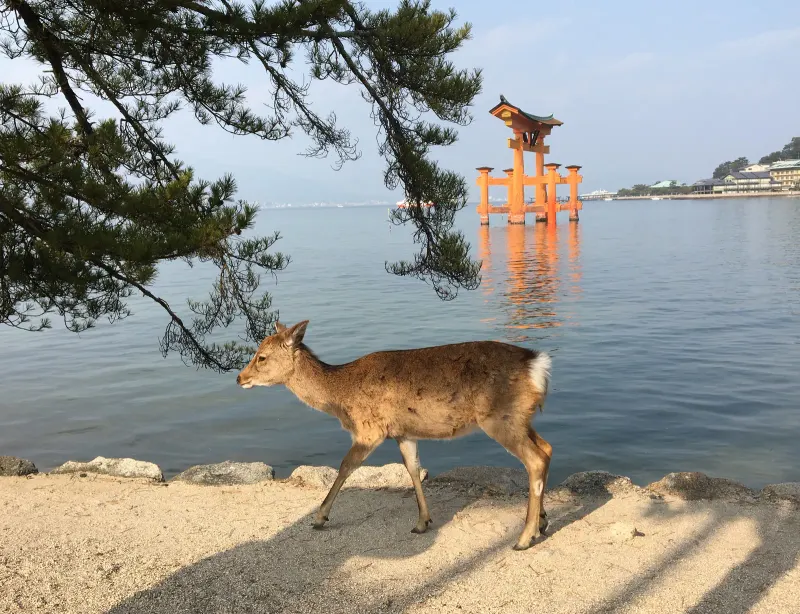
The great torii: about 16.8 m high, the ninth on the site, erected in 1875. It is not fixed to the seabed; it stands by its own weight.
Itsukushima Shrine: 06:30–18:00 from 1 March to 14 October, to 17:30 until 30 November, to 17:00 in December. Adult ¥300, high-school ¥200, younger pupils ¥100.
Treasure Hall: 08:00–17:00, ¥300, or ¥500 with the shrine on a ticket sold at the shrine entrance only.
Senjokaku (Hokoku Shrine): the large wooden hall beside the pagoda, 08:30–16:30, ¥100.
The shrine opens before anything else on the island. A ship that anchors at 06:00 can have its passengers in the corridors within the first hour.
The Miyajima Ropeway climbs in two legs: 8-seat gondolas for about 10 minutes to Kayatani, then a 35-seat car for about 4 minutes to Shishiiwa.
Hours: up 09:00–16:00, last car down 16:30, as posted on 13 November 2026. Hours vary by day.
Fare: adult ¥2,000 return, ¥1,100 one way; child ¥1,000 and ¥550.
Booking: online booking is required on the busy days the operator lists.
Limits: no strollers or wheelchairs. It stops in high wind or thunder.
Momijidani Station is about 20 minutes on foot from the ferry terminal, uphill through Momijidani Park. The operator also runs a free shuttle bus to the station from the park entrance stop, about every 20 minutes from 09:50, with a break around midday.
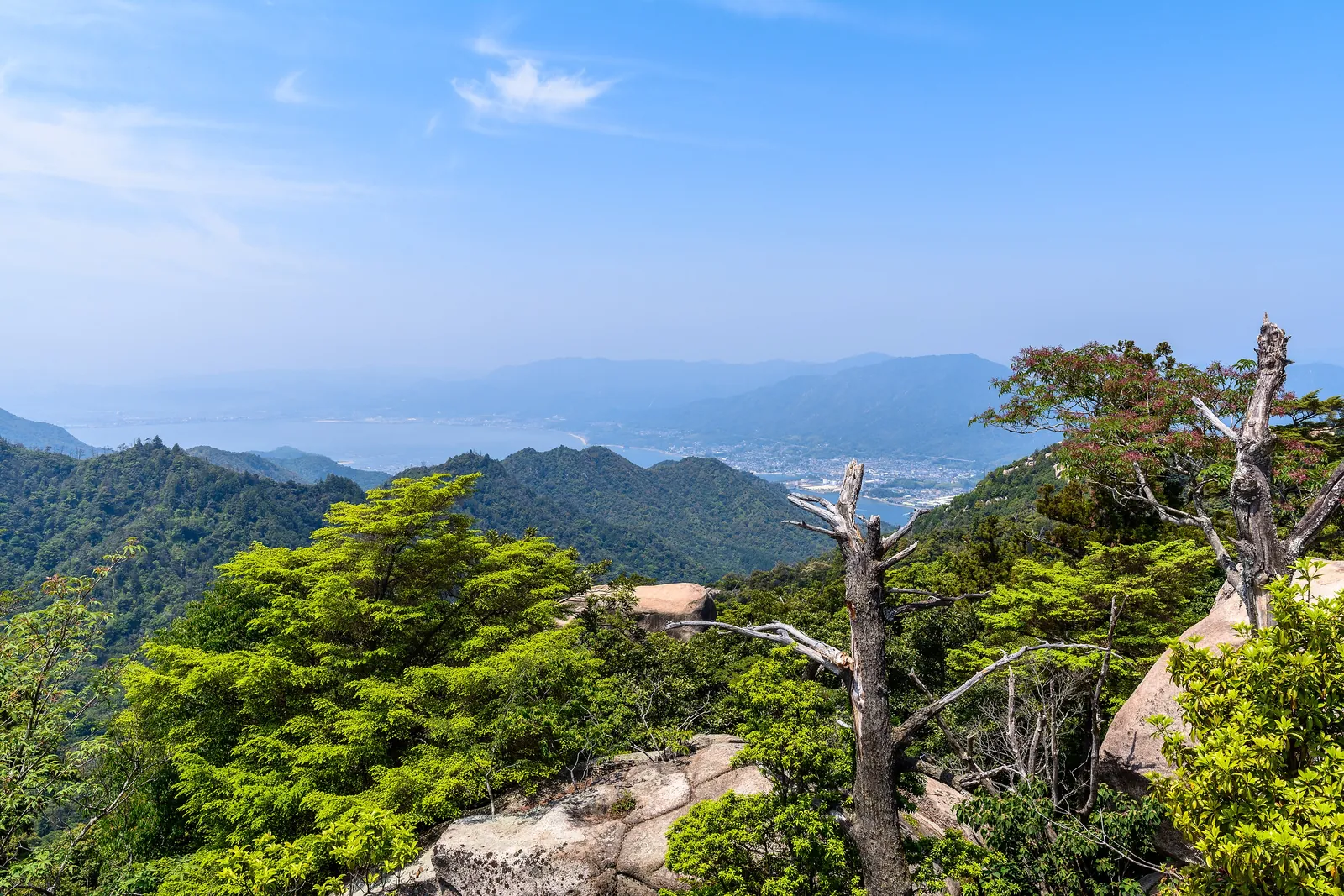
The summit is beyond the upper station, along about 1 km of mountain path; allow 30 minutes each way. Reikado hall, on the way, keeps a fire that the Tourist Association says has burned for over 1,200 years.
Daisho-in and Momijidani
Daisho-in is the temple at the foot of Mount Misen, 7 minutes on foot from the shrine exit. Its gates open 08:00–17:00. The temple's own page allows 30 minutes from the pier.
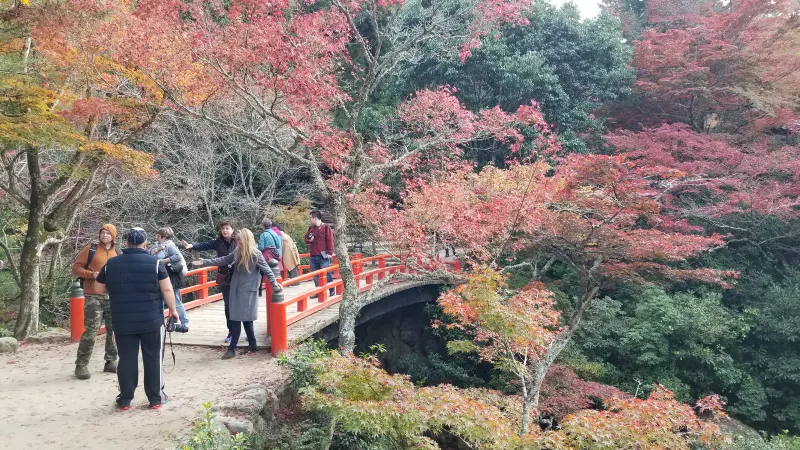
Momijidani Park, the maple valley on the way to the ropeway, is free and always open. The Japan Meteorological Agency's normal date for maple colour at Hiroshima is 22 November.
What to eat
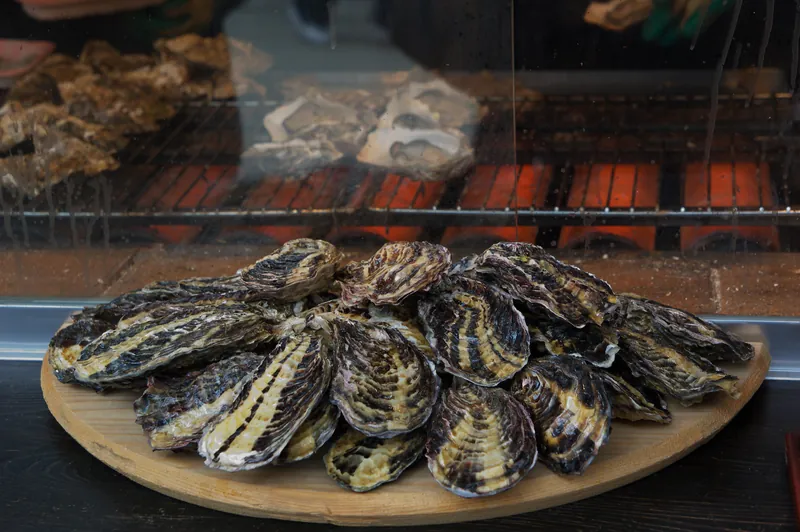
Yakigaki no Hayashi has grilled oysters on Omotesando since 1948. It steams them in the closed shell. Open 10:30–17:00, last order 16:30, closed Wednesdays.
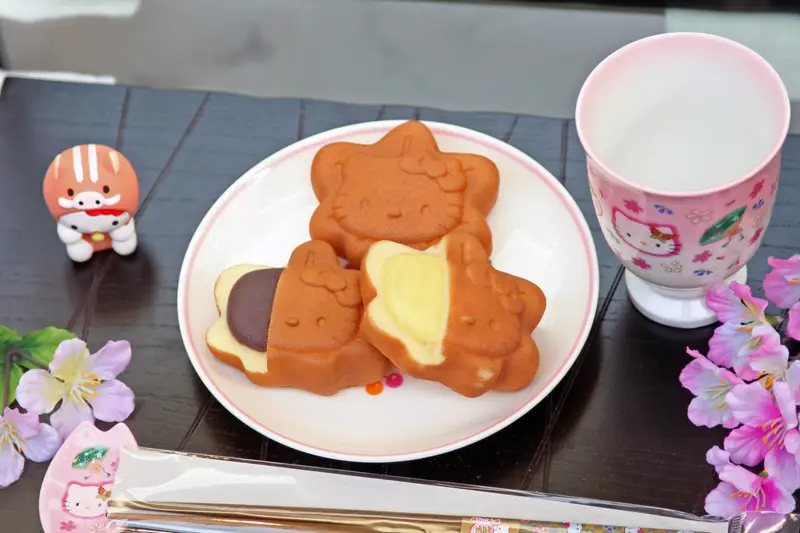
Fujiiya, also on Omotesando, sells momiji manju from 09:30 to 17:30 and has a tea room open to 17:00.
About 500 wild deer live on the island and about 200 of them in the town. They walk the shore between the ferry terminal and the shrine.
The Tourist Association asks visitors not to feed them. Paper, plastic and cloth are the danger: deer that keep eating them can die. Keep maps, tickets and paper bags in a closed bag.
Crowds
Hatsukaichi City counted 4.85 million visitors to the island in 2024, and more in 2025, a record for the second year running.
The shrine opens at 06:30, two and a half hours before the ropeway and three before the shops. A ship that anchors at 06:00 can use those hours. On the ropeway, the booking days the operator lists are the busy ones.
The visitor tax, money and access
Hatsukaichi City charges a Miyajima visitor tax of ¥100 per visit to anyone who enters the island by boat. Ferry operators add it to the fare. The city's page does not say how it is collected from a ship's tender passengers.
Carry yen for the shrine, Senjokaku and small shops. The ropeway takes cards, transit IC cards and PayPay at Momijidani Station only.
The shore walk to the shrine is flat. Senjokaku is up steps, and the ropeway cannot take wheelchairs. Whether a tender or Zodiac can take a wheelchair is for the ship to say.
Miyajima and Hiroshima on the same day
Most of these ships pair the island with Hiroshima Port. Le Soléal spends the morning at Miyajima and reaches Hiroshima at 13:00 to 14:00; on 20 March the order is reversed. Island Sky does Hiroshima first and sails to Miyajima over lunch.
So the Peace Memorial Park is the other half of the day, from the berth at Ujina. The Hiroshima guide has the tram, the times and the berth.
The best things to do in Miyajima on a port day
Our full list, with the time each takes from the landing, is on the Miyajima top 10. Timed plans are on Miyajima plans.
How to think about your hours
All-aboard is usually 30 minutes before departure, and you want to be at the landing an hour before that. The first half hour goes on getting ashore. So the time you can use is the call length minus about two hours.
At a tender port, take off more. The boats run to the ship's timetable, and the last one back is earlier than all-aboard. A 06:00–12:00 call gives about four hours ashore; 07:45–12:30 gives under three.
Weather
Japan Meteorological Agency normals for Hiroshima, 1991–2020: average highs of 14.5 °C in March, 19.8 °C in April, 24.4 °C in May, 27.2 °C in June and 23.7 °C in October. June and July have the most rainy days, about 11 a month.
Cherry blossom opens around 25 March and is full around 3 April in a normal year. Wind matters more than rain here: it can stop the ropeway, and it can stop the tenders.
Getting back to the ship
Work backwards from the last tender, not from departure. Ask for its time when you land, and aim for the boat before it.
From the shrine the ferry terminal is 10 minutes on foot; from Daisho-in 17; from the ropeway's lower station 20. From the Shishiiwa lookout allow an hour, because the ropeway is two legs and a walk.
Researched from official timetables, operators and the port authority, with our estimates where none is published. Every time and fare in this guide was checked against the sources listed above on 13 November 2026; where we had to estimate (a walk, a taxi in traffic), the text says so. Timetables change — if you find one that has, tell us and we will fix it.