
Kakegawa Castle
The keep that went to Kochi and came back in wood
The lord who built the first keep here took his carpenters to Kochi and built another like it. Four centuries later, Kakegawa used the Kochi one as the pattern to rebuild its own.
Kakegawa sat on the Tokaido at a crossing of the east–west and north–south roads, which is why people fought over it. The first castle was built between 1497 and 1501 by Asahina Yasuhiro, on orders from the Imagawa lords of Suruga. It stood about 500 metres east of the present site. In the early 1500s a new castle went up on the Ryūtō hill, where the keep stands today.
After Imagawa Yoshimoto died at Okehazama in 1560, his son Ujizane fell back on Kakegawa in 1568. Tokugawa Ieyasu ringed it with more than a dozen forts. After half a year Ujizane surrendered under a truce, and Ieyasu installed his retainer Ishikawa Iefusa to face the Takeda.
Kazutoyo's keep
In 1590, after Hideyoshi unified Japan and moved the Tokugawa to the Kanto, Yamauchi Kazutoyo was given Kakegawa. He rebuilt it thoroughly: stone walls, moats, an outer earthwork around the town, and the first tenshu or keep. He set the Ōte gate in its present position. He laid out the castle town and worked on flood defences for the Oi River.
After Sekigahara he was rewarded with Tosa. He entered the province in 1601 and began Kochi Castle the same year; it was largely finished by 1611. Craftsmen from Kakegawa went with him, and the Kochi keep is held to have been built in the Kakegawa manner. Kochi's keep burnt in 1727 and was rebuilt in 1749, and that building survives.
Earthquakes, twice
The castle then passed to a line of hereditary Tokugawa vassals. In 1707 the Hōei earthquake brought down the lord's palace in the main enclosure, and it was moved to the second enclosure. In 1854 the Ansei Tokai earthquake damaged the keep, the palace and the drum tower. The palace was rebuilt. The keep was not. In 1869 the castle was formally abolished.
The palace that survived
The Ninomaru Goten was rebuilt between 1855 and 1861 under lord Ōta Sukekatsu. It has about twenty rooms in seven linked buildings, tatami floors and sliding paper doors in the shoin style. It was three things at once: the hall for domain ceremonies, the lord's residence, and the domain's offices, until 1868. Entrances were ranked. The lord and senior retainers used the formal porch, other samurai the east door, foot soldiers an earthen-floored door at the north.
After repairs from 1972 to 1975 it was designated an Important Cultural Property on 26 January 1980. The castle counts it as one of only four castle palaces left in Japan, alongside Nijō Castle in Kyoto.
Four castle palaces survive in Japan. One is in Kyoto. One is here.
1994: the first keep rebuilt in wood
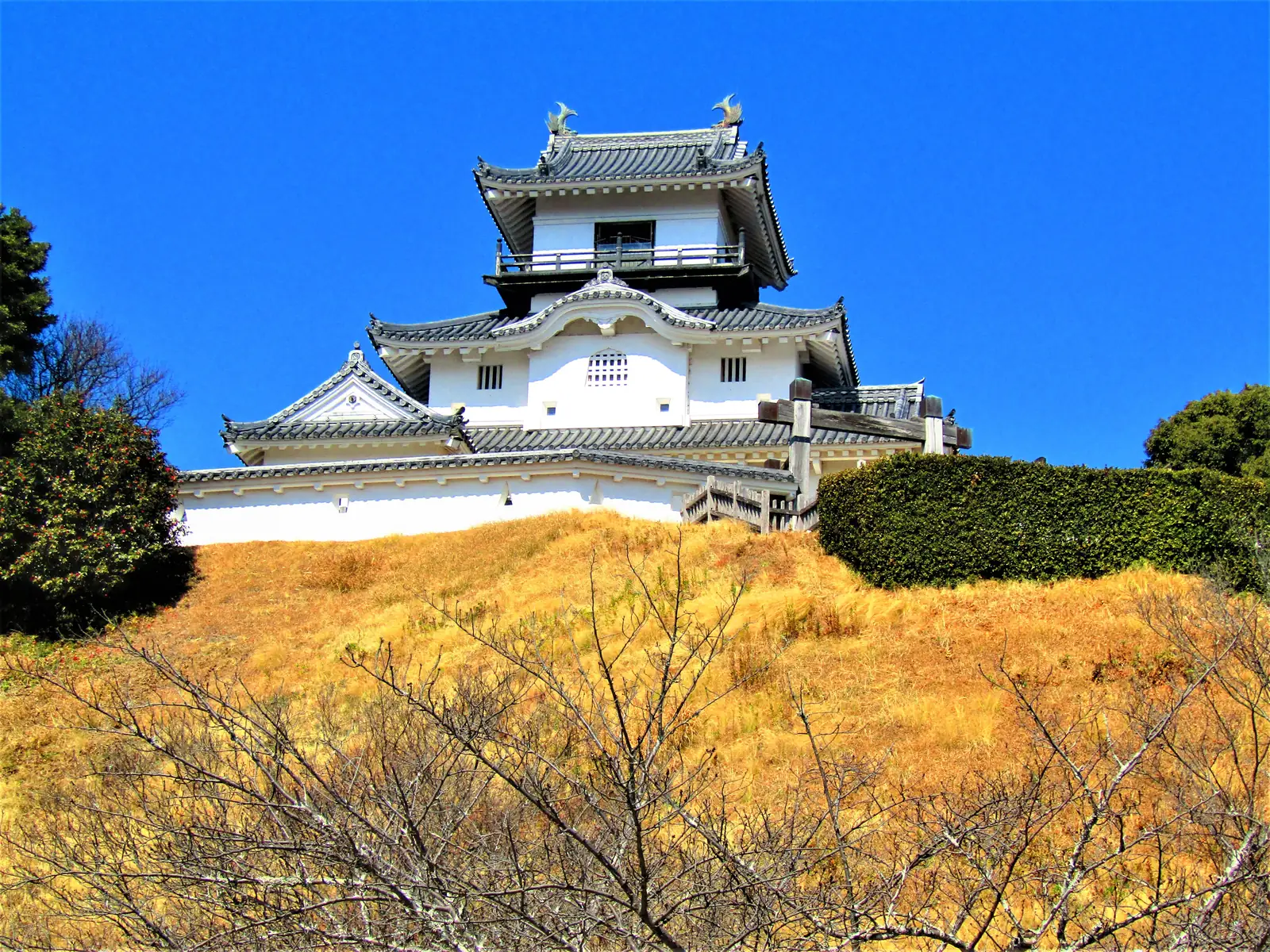
Most Japanese castle keeps rebuilt in the twentieth century are concrete. Kakegawa's citizens asked for wood, and in April 1994 they got it. It was the first full-scale wooden reconstruction of a keep in modern Japan, about 140 years after the original fell. The cost was about ¥1 billion. The builders worked from the 1644 Shōhō castle map, an 1851 drawing and the 1854 damage survey, and from the surviving keep at Kochi.
The building code of the day did not allow a four-storey wooden building. The top two floors occupy less than an eighth of the floor area. They were classed as a watchtower, and the keep passed as a two-storey house. Outside it shows three tiers, inside it has four floors. The body measures six by five ken, about 12 by 10 metres. The white plaster is thought to follow Hideyoshi's Jurakudai palace and the black-lacquered eaves follow Osaka Castle. The lookout on top is small in the early style, a watch-room on a house.
The castle's own history ties the rebuild to something older. Kakegawa's domain school, the Kyōyōkan, was the first place in Japan to use the word kyōyō, culture or cultivation, and admitted commoners. The city still teaches the Hōtoku ethic of Ninomiya Sontoku in every school. It credits that habit of civic effort with the Shinkansen station, the keep and the saved wooden railway station.
The post town below
Sixteen kilometres of the Tokaido ran through what is now the city. Kakegawa-juku was the 26th of the road's 53 post stations. The Ōte gate stood at the castle's south-east corner and opened straight onto the post town, whose inns lined the road in front of it. The thirteen town quarters laid out then still carry their names. Hokusai's print of Kakegawa shows a shop selling kuzu cloth, the domain's speciality, woven from kudzu fibre for samurai formal dress and rain capes.
Next station east was Nissaka, the 25th, at the foot of the Sayo-no-Nakayama pass. Travellers held up by the Oi River's closures filled its inns. The same river's porters, put out of work in 1870, went on to clear the Makinohara tea plateau.
Kakegawa and tea
The city dates its tea to the Tenshō era, the 1570s, Kazutoyo's own decade. Kakegawa tea has won the national tea competition's area prize 25 times, more than anywhere else. Its growers farm with the chagusaba grass-mulch method listed by the FAO in 2013. The Ninomaru tea house in the castle grounds serves it, matcha or sencha with a sweet, for ¥510, with the keep in the garden view.
How it happened
- 1497–1501The first Kakegawa castle
Asahina Yasuhiro builds for the Imagawa, 500 m east of today's site
- 1569Ieyasu takes it
A half-year siege of Imagawa Ujizane ends in a truce
- 1590Yamauchi Kazutoyo arrives
Stone walls, moats, the first keep and the castle town
- 1601Kazutoyo goes to Tosa
Kochi Castle begun the same year, in the Kakegawa manner
- 1854The Ansei earthquake
Keep, palace and drum tower damaged; only the palace is rebuilt, 1855–61
- 1869The castle is abolished
Meiji 2; the keep site stays empty for 125 years
- 1980The palace becomes an Important Cultural Property
26 January, after repairs in 1972–75
- 1994The keep returns, in wood
April; Japan's first full-scale wooden reconstruction, about ¥1 billion
Where this becomes real on your port day
Kakegawa is a 30–50 minute taxi from the berth, so it is a half-day choice. The keep, the palace and the tea house take about 75 minutes together, seven minutes' walk from the station.
The vocabulary of the castle
- Tenshu 天守
- The keep. Kakegawa's 1994 tenshu was the first in modern Japan rebuilt in wood rather than concrete.
- Goten 御殿
- The lord's palace: ceremonial hall, residence and offices in one. Four survive at Japanese castles.
- Ninomaru 二の丸
- The second enclosure, where the palace was rebuilt after the 1707 earthquake.
- Kakegawa-juku 掛川宿
- The 26th post station of the Tokaido, laid out at the castle's gate.
- Kuzufu 葛布
- Kudzu-fibre cloth, the domain's speciality, drawn in Hokusai's Kakegawa print.
FAQ
Is Kakegawa Castle original?
The palace is: the Ninomaru Goten was rebuilt in 1855–61 and is an Important Cultural Property, one of four castle palaces left in Japan. The keep is a 1994 reconstruction, but in wood, the first of its kind, built from Edo-period drawings and the surviving keep at Kochi.
Who was Yamauchi Kazutoyo?
The lord given Kakegawa in 1590. He built its first keep, walls and town. After Sekigahara he was rewarded with Tosa and moved to Kochi in 1601, taking Kakegawa craftsmen with him. Kochi's keep, rebuilt in 1749, was the model for Kakegawa's 1994 rebuild.
How long does Kakegawa Castle take?
About 75 minutes for the keep, the palace and a cup of tea in the Ninomaru tea house. Keep and palace open 9:00 to 17:00 every day, last entry 16:30, for ¥410. The keep's stairs are steep and you remove shoes in the palace.
Can I reach Kakegawa by train from the cruise port?
Not directly. Omaezaki has no railway; the castle is a 30–50 minute taxi from the wharf. Kakegawa Station, seven minutes' walk from the castle, is a Kodama Shinkansen stop, 11 minutes from Hamamatsu and 13 from Shizuoka.
More from Omaezaki
A Scotsman's brick tower on the reef coast where the Kuroshio meets the bay
Read →
Samurai with hoes, river porters without a river, and the tea that came of it
Read →
Japan's deepest bay, its pink shrimp, its whitebait and the eels next door
Read →