What Omaezaki isOmaezaki is the southernmost point of Shizuoka, a town of about 31,000 on a cape between Suruga Bay and the Enshu coast, half-way between Tokyo and Osaka. Its port handles car carriers and containers; cruise ships have called since 2019, and the town turns out with fishing flags and taiko for each one. Behind the cape lies Makinohara, the largest tea plateau in Japan, and beyond it the Tokaido line towns of Kakegawa and Shizuoka.
Researched from official timetables, operators and the port authority · checked 9 October 2026 · 38 sources · Takumi Yamada
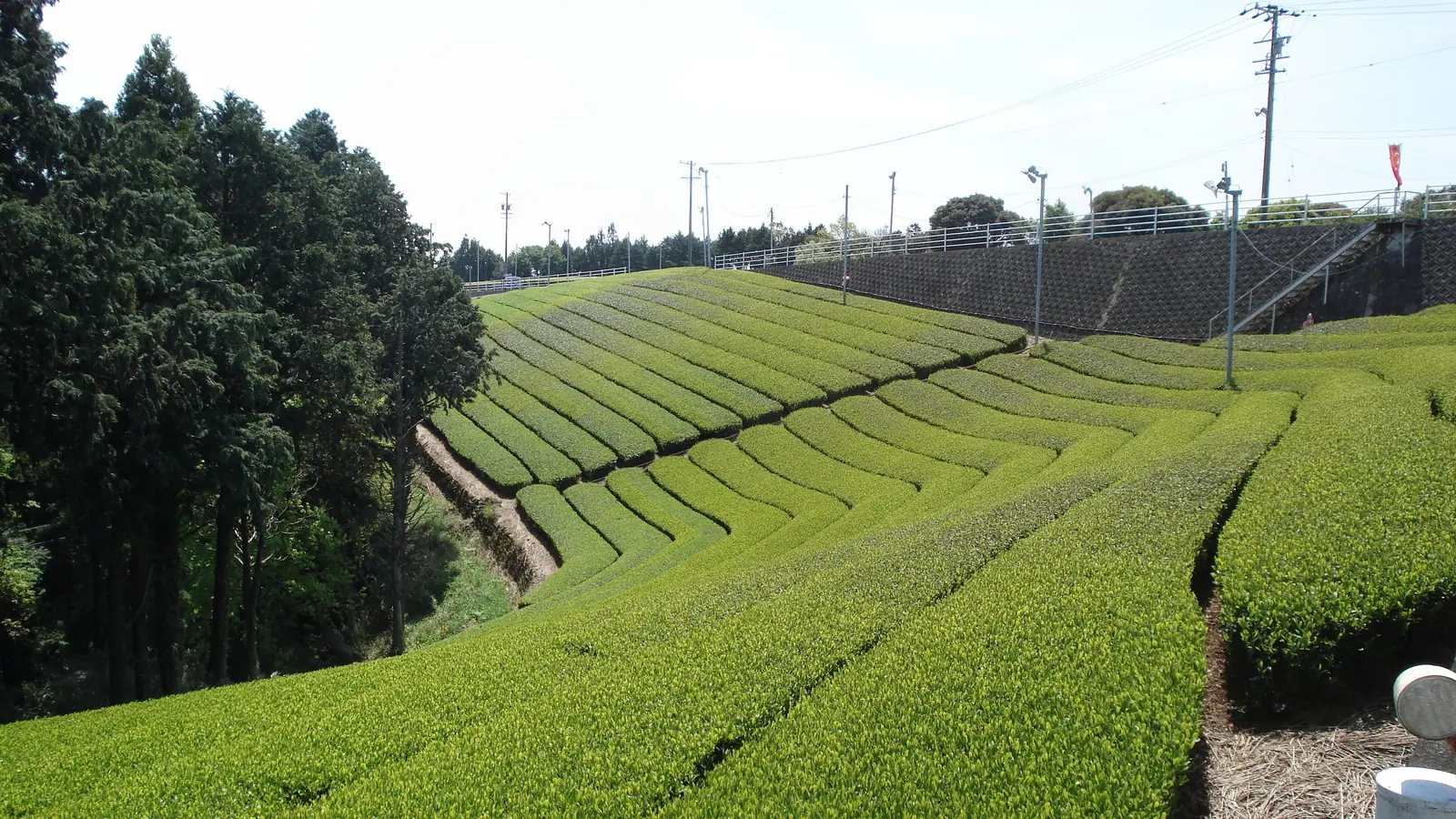
The Makinohara tea plateau and the Grinpia factory
Japan's largest tea plateau, rows of clipped green bushes to the horizon.
From the shipTaxi 25–30 minutes each way (about ¥7,000 at the tariff floor; a secondary guide quotes ¥5,000); Holland America calls it a thirty-minute taxi.
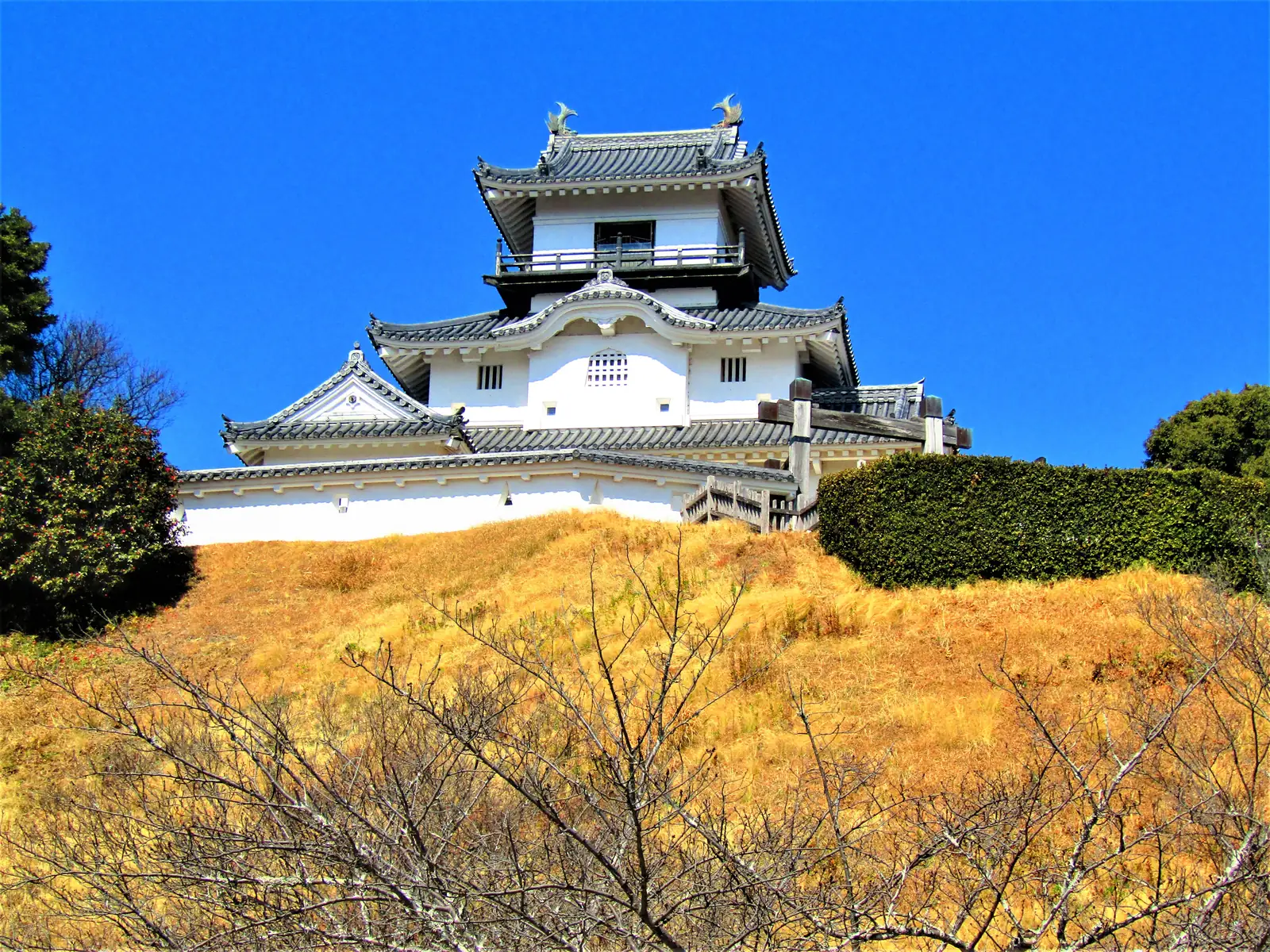
Kakegawa Castle, the wooden keep and the surviving palace
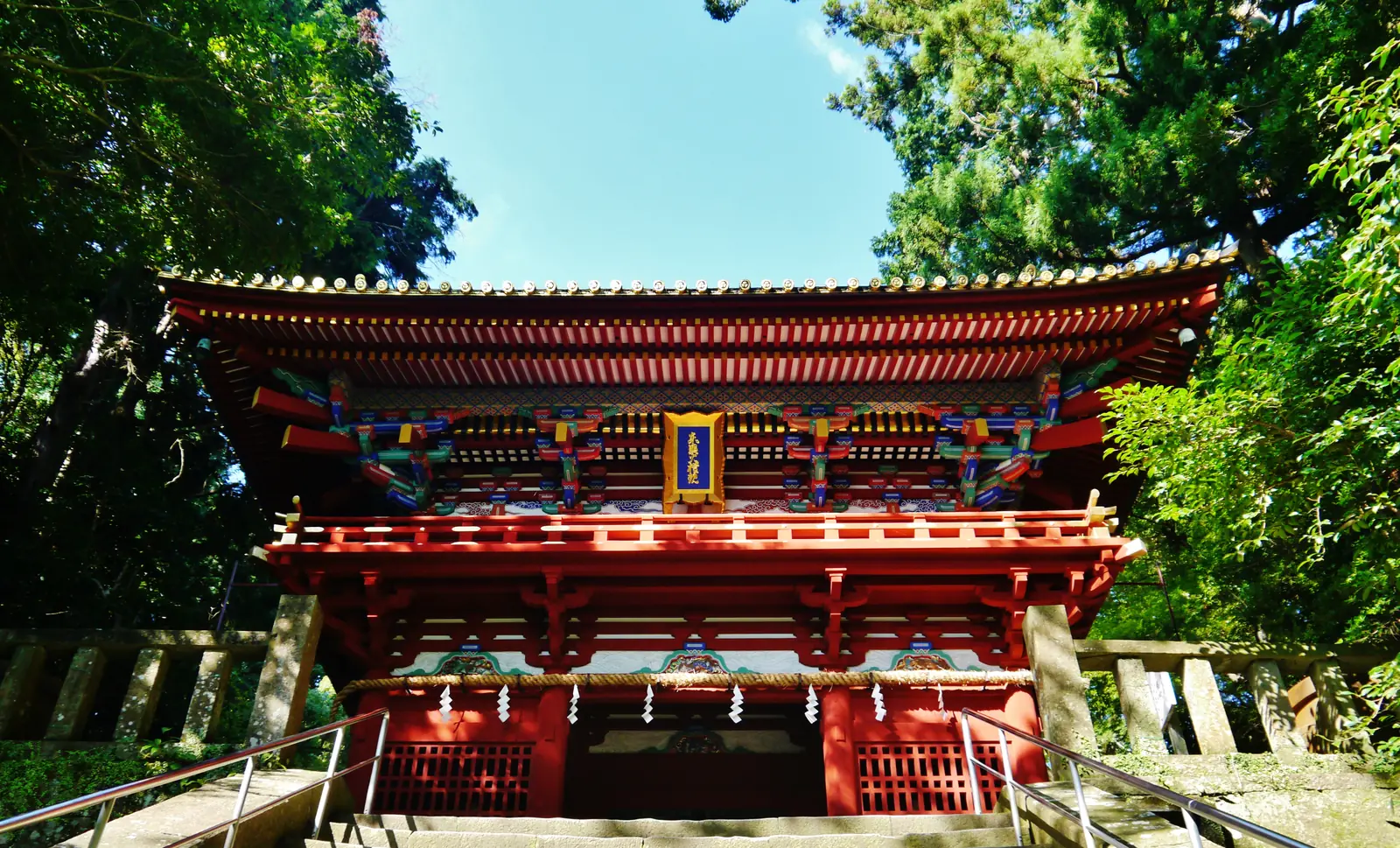
The 1994 keep was Japan's first full-scale wooden castle reconstruction; the Goten beside it is a late-Edo palace, one of four castle palaces left in the country and an Important Cultural Property.
From the shipTaxi 30–50 minutes each way, 32–35 km, about ¥12,500 at the tariff floor; or the ship's 5-hour coach.
Your hours, or your ship. The page picks your day and the one booking, with the hour before all-aboard set aside.
Hours your ship is in port
Why Omaezaki is worth getting off the ship for
Omaezaki is on the itinerary because it is the only Shizuoka port on Westerdam's spring loop, and because the town wants you. Residents have lined the quay with fishing flags and taiko at each call so far. The reward for getting off is three things, in three directions.
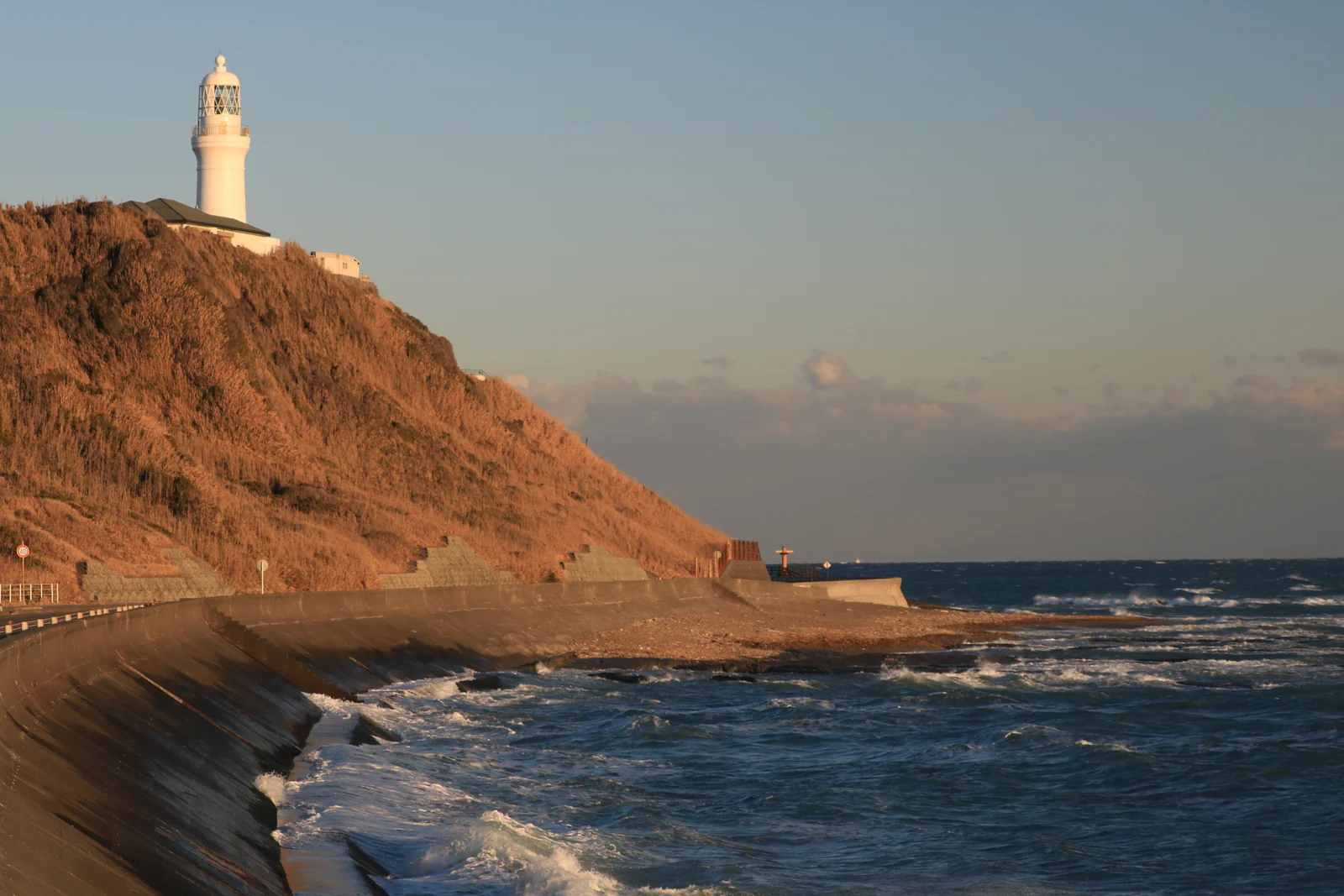
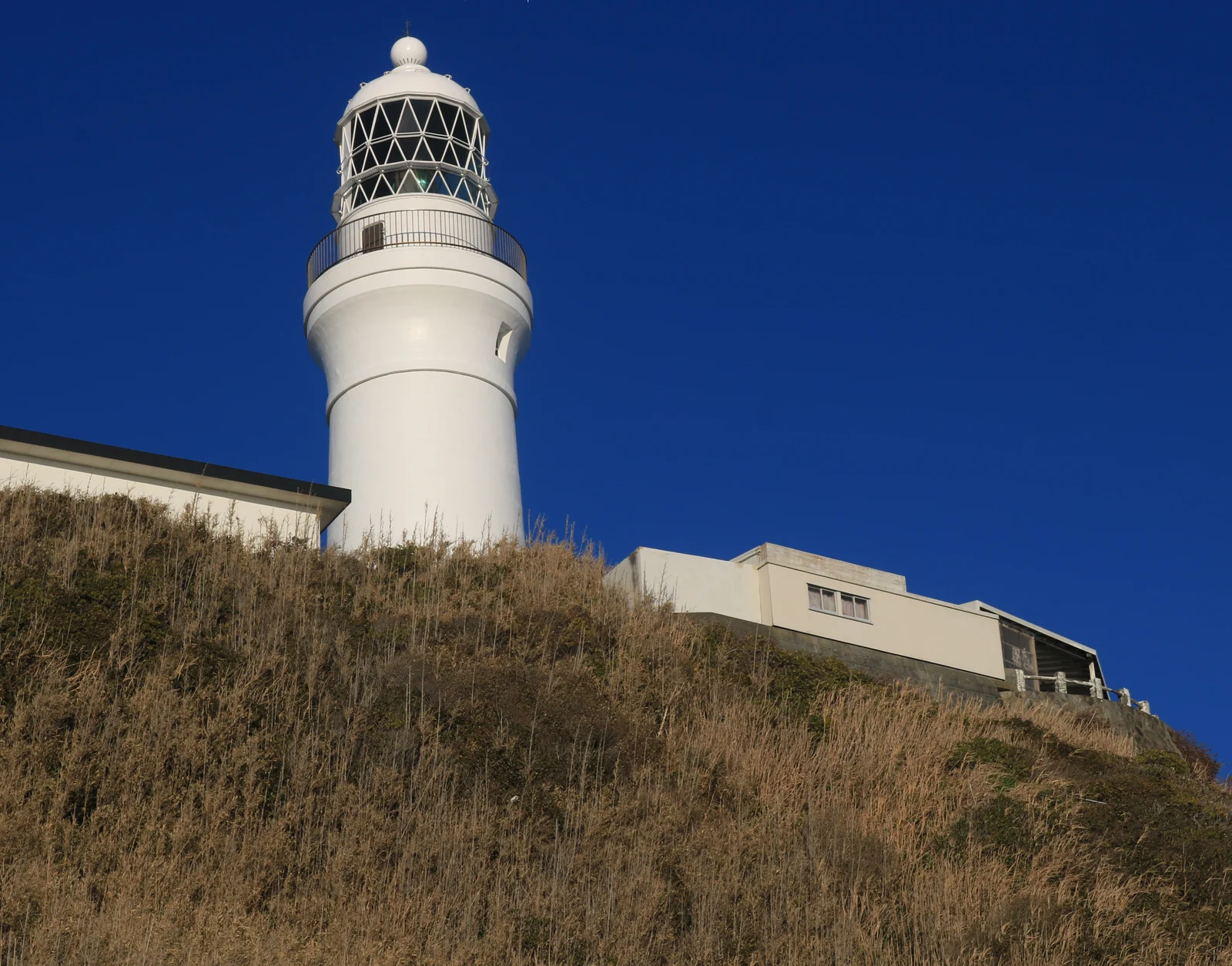
Ten minutes away stands the Omaezaki Lighthouse, a white brick tower first lit in 1874 and one of 16 lighthouses in Japan you can climb. Behind the cape lies Makinohara, the largest tea plateau in the country, with a factory you can walk through for free. Inland, 32 km away, Kakegawa Castle has a wooden keep rebuilt in 1994 and a real Edo palace beside it.
What this port is not: a walk-off port, and not a Fuji port. Ships dock at a car-carrier quay with tents for a terminal, and passengers cannot walk out of the compound. Mt. Fuji is about 96 km from the cape, visible on a clear morning and not otherwise.
This guide is built from the port council's notices, the city's pages, the official taxi tariff and the sights' own hours. Everything was checked on 8 and 9 October 2026.
First: the berth is West Wharf No. 2, and the terminal is a tent
Omaezaki has one cruise berth in practice. West Wharf berth No. 2 is a −12 m quay in the western part of the port, completed in 1985 for car carriers and domestic RORO ships. Every cruise call since the first in 2019 has used it: Pacific Venus, Zaandam, three Westerdam calls and Diamond Princess at 115,875 tons.
West Wharf berth No. 2
Where
Minato, Omaezaki City, on the north side of the cape; port office at 6170-1 Minato
Ships
Westerdam, Diamond Princess, Zaandam, Pacific Venus: every call on record
Terminal
None. Immigration, the tourist-information booth, the shuttle stop and the taxi stand are tents inside the berth area
On foot
Nothing. The lighthouse is 2.3 km and Nabura Market 1.9 km, but the compound is closed to pedestrians
The council lists the Central Wharf as cruise-capable too. The prefecture's long-term plan would make it a passenger berth for ships up to about 23,000 tons, but no cruise call has used it. The container terminal at Megishi, with its cranes, is not the cruise berth either.
On ship days the quay hosts a public welcome event. At the October 2026 call that means stalls 08:00–15:30, a stage from 10:00 and a ¥1,000 fishing event on berths 3–4. Ship interiors are closed to the public. Expect crowds on the apron at sailing time, which is part of the charm.
Getting from the West Wharf to the lighthouse, Makinohara and the stations
There are three ways out and no fourth. The city's shuttle, when it runs; a taxi from the stand inside the berth area; or the ship's coach. Omaezaki has no railway, and the local buses are infrequent with Japanese-only signage.
To
How
Time
Cost
Omaezaki Lighthouse
City shuttle (if running) or taxi
about 10 min
free, or about ¥1,100 (a secondary guide quotes ¥2,000)
Nabura Market
Shuttle or taxi, 1.9 km
about 5 min
free, or about ¥1,000
Hamaoka Sand Dunes
Taxi, 10 km
about 10 min
about ¥3,900
Grinpia Makinohara (tea factory)
Taxi, about 20 km
25–30 min
about ¥7,000 (a secondary guide quotes ¥5,000)
Tea Museum, Kanaya
Taxi, 28 km
about 30 min
about ¥10,000
JR Kikugawa Station
Taxi, 26–30 km
council: 40 min
about ¥9,500–10,700
Kakegawa Castle
Taxi, 32–35 km
council: 50 min to the station
about ¥11,600–12,500
Mt. Fuji Shizuoka Airport
Taxi, 28–30 km
council: 35 min
about ¥10,200–10,900
Shizuoka Station
Taxi, 50 km
45 min without traffic
about ¥18,000
Kunozan Toshogu / Nihondaira Ropeway
Taxi, 54–63 km
45–55 min without traffic
about ¥19,300–22,400
Hamamatsu Station
Taxi, 48 km
about 40 min without traffic
about ¥17,500
Road times are our estimates from map routing without traffic, so add a quarter to a half. The council's own figures are quoted where it publishes them. Taxi fares are the distance-only floor of the official Shizuoka-district tariff, ¥700 for the first 1.17 km and ¥100 per 285 m after, without the time charge.
Hourly hire is the tool for anything beyond the cape: ¥3,850 per 30 minutes and ¥1,920 per extra 15, about ¥7,700 an hour for a sedan carrying three. A reseller quotes a van for six at ¥11,600 an hour. Book it before you sail; the stand on the apron serves a small fleet, and waits of 15–20 minutes were reported late in the morning of the 2026 call.
The shuttle deserves its own paragraph because it decides the day for most people. The council's record of the 2023 call says shuttle buses took passengers to sights in Omaezaki and Makinohara, and television footage of the April 2026 call shows the same. Only a secondary guide says the buses were free. No notice has ever published where they go, when they run or what the last return is. A secondary guide written for the 2026 call described a pier–Nabura Market–lighthouse loop every 20–30 minutes from about 08:30, last return 15:00–16:00; a reader's comment adds a Makinohara bus on the official map. Treat that as likely, not promised. Read the map at the tent.
Public transport exists on paper. A Shizutetsu bus runs from the Omaezaki Kaiyo Center stop, 10 minutes' walk from the lighthouse, to the Hamaoka office in about 30 minutes, and a second bus goes on to Kikugawa Station in about 40. The timetables are not published in English and the frequency is low; from Kikugawa a JR local reaches Shizuoka in 39 minutes for ¥770 and Kakegawa in 6 for ¥200. Nobody on a 9-hour call should build the day on that chain.
Omaezaki to Mount Fuji: a 96 km view on a clear morning
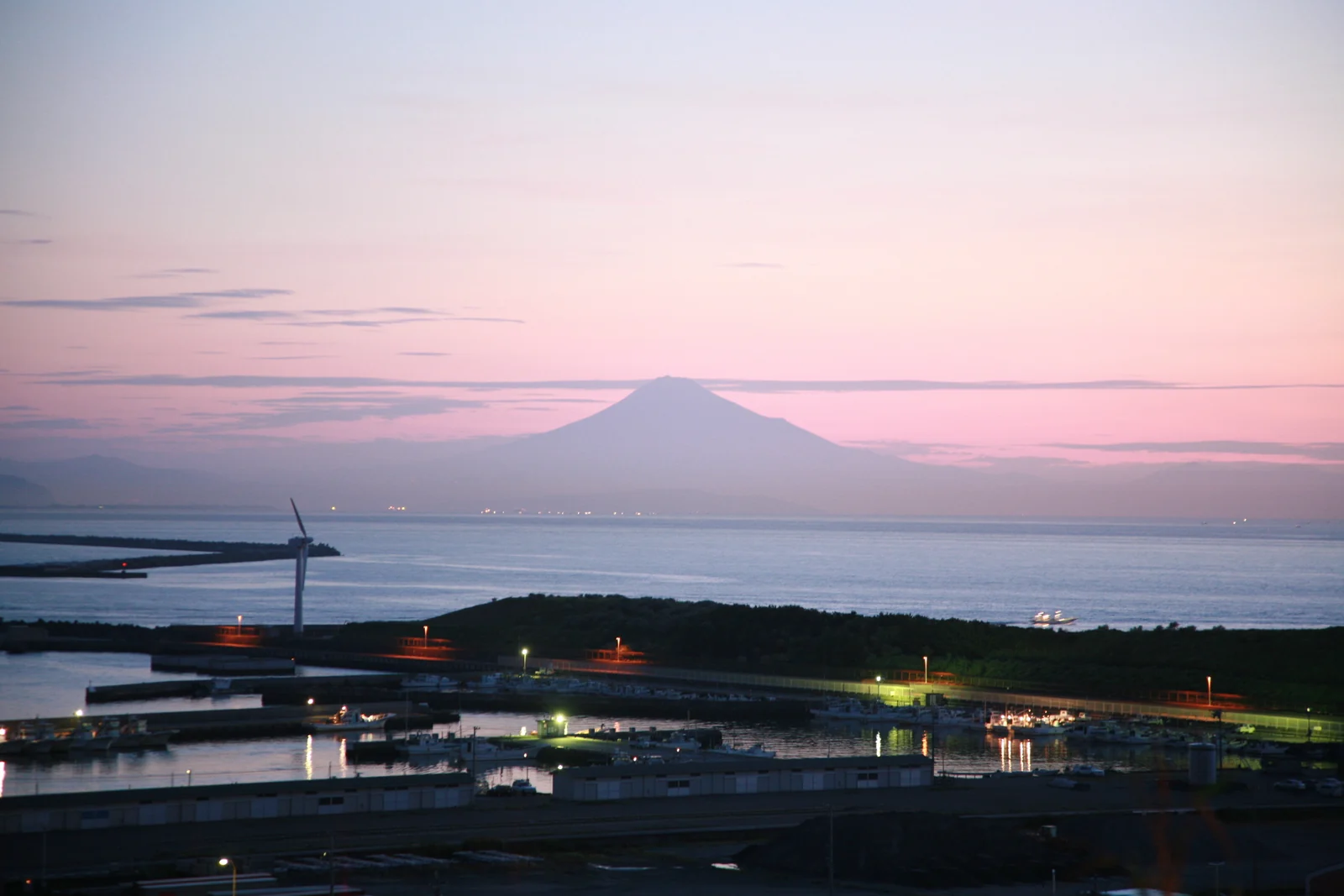
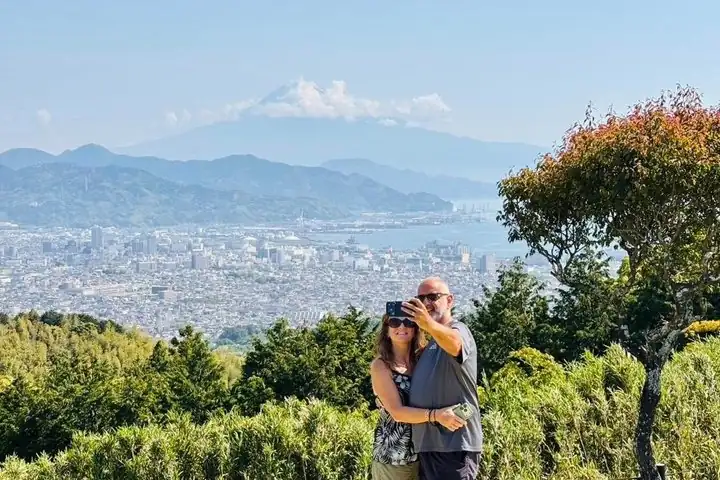
The lighthouse association and the transport ministry both list Mt. Fuji among the views from the lighthouse, with the Izu peninsula and the Southern Alps. The summit is about 96 km from the tower in a straight line, more than twice as far as from Shimizu. The photograph above, taken from the port district, shows what a clear day gives.
No statistics for Fuji visibility from Omaezaki exist, and this guide will not invent any. The only published series is Fuji City's, 20 km from the mountain, and it does not transfer. What the climate normals do say is that April on the cape averages 5.1 m/s of wind and 201 mm of rain. It is a windy month. Look north-east from the ship at breakfast; if the mountain is there, go to the cape first.
Omaezaki Lighthouse and Cape Park: hours, fee, wind
The lighthouse is a 22 m white brick tower designed under the British engineer Richard Henry Brunton and first lit on 1 May 1874. Its lens was destroyed by attack in July 1945 and restored in 1949; it became an Important Cultural Property in August 2021. The climb is a steep spiral stair with no lift, to a gallery; the light stands 54 m above the sea.
Hours since 1 March 2026 are 09:00–12:00 every day, then 13:00–16:00 on weekday afternoons from March to October and 13:00–16:30 on weekends and holidays. It is closed 12:00–13:00 daily, and last entry is 15 minutes before each closing. The fee is a ¥300 visitor donation, paid in cash; children of primary-school age and under are free. Strong wind or bad weather closes it, and reviews describe hats blown off the gallery.
Cape Park is a minute away: free, always open, with a coast path past the Shiosai statue that takes 30–45 minutes. Allow 30–45 minutes for the tower and the park together, longer if the shuttle loop sets the pace. The council says the Marine Park beach is 25 minutes' walk from the park and the market 6 minutes beyond that, so the whole cape can be done on foot once you are out of the wharf.
Nabura Market at 6099-7 Minato, 1.9 km from the berth, is named for the fishermen's word for a school of bonito. The fish hall opens 09:00–17:00 (08:30 on weekends and holidays); the food hall opens 09:00–21:00 with hours that vary by shop. It is closed on Tuesdays (open if the Tuesday is a holiday) and on 1 January. Payment is cash, with other methods shop by shop.
The dish is seared bonito tataki at Ipponzuri Nikkomaru, a restaurant run by a pole-and-line boat (11:00–17:30, last orders 17:00). The Kaisen counter serves seafood bowls on weekends and holidays, and MARE sells shirasu gelato. The Omaezaki Tourism Association sits in the Nabura-kan building next door, closed Tuesdays, and lists rental e-bikes without a price. A 7-Eleven stands beside the market.
Marine Park Omaezaki is 6 minutes' walk from the market: a free beach park with the Eco-Park botanical garden, about 460 parking spaces and the temporary car park used on ship days. The Hamaoka Sand Dunes, 10 km west, are a free stretch of rippled sand where loggerhead turtles nest from May to August. The grey buildings beside the port are Chubu Electric's Hamaoka nuclear plant, shut since 2011; its free museum with an observation deck opens 09:00–17:00, closed the third Monday.
Makinohara tea: Grinpia and the Tea Museum
The Makinohara plateau is the largest tea-growing area in Japan, and the ships arrive at the right moment. The Shizuoka tea market's first new-tea auction falls in the second half of April, and Grinpia's 2026 picking season opened on 11 April. A 12 April call lands at the very start of the first flush; an October call sees the autumn picking.
Grinpia Makinohara, at Nishihagima 1151, offers a self-guided tea-factory tour 10:00–17:00, free, no booking, with some lines idle out of season, and a shop. Tea picking costs ¥1,000 and runs in blocks from mid-April to early October. It sits near the Sagara-Makinohara interchange, which the council puts 25 minutes from the port; Holland America calls the tea fields a thirty-minute taxi.
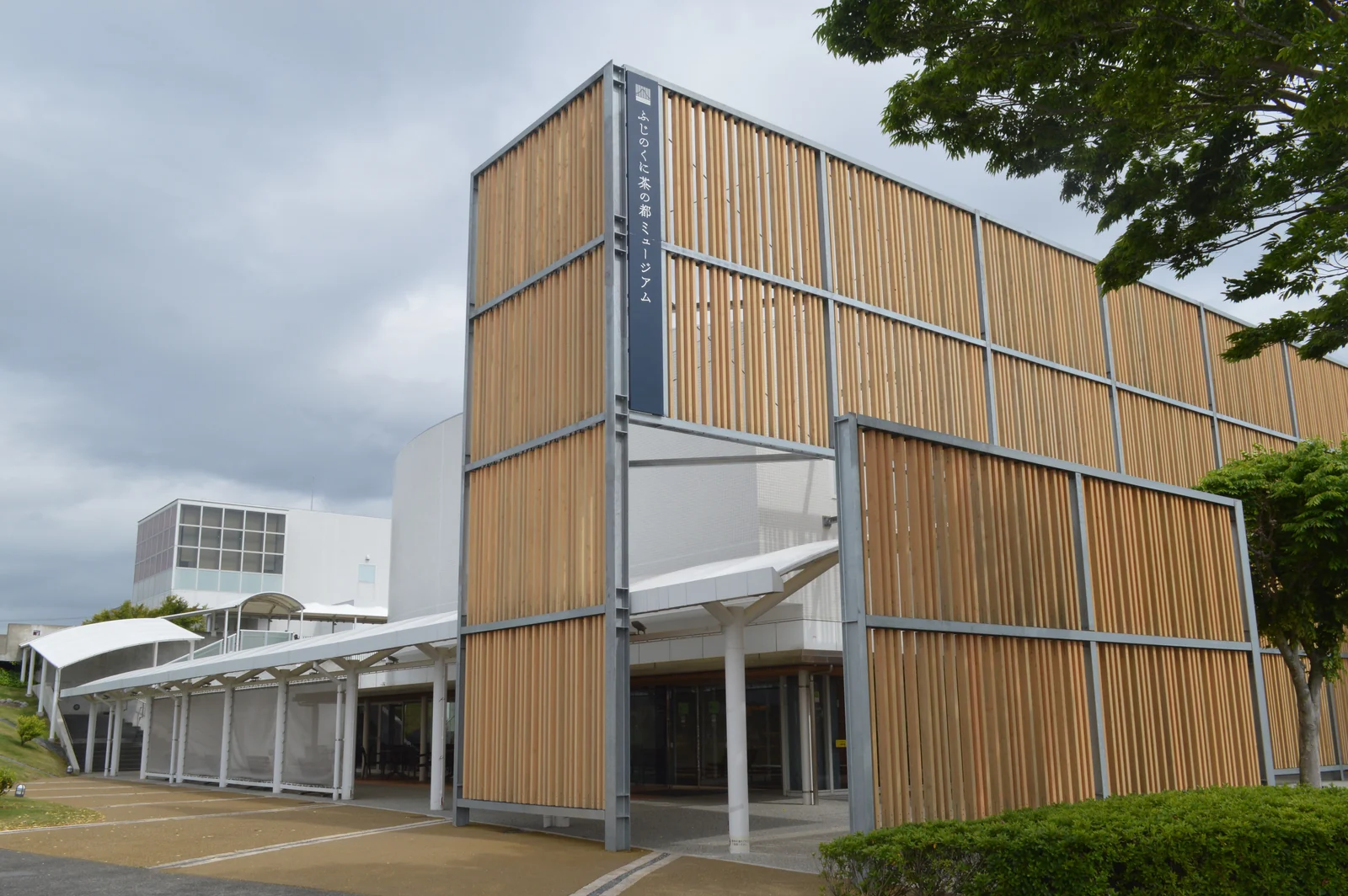
The Tea Museum Shizuoka at Kanaya, 28 km from the wharf, opens 09:00–17:00 (last entry 16:30), with a tea room 09:30–16:00. Admission is ¥500, free at 70 and over; it is closed on Tuesdays. The HAL tours pair it with the 1879 Horai wooden footbridge and the 300-year-old Ogane family farmhouse. Fees and hours for those two are not published in our sources.
Kakegawa Castle: the wooden keep and the palace
Kakegawa Castle is 32–35 km inland, 7 minutes' walk from JR Kakegawa Station, where the Kodama Shinkansen stops. The original keep fell in the 1854 earthquake and was abandoned in the Meiji era; the 1994 rebuild was Japan's first full-scale wooden tenshu reconstruction. Beside it stands the late-Edo Goten, used for ceremonies, audiences and administration, one of four castle palaces surviving in Japan and an Important Cultural Property.
The keep and palace open 09:00–17:00 (last entry 16:30), every day; adults pay ¥410, children ¥150, with no senior rate. The keep's stairs are steep; the palace is flat, shoes off. The Ninomaru Tea House (09:30–17:00) serves matcha or sencha with a sweet for ¥510, and the Ninomaru Museum (¥200) closes on Mondays. Allow 60–75 minutes for the two buildings.
Holland America's coach pairs the castle with Kasuisai, a Soto Zen temple of 1394 at Fukuroi, about an hour's drive from the port. Its peony garden flowers from April to early May. The entry fee in recent notices is ¥500–700.
Shizuoka city is 50 km from the wharf and Kunozan Toshogu 54 km: 44–55 minutes without traffic, so about 75 with. The shrine, Tokugawa Ieyasu's first mausoleum, is open 09:00–17:00 every day at ¥700 (¥1,200 with the museum). It is reached by the Nihondaira Ropeway (¥1,250 return, first car 09:10, last 17:00, cards accepted) or by a long stone stairway from the coast road, about 1,000 steps; inside, the shrine says plainly that wheelchairs cannot be used.
Sunpu Castle Park is a free park 15 minutes' walk from Shizuoka Station; its gates, towers and garden (combined ¥360) are closed on Mondays, which rules them out on 12 April 2027. Miho no Matsubara, the pine shore on the World Heritage list, is 61 km from the wharf. On a 9-hour call the city means one sight by hired car and straight back, as model day 2 shows.
Hamamatsu is 48 km west: the rebuilt castle (08:30–16:30, ¥200, free at 70 and over on a secondary listing) and the city's grilled eel. From Kakegawa a Kodama reaches it in 11 minutes for ¥1,380, but with the taxi to Kakegawa first it is a lunch and nothing else.
Omaezaki and Shimizu: the difference
Both are Shizuoka ports and both are sold as Fuji calls, which is where the resemblance ends. Shimizu's Hinode Pier is a walkable waterfront in a city of about 660,000, with Fuji 45 km across the bay. The complete guide to it is on Port of Fuji; the site's Shimizu page links there.
Omaezaki's berth is a cargo quay in a town of about 31,000 on a windy cape. Fuji is 96 km away and the nearest station is a 26 km taxi ride. The whole day depends on the city shuttle, a small taxi fleet or the ship's coach.
What it has that Shimizu does not: the climbable 1874 lighthouse, the tea plateau 25–30 minutes away and Kakegawa's wooden castle. And a town that has turned out for each ship so far.
The best things to do in Omaezaki on a port day
Our full list, with the time each takes from the berth, is on the Omaezaki top 10. In brief:
Kakegawa Castle, the Tea Museum and Grinpia by hourly taxi: the 9-hour Westerdam day
Fits the 07:00–16:00 Westerdam calls (Monday 12 October 2026 and Monday 12 April 2027) and any 9-hour-plus call. Book the hourly hire before you sail; the wharf taxi stand cannot be relied on for a whole-day car.
The castle first, then tea country on the way back. Times assume 07:00 arrival and 16:00 departure, so all-aboard about 15:30 and our target at the gangway 14:30. Mondays are fine for every stop below; the Tea Museum and Nabura Market close on Tuesdays.
07:30Off the ship. Pick up the shuttle map at the information tent and note the last return time. Your pre-booked hourly taxi waits at the taxi stand inside the berth area.
07:35Taxi to Kakegawa, 35 km, about 30 minutes without traffic; the council quotes 50 minutes to Kakegawa Station. Coffee near the station until the castle opens.
09:00Kakegawa Castle opens: the wooden keep (steep stairs) and the Goten palace (shoes off), ¥410. Allow 75 minutes.
10:15Ninomaru Tea House in the grounds (from 09:30): matcha or sencha with a sweet, ¥510, with the keep across the garden.
10:50Taxi to the Tea Museum Shizuoka at Kanaya, about 20 km and 25–30 minutes.
11:20Tea Museum (¥500, free at 70+): the plateau's story, then the tea room (09:30–16:00) for a Shizuoka tea service in place of lunch.
12:30Taxi about 10 minutes to Grinpia Makinohara near the Sagara-Makinohara interchange.
12:45Grinpia factory tour (free, no booking) and the shop. Tea picking (¥1,000) only if the season has opened; in 2026 it began on 11 April, so ask on the day.
13:30Taxi back towards the port: the council quotes 25 minutes from the interchange. Optional 25-minute stop at Nabura Market for a bonito bowl, meter running.
14:30At the gangway, an hour before all-aboard. Hire of about 7 hours is about ¥54,000 for a sedan (up to 3) or about ¥81,000 for a van (up to 6), plus ¥410, ¥510 and ¥500 (¥0 at 70+).
Shizuoka city by hired car: Kunozan Toshogu and Nihondaira, nothing else
Fits the 9-hour Westerdam calls only, and only with a car booked by the hour before you sail. On 12 April 2027, a Monday, Sunpu Castle Park's paid buildings are closed, so the day is the shrine and the ropeway.
Shizuoka city is 50–63 km each way, about 75 minutes with traffic. One sight is the realistic haul. Times assume 07:00–16:00, target gangway 14:30, and a sedan at about ¥7,700 an hour: about ¥46,000 for six hours.
07:45Hired car to the Nihondaira Ropeway top station, 63 km: 55 minutes without traffic, so allow 75.
09:10First ropeway down to the shrine, 5 minutes; ¥1,250 return, or the ¥1,950 set ticket with shrine admission. Cards, QR and e-money accepted.
09:20Kunozan Toshogu (¥700; ¥1,200 with the museum), Tokugawa Ieyasu's first mausoleum: lacquered halls and stone steps inside the precinct. An hour and ten minutes.
10:45Ropeway up, then the free Nihondaira terrace for Fuji across Suruga Bay if the air is clear; no visibility figures exist for April.
11:15Drive 12 km to the Shizuoka Station area for lunch, and the free grounds of Sunpu Castle Park (the gates and towers are closed on Mondays).
12:30Drive back to the berth, 50 km: 45 minutes without traffic, so allow 75.
13:45At the gangway, 45 minutes ahead of target.
The cape only: lighthouse, Nabura Market and the shore by shuttle or short taxi
Fits every call, including a shortened one. Built for passengers who have not booked a tour or a car and will use whatever shuttle the city runs; the fallback is two short taxis.
Everything is within 2.3 km of the wharf, and the only reason you cannot walk is the cargo compound. Times assume 07:00–16:00 and a shuttle starting about 30 minutes after clearance, as a secondary guide described the 2026 loop. If no shuttle appears, a taxi to the lighthouse is about ¥1,100–2,000.
07:30Off the ship. At the information tent, take the shuttle map, confirm the stops and the last return time, and ask the taxi stand to book a return ride if you want one.
08:00Shuttle or taxi to the lighthouse, about 10 minutes. The tower opens at 09:00, so walk Cape Park first: the coast path past the Shiosai statue, 30–45 minutes, windproof layer on.
09:00Climb the lighthouse, ¥300 cash: 22 m of spiral stairs to the gallery. The Enshu coast and Izu are in front of you; Fuji only on a clear morning.
09:45Shuttle or 5-minute taxi (about ¥1,000) to Nabura Market. The fish hall opens 09:00: bonito, Suruga Bay fish, dried goods for the ship.
11:00Lunch as Ipponzuri Nikkomaru opens: seared bonito tataki from a pole-and-line boat. Then shirasu gelato at MARE in the food hall.
12:15Walk 6 minutes to Marine Park Omaezaki: the beach, the botanical Eco-Park and the sea wall. Free, always open.
13:15Walk back to the market stop for the shuttle to the ship, or your booked taxi. The 7-Eleven beside the market is the nearest ATM.
14:00At the gangway, 90 minutes before all-aboard. Spend: ¥300 plus lunch, or about ¥3,000–4,000 more for three taxis.
How to think about your hours
Work backwards from the ship. All-aboard is usually 30 minutes before departure (check the daily programme), and you want to be at the gangway an hour before that. The first half hour after arrival goes on clearance and the walk to the tents. So the time you can use is the call length minus about two hours.
Every plan here also assumes a shuttle or a taxi for the first and last leg. There is no walking version.
Call
Usable
What fits from West Wharf No. 2
4 hours
about 2
The lighthouse climb and Cape Park, then Nabura Market for a bonito lunch. Nothing further.
6 hours
about 4
The cape plus the Hamaoka dunes by taxi; or Kakegawa Castle by taxi (about ¥12,500 each way) and back. One or the other.
8 hours
about 6
Hourly-hire taxi: Kakegawa Castle, the Tea Museum and Grinpia; or Shizuoka city for Kunozan Toshogu alone.
9 hours
about 7
Model day 1 or 2 with a car; model day 3 without. Hamamatsu only as castle-and-eel by car.
Published calls are 8 to 9 hours. Westerdam's are 07:00–16:00, on 12 October 2026 and 12 April 2027. Diamond Princess calls on 10 November 2026 (times not yet set), then 17 May and 26 November 2027 at 09:00–17:00. The list is on cruises to Omaezaki. Westerdam's 28 March 2027 loop does not call here; the port-by-port journal covers that voyage.
One pick per length of call. Every card opens our own page first: what the operator includes, who should skip it, and which upcoming Omaezaki calls it fits. Prices are the operator's "from" price as of 26 Sep 2026.
5h+Half a day with local hosts, starting in Omaezaki
The one Viator listing written for this port. Its record names no meeting point beyond a sign with the tour name, so ask the operator where it stands before you book.
If your call is longer, or the day before or after the cruise
9h+Shizuoka-city listings: only if the operator agrees in writing to start from Omaezaki
These two are built for Shimizu's piers, 55–60 km away, and their records say so. Neither mentions Omaezaki as a start point, so treat them as a lead to ask about, not a booking to make blind.
Tours are booked through Viator (a Tripadvisor company). If you book, we may earn a small commission at no extra cost to you. It never decides what we recommend — which is why each tour page has a "think twice" note.
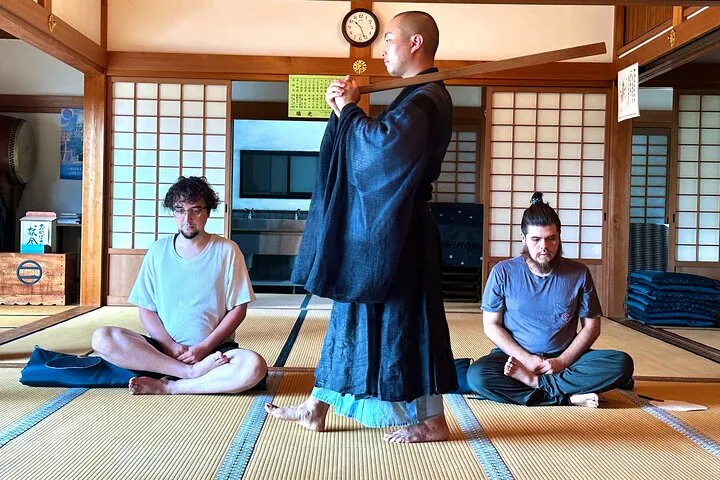
About the return to the ship. The catalogue for this port is thin, and only one of its five listings starts in Omaezaki: the 2½-hour zen, mizuhiki and taiko session with local residents (5587248P17). The other four are Shizuoka-city products whose records name Shimizu's piers or Shizuoka Station as the meeting point, 55–60 km away; one bike tour says in its own words that it is not for cruise passengers. The tea-tasting day ends at Shizuoka Station at 15:30–16:00, which no call here allows.
None of the five promises an on-time return in writing. Among resellers, Japan Shore Excursions prints a 'Back-to-Ship Guarantee: Return to Your Ship 90–120 Minutes Before Departure' on its Omaezaki page, wording no other operator here matches. Its 6-hour highlights-and-tea day is listed from US$190, pricing basis not stated.
A ToursByLocals private guide offers a 7-hour day from the port with transport at the charter rate, and makes no return promise at all. For most passengers the realistic choices are the ship's own excursions, listed below, or a hired taxi day from this guide.
Whatever you book, tell the guide your all-aboard time at the start and agree the gangway an hour before it.
The ship's excursions: Holland America and Princess
Holland America's Omaezaki pages (port code OMZ) showed these tours on 9 October 2026. Prices are 'from', per person, in US dollars.
Excursion
Duration
From
Notes
Kakegawa Castle & Kasuisai Temple
about 5 h
$139
1-hour drive to Kasuisai, then the castle; shoes off; not wheelchair-accessible; no meal
Highlights of Omaezaki
about 4 h
$129
Tea Museum, Horai Bridge, Ogane family residence; 'no guarantee is offered with regard to visibility or views on any particular day'
Japanese Tea Culture in Shizuoka
about 4½ h
$139
Tea Museum, Grinpia picking and factory, Ogane residence; runs late April to early October, so probably not on 12 April
Sunpu Castle Park & Shizuoka Sengen Shrine
not shown
not shown
name only on the port page
Nihondaira Outlook & Kunozan Toshogu Shrine
not shown
not shown
name only on the port page
Princess's page for Diamond Princess names four tours without prices or durations. They are Kakegawa Castle & Kasuisai Temple, Nihondaira Outlook & Kunozan Toshogu (ropeway and Yaizu fish market), Sunpu Castle Park & Shizuoka Sengen Shrine (with Yaizu fish market) and Highlights of Omaezaki.
Book early. On forums, a Princess passenger in 2025 found most trips fully booked and nothing else on offer; a 2023 Westerdam passenger could not book three months out.
Money, cards and the practical stuff
Carry yen. The lighthouse donation, Nabura Market's stalls and the local buses are cash. No sight in our sources publishes what cards it takes except the ropeway.
Place
Pay with
Omaezaki Lighthouse (¥300)
Cash
Nabura Market
Cash; other methods shop by shop
Taxis
Not published; assume cash
Kakegawa Castle, Tea Museum, Grinpia
Not published; carry yen
Nihondaira Ropeway
Cash, credit cards, QR and e-money
JR local trains from Kikugawa
IC cards (Suica, ICOCA, TOICA) or cash tickets
There is no ATM, exchange desk or shop at the wharf. The nearest mapped machines are a FamilyMart about 1 km away, the 7-Eleven beside Nabura Market and a Shimada-Kakegawa Shinkin Bank branch in town. Whether any takes foreign cards is not confirmed, so get cash on board.
Tourist information. The tent on the apron has volunteer interpreters on ship days. In town, the tourism association beside Nabura Market is closed Tuesdays; its Nabura-kan building was shut for renovation 1–14 October 2026. The council's secretariat at the city's Port Business Office answers on weekdays 08:30–17:00, in Japanese.
Closed days against the call dates. Tuesday closes Nabura Market, the Tea Museum and the tourism office: that is the 10 November 2026 Diamond Princess call. Monday closes Sunpu Castle Park's buildings and Kakegawa's Ninomaru Museum, and the third Monday closes the Hamaoka museum: 12 April 2027 is the second Monday. 12 October 2026 is a public holiday, so Sunpu's buildings and the Ninomaru Museum open and the lighthouse keeps weekend afternoon hours.
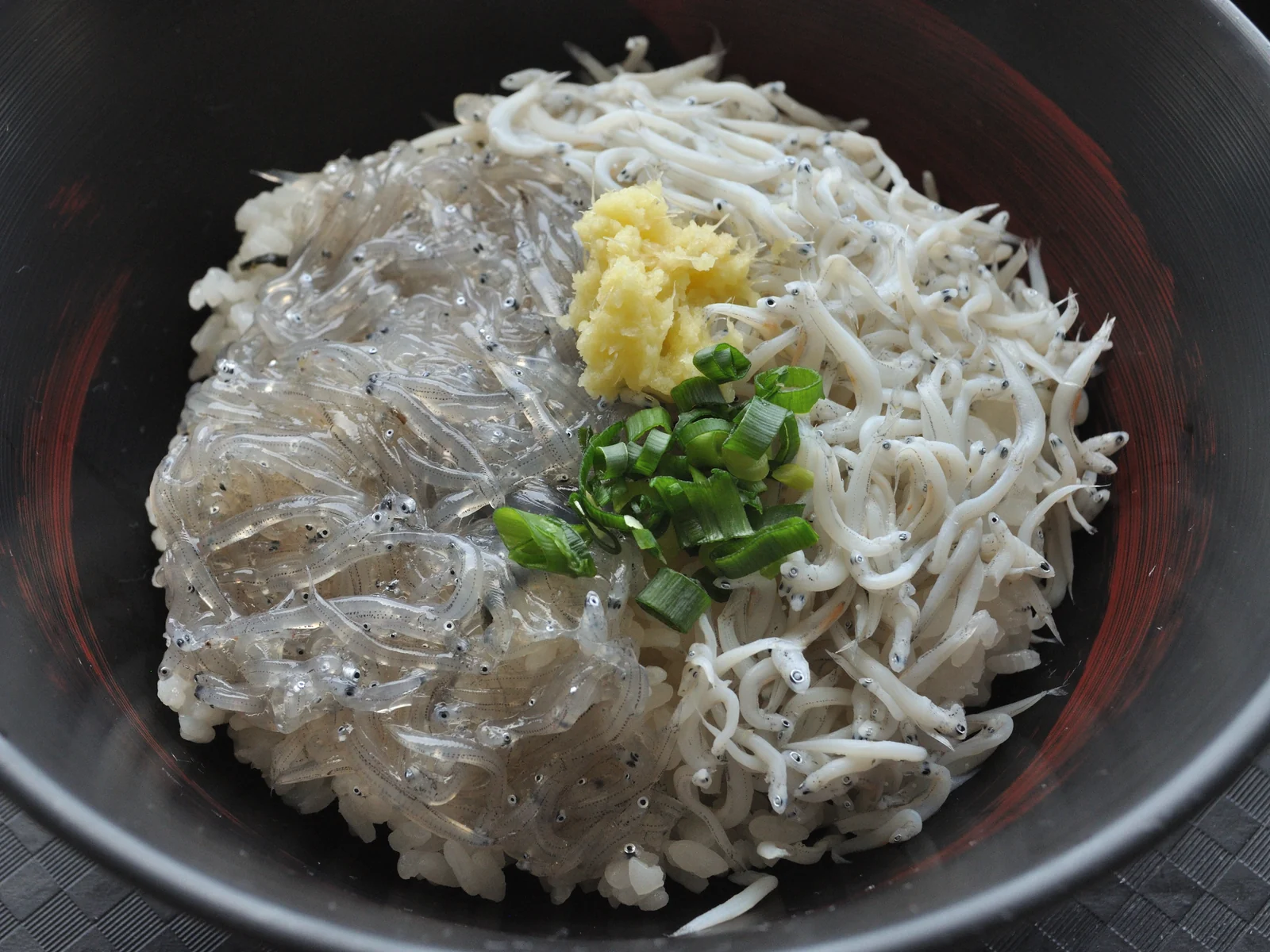
Shirasu-don: raw whitebait piled on rice, a Suruga Bay lunchPhoto: Ocdp / CC0
Food on the route. At the cape: Nabura Market's bonito restaurant and food hall, the city's eel house Unagidokoro Nozaki (hours not published) and Kameya Honten's turtle-shaped kame manju. At Kakegawa: the castle tea house. At Kanaya: the museum's tea room. In Hamamatsu: unagi, on a car day only. Suruga Bay sakura shrimp has spring and autumn seasons, but whether it is on Nabura's counter on a given day is not published.
When to go: seasons and crowds
April is the Westerdam month: mean 14.7 °C, highs of 18.3 °C, 201 mm of rain and 201 hours of sunshine, with a mean wind of 5.1 m/s on the cape. Shizuoka's cherry blossom opens around 24 March and peaks around 2 April, so a 12 April call is normally past it; the tea plateau is at its brightest green and picking is just beginning.
October calls fall inside the typhoon season (0.7 approaches to the Tokai region in a normal October, 1.2 in September) with 256 mm of rain and highs of 23 °C. The Kakegawa Matsuri ran 9–11 October in 2026, the days before the Westerdam call.
November is the Diamond Princess month: highs of 18.2 °C, the driest month at 134 mm, and wind rising to 5.0 m/s. No typhoon approaches in the normal period.
May brings the Lighthouse Festival (3–5 May, cancelled in rain or wind) and the Hamamatsu Matsuri on the same dates, before the 17 May 2027 call; tea picking is in full swing.
Wind is the cape's weather. The annual mean is 4.9 m/s and spring is windier; the lighthouse closes in strong wind, and the cape is a windsurfing centre for a reason. Bring a windproof layer in any month.
Rain plan: the Tea Museum, the castle keep and palace, Nabura Market's halls and the free Hamaoka museum are indoors. Skip the lighthouse and the dunes.
Mistakes we see passengers make
Expecting to walk off the pier into town.West Wharf No. 2 is a working car-carrier quay inside a closed compound. The lighthouse is 2.3 km and Nabura Market 1.9 km away, but you reach them by shuttle or taxi, not on foot.
Relying on the shuttle without checking its last run.Nothing is published before the day. On the 2026 call a secondary guide gave the last return as 15:00–16:00; read the map at the tent and write the time down.
Leaving the ship late and expecting a taxi.The fleet is small; waits of 15–20 minutes late in the morning were reported in 2026. Book the hourly hire or the ship's tour before you sail.
Booking the ship's excursions late.Forum posts: Princess passengers in 2025 found most trips fully booked and no other operators; a 2023 Westerdam passenger could not book three months out. Book when the excursions open.
Trying for Shizuoka city or the Shinkansen on public transport.Omaezaki has no railway. The nearest JR station is 26 km away and the bus chain takes 70 minutes plus waits. By hired car Shizuoka is one sight and nothing else.
Arriving at the lighthouse at noon, or counting on Fuji.The tower closes 12:00–13:00 every day and at 16:00 on weekday afternoons; strong wind shuts it. Fuji is 96 km away and no visibility figures exist, so treat it as a bonus.
Researched from official timetables, operators and the port authority. Every time and fare in this guide was checked against the sources listed above on 9 October 2026; where we had to estimate (a walk, a taxi in traffic), the text says so. Timetables change — if you find one that has, tell us and we will fix it.
On the day
Cash, Wi-Fi, toilets, steps: the practical facts
Tender or dock
No. Ships berth alongside at West Wharf berth No. 2, a −12 m quay built in 1985 for car carriers. Every cruise call since 2019 has used it; the Central Wharf is listed as cruise-capable but has never been used.
At the terminal
None. The council's own notices say every berth-side facility is a tent on the apron: immigration, a tourist-information booth with volunteer interpreters, the shuttle stop and the taxi stand. No Wi-Fi, exchange desk or shop is published.
Cash, cards, ATM
No ATM at the wharf. The nearest mapped machines are a FamilyMart about 1 km away, a 7-Eleven beside Nabura Market (1.9 km) and the Shimada-Kakegawa Shinkin Bank branch in town; none is confirmed for foreign cards. Bring yen from the ship.
Wi-Fi and SIM
No Wi-Fi or SIM counter is published at the wharf or in town. Buy an eSIM before sailing.
Toilets
Nothing is published for the wharf; use the ship before you leave. Nabura Market, the lighthouse car park area and Kakegawa Castle are the public buildings on the route.
Luggage
No lockers are published at the wharf or anywhere in Omaezaki. Travel light.
Steps and slopes
The lighthouse has steep spiral stairs and no lift. Kakegawa Castle's keep has steep wooden stairs; the palace is flat with shoes off. Kunozan Toshogu is stone steps only, and its shrine says wheelchairs cannot be used. Nabura Market and the Marine Park shore are flat.
English
On ship days the information tent has volunteer interpreters in English and other languages. The Omaezaki Tourism Association sits beside Nabura Market, closed Tuesdays. Local buses have Japanese signage only.
Pharmacy, hospital
Dial 119 for an ambulance and 110 for police; the JNTO Japan Visitor Hotline, 050-3816-2787, answers in English 24 h. No clinic or pharmacy is published near the wharf.
With children
The lighthouse is free for primary-school age and under; Kakegawa Castle is ¥150 for children; Grinpia's factory tour is free and the Marine Park beach is free.
If this is your first Japanese port, everyone goes through face-to-face immigration at the terminal; allow 30 to 60 minutes after the ship clears. What happens at your first Japanese port →
Eat
Three things to eat in Omaezaki, and where
Dish
Where
Price
Hours
Bonito (katsuo) tataki, seared pole-and-line bonitoRun by a pole-and-line fishing boat. Cash is the safe assumption; card acceptance is not published.
Ipponzuri Nikkomaru, inside Nabura Market, 1.9 km from the berthMap
—
11:00–17:30 (last orders 17:00); irregular on holidays; the market is closed Tuesdays
Shirasu (whitebait) gelato and seafood bowlsThe market pays in cash; other methods depend on the shop. Suruga Bay sakura shrimp is seasonal and not confirmed on the counter on any given day.
MARE and the Kaisen counter, Nabura Market food hallMap
—
Food hall 09:00–21:00, varies by shop; the Kaisen counter serves bowls on weekends and holidays
Kakegawa matcha with a sweet, looking at the keepSencha is offered as well as matcha. Payment method not published.
At West Wharf berth No. 2, a −12 m car-carrier quay in the western part of Omaezaki Port. Every cruise call since the first in 2019 has used it, including Westerdam and Diamond Princess. There is no terminal: immigration, the tourist desk, the shuttle stop and the taxi stand are tents on the apron.
Is there a shuttle bus from the Omaezaki cruise port?
The city ran shuttles to sights in Omaezaki and Makinohara at the 2023 and 2026 Westerdam calls; a secondary guide says they were free. No notice publishes the destinations, timetable or fare before the day. Princess's 2026 port sheet says 'confirm locally'. Pick up the map at the information tent and note the last return time.
How do I get from the cruise port to Omaezaki Lighthouse?
By the city shuttle if it runs, or by taxi: about 10 minutes, about ¥1,100 at the tariff floor (a secondary guide quotes ¥2,000). The council says it is an hour on foot, but passengers may not walk out of the wharf compound. The tower opens 09:00–12:00 and 13:00–16:00 on weekdays, ¥300 in cash.
Can you see Mount Fuji from Omaezaki?
On a clear morning, from the lighthouse gallery and Cape Park, about 96 km away: more than twice the distance from Shimizu. The transport ministry lists Fuji, the Izu peninsula and the Southern Alps among the views from the tower. No visibility statistics exist for the cape, and April is a windy month, so do not plan the day around it.
How do I get from Omaezaki port to Kakegawa Castle?
By taxi, 32–35 km: the council quotes 50 minutes to Kakegawa Station, routing gives 30 without traffic. About ¥12,500 each way at the tariff floor, which is why an hourly hire (¥3,850 per 30 minutes) is the usual way. The castle is 09:00–17:00 daily, ¥410, 7 minutes' walk from the station. Holland America's 5-hour coach pairs it with Kasuisai temple.
How do I visit the Makinohara tea fields from the cruise port?
Taxi 25–30 minutes each way (about ¥7,000 at the tariff floor; a secondary guide quotes ¥5,000) to Grinpia Makinohara: a free self-guided factory tour 10:00–17:00 with no booking, and tea picking for ¥1,000 from mid-April. The Tea Museum at Kanaya is 28 km from the wharf, ¥500 and free at 70+, closed Tuesdays. The city shuttle has also gone to Makinohara on past calls.
Can I get to Shizuoka city from Omaezaki on a cruise call?
Only by hired car or the ship's coach: 50–63 km each way, about 75 minutes with traffic, for one sight such as Kunozan Toshogu by the Nihondaira Ropeway. By public transport it is a 26 km taxi to Kikugawa then 39 minutes by JR (¥770), about 75 minutes each way. Sunpu Castle Park's buildings are closed on Mondays, which includes 12 April 2027.
How much does a taxi cost at Omaezaki?
The Shizuoka-district tariff since 25 November 2025 is ¥700 for the first 1.17 km, then ¥100 per 285 m, plus a time charge in slow traffic. Hourly hire is ¥3,850 per 30 minutes, about ¥7,700 an hour. The lighthouse is about ¥1,100–2,000, Grinpia ¥5,000–7,000, Kakegawa Castle ¥11,600–12,500 and Shizuoka Station ¥18,000, distance only.
Do I need cash at Omaezaki?
Yes. The lighthouse donation, Nabura Market stalls and local buses take cash, and taxi card acceptance is not published. The Nihondaira Ropeway takes cards, QR and e-money. There is no ATM at the wharf; the nearest mapped machines are a FamilyMart about 1 km away and a 7-Eleven beside Nabura Market.
What can I do on a 9-hour call at Omaezaki?
About 7 usable hours. With a car booked by the hour: Kakegawa Castle, the Tea Museum and Grinpia's factory, back by 14:30; or Shizuoka city for Kunozan Toshogu alone. Without a car: the lighthouse, Cape Park, Nabura Market for bonito and the Marine Park shore by shuttle or two short taxis.
What is the best tour from the Omaezaki cruise port?
For most passengers the ship's own excursions: Holland America's Kakegawa Castle and Kasuisai coach (about 5 hours, from US$139) or Highlights of Omaezaki (about 4 hours, from US$129). The one Viator listing starting in Omaezaki is a 2½-hour zen, mizuhiki and taiko session with local hosts (5587248P17, US$97). None of them promises an on-time return in writing on the pages we read.
How is Omaezaki different from Shimizu?
Shimizu's Hinode Pier is a walkable waterfront in a city of about 660,000 with Fuji 45 km across the bay; its guide is on Port of Fuji. Omaezaki's berth is a cargo quay in a town of about 31,000, Fuji is 96 km away and the nearest station is a 26 km taxi ride. What Omaezaki has instead: a climbable 1874 lighthouse, the Makinohara tea plateau and Kakegawa's wooden castle.