Omaezaki Lighthouse
A Scotsman's brick tower on the reef coast where the Kuroshio meets the bay
For 240 years a village kept an oil lamp burning in a paper box on this headland. Then a warship went onto the rocks, and Japan sent for an engineer from Scotland.
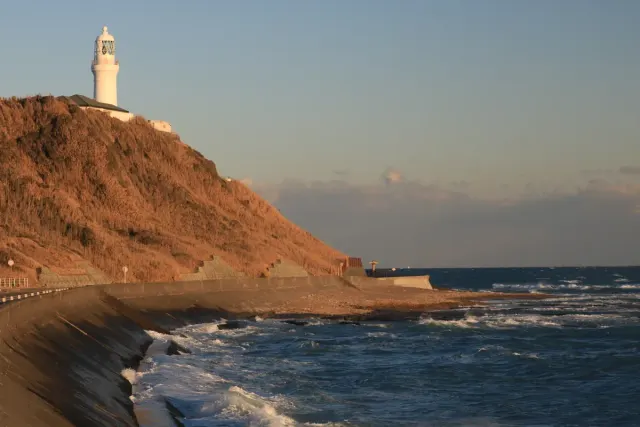
Cape Omaezaki is the southernmost point of Shizuoka Prefecture. It divides Suruga Bay from the Enshu-nada, the open stretch of Pacific to the west. The lighthouse association that runs the tower describes the water off the point plainly. The Kuroshio current meets the currents of the bay here with force, and Omaezaki Rock and many other reefs lie scattered offshore. Sailors feared it for centuries.
The tower stands at 34°35′45″N, 138°13′33″E. From the gallery you can see the Izu peninsula, the Southern Alps and, on a clear day, Mount Fuji, about 96 kilometres away.
A lamp in a paper box
In 1635 the shogunate set up a lantern hall on the point, the Miobi Tōmyōdō. It was a box about 3.6 metres square and 2.8 metres high. An oil lamp burned in the centre, and the three sides facing the sea were screened with oiled paper. Villagers tended it in turns. The shogunate paid for the oil and the paper. It worked for more than 240 years, and ships still went onto the reefs.
On 8 April 1871 a warship built by the former shogunate ran aground on the Seigo-ne reef, directly off the lamp. The new Meiji government rebuilt the lantern as a five-metre platform with an octagonal glass lamp room 2.6 metres across. Five junior keepers lived in a row house beside it. It was a stopgap, and everyone knew it.
Brunton's tower
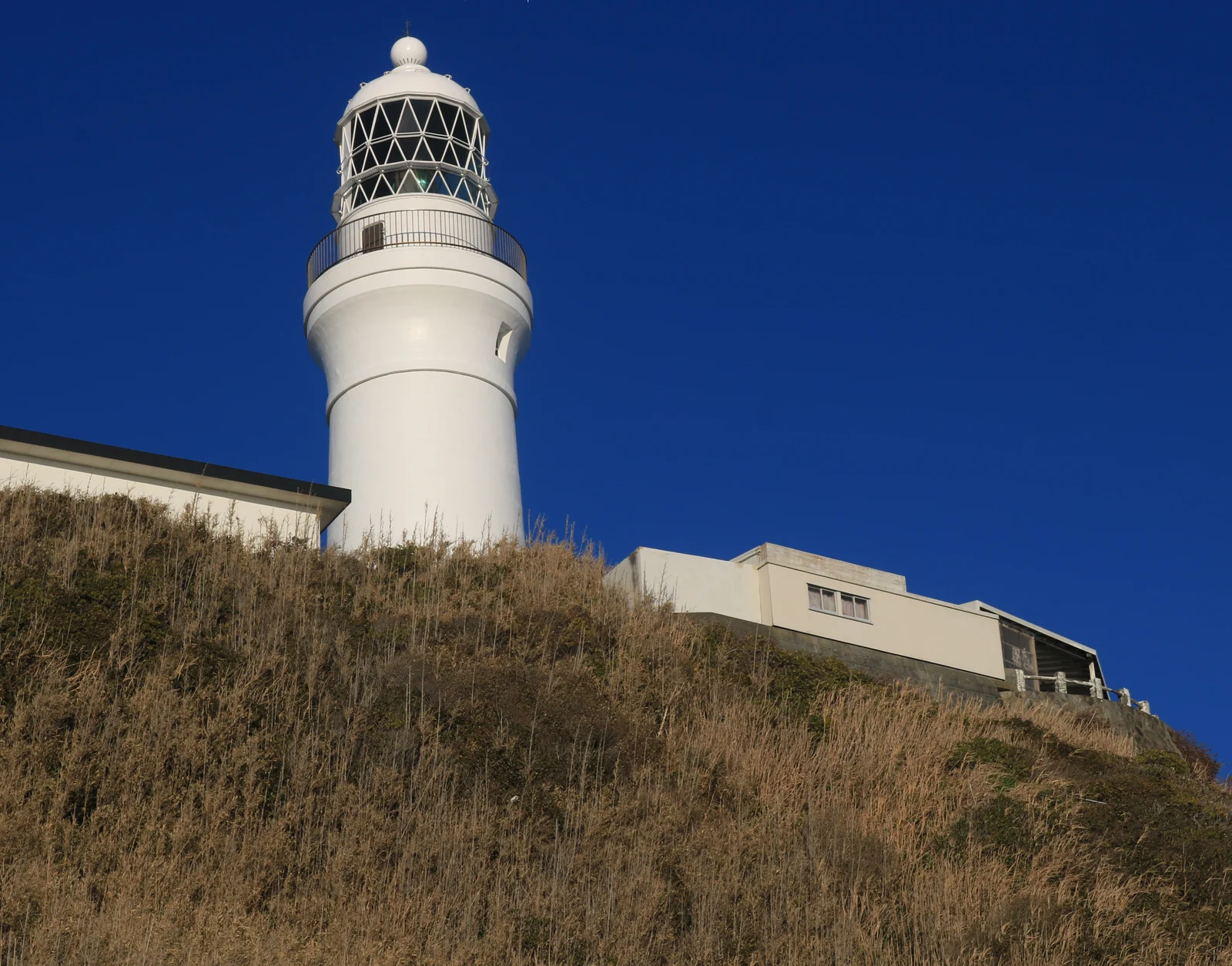
Richard Henry Brunton, the Scottish engineer hired by the Meiji government to light the coast, oversaw the Western-style lighthouse. Work began in 1872. The brick tower was first lit on 1 May 1874. Its lens was a French-made, eight-sided rotating first-order lens, the first of its kind in Japan. The Ministry of Land notes that the original was damaged and a smaller third-order lens is used today.
The tower is 22 metres high. The light sits 17 metres above the ground and 54 metres above the sea. It shows one white flash every ten seconds at 560,000 candela, visible for 19.5 nautical miles, about 36 kilometres.
One white flash every ten seconds, seen 36 kilometres out, from a tower that has stood since 1874.
Shot up, and put back
On 24 July 1945 carrier aircraft and naval gunfire attacked the cape. The lens and lamp were destroyed and the tower was hit many times. Restoration was finished on 24 March 1949, and the tower was returned to its Meiji appearance. On 2 August 2021 the lighthouse and its brick keepers' residence were designated a national Important Cultural Property. The Agency for Cultural Affairs calls it one of Japan's earliest brick lighthouses.
It is one of only sixteen lighthouses in Japan that the public may climb. The stairs are a steep spiral and there is no lift. Entry is a ¥300 donation, paid in cash. Since March 2026 the tower closes from noon to one o'clock for the keepers' lunch, and it closes in strong wind.
The wind
Wind is the fact of the place. The Japan Meteorological Agency's thirty-year normals for Omaezaki give an annual mean of 4.9 metres per second. March averages 5.6 and April 5.1. The city's Long Beach has two faces: Pacific swell on the Enshu-nada side, and shallower, calmer water on the Suruga Bay side. The city says its wind suits windsurfing, and the beach hosts surfing, SUP and national-level contests.
The city newsletter calls Omaezaki the holy ground of Japanese windsurfing. In March 2023 it staged the first event of a new world tour that united the PWA and IWT rankings. In February 2024 the Spicare Omaezaki Japan Cup drew 68 competitors from Japan and abroad. The winner, an American, said the cape offers wind and waves found nowhere else.
The same wind now turns turbines. Chubu Electric's Omaezaki wind farm runs eleven 2,000-kilowatt machines along about ten kilometres of coast. Three began in 2010 and the other eight reached full operation on 28 January 2011. Each rotor is 80 metres across, on a downwind design. The big grey buildings between them are the Hamaoka nuclear plant, shut since 2011; its free museum sits beside it.
The turtles
West of the cape, about two kilometres of beach is a national Natural Monument, designated on 6 March 1980. Loggerhead turtles come ashore here to nest from June to August. Over four years of surveys the average was about 100 landings a year, though numbers vary. Each nest is a hole about 50 centimetres deep holding 100 to 150 eggs, which hatch in about 60 days.
The agency notes that Omaezaki fishermen have long read the turtles as a sign of good catches. They still honour them as deities of the sea. The beach is the northern limit of loggerhead nesting in Japan. A spring call is too early for the turtles; the beach and the Hamaoka dunes beyond it are open all year.
How it happened
- 1635The paper lantern hall
A shogunate oil lamp in a 3.6-metre box, tended by villagers for 240 years
- 1871A warship on the Seigo-ne reef
8 April; the government rebuilds the lamp with a glass lantern room
- 1874Brunton's tower is lit
1 May; Japan's first rotating first-order lens, from France
- 1945Attacked from the air and the sea
24 July; lens and lamp destroyed
- 1949Restored to its Meiji form
Completed 24 March
- 1980The turtle beach is protected
National Natural Monument, 6 March; northern limit of loggerhead nesting
- 2011Eleven turbines on the coast
Chubu Electric's wind farm reaches full operation on 28 January
- 2021Important Cultural Property
2 August; tower and brick keepers' house together
Where this becomes real on your port day
The lighthouse is ten minutes from the berth by shuttle or taxi and fits any call. The turtle beach and dunes are a short taxi further west; the turtles themselves are a summer event.
The vocabulary of the cape
- Omaezaki 御前崎
- The cape and the city. Note the lighthouse is written 御前埼, with the older character for 'cape'.
- Tōmyōdō 燈明堂
- A lantern hall: the oil lamp in a paper-screened box that guided ships here from 1635.
- Kuroshio 黒潮
- The warm Pacific current that meets the bay's water off the point, the reason for the reefs' reputation.
- Enshū-nada 遠州灘
- The open stretch of Pacific west of the cape; the lighthouse divides it from Suruga Bay.
- Akaumigame アカウミガメ
- The loggerhead turtle. About 100 come ashore to nest each summer on the protected beach.
FAQ
Can you climb Omaezaki Lighthouse?
Yes. It is one of sixteen climbable lighthouses in Japan. The stairs are a steep spiral with no lift. Entry is a ¥300 donation in cash. It opens 9:00 to 12:00 every day and again from 13:00; weekday afternoons end at 16:00 from March to October. It closes in strong wind.
Who built Omaezaki Lighthouse?
It was built under Richard Henry Brunton, the Scottish engineer who lit much of Japan's coast for the Meiji government. Work began in 1872 and the light was first shown on 1 May 1874. It replaced a shogunate oil lamp that had burned on the point since 1635.
Can you see Mount Fuji from the cape?
On a clear day, yes, across Suruga Bay. The summit is about 96 kilometres away, more than twice the distance from Shimizu, and no visibility statistics exist for Omaezaki. Treat it as a bonus on a crisp morning, not a plan.
Why is Omaezaki so windy?
It is a headland in the open Pacific. The thirty-year average wind is 4.9 metres per second, higher in spring. That is why the cape hosts world-tour windsurfing, why eleven turbines line the coast, and why the lighthouse shuts its door on the worst days.
More from Omaezaki
Samurai with hoes, river porters without a river, and the tea that came of it
Read →
The keep that went to Kochi and came back in wood
Read →
Japan's deepest bay, its pink shrimp, its whitebait and the eels next door
Read →