
Naksansa
A seventh-century temple on a sea cliff, burned to the ground in 2005 and rebuilt from a painting
The bodhisattva of compassion is said to live on an island in the southern sea. In 671 a monk decided this cliff was it.
Naksansa stands on a headland 12 kilometres south of the cruise berth, in Yangyang County. It faces east over open water, which is the point of it. The temple's name is the Korean short form of Potalaka, the island home of Avalokitesvara. Koreans call that bodhisattva Gwaneum, the one who hears the cries of the world.
Uisang and the red lotus
The Encyclopedia of Korean Culture dates the founding to 671, the eleventh year of King Munmu of Silla. The founder was the monk Uisang, newly back from study in Tang China. The story is that he heard Gwaneum lived in a cave below these cliffs. He prayed on the rocks for seven days and nights. Then the bodhisattva rose from the sea on a red lotus, and he built a hall where bamboo sprang up at the spot.
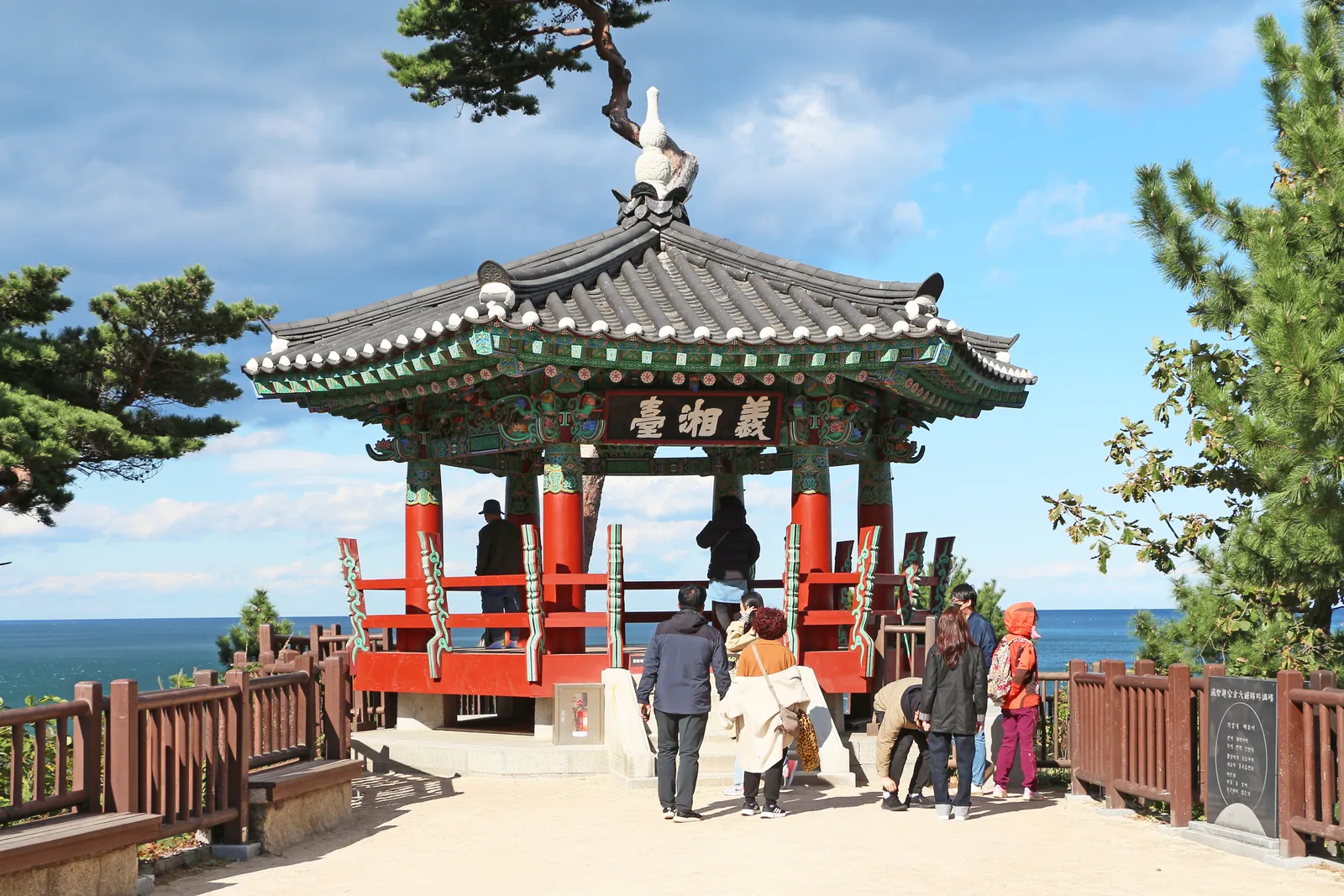
Two places mark the legend. Hongnyeonam, the Red Lotus Hermitage, is built on pillars over the sea cave; a small window in its floor looks down at the water. Uisangdae is the pavilion on the rock where Uisang is said to have sat. The present pavilion dates from 1925. Both were listed together as a Scenic Site on 7 December 2007, and the whole temple became a Historic Site on 18 December 2008.
Burned, and burned again
A temple on a dry, windy coast burns. A forest fire took most of it early in the Goryeo period; the Mongol invasions burned the rest. Royal orders rebuilt it in 1467, 1469, 1631 and 1643. The seven-storey stone pagoda in the courtyard was raised from three storeys to seven in 1467. The Korean War burned it to the ground; an army corps commander had the main hall rebuilt in 1953.
The bronze bell was the treasure that survived everything. The Korea Heritage Service records it as cast in the fifteenth year of King Sejo and designated a Treasure on 19 December 1968. Yejong had it made for his father.
5 April 2005
The fire started at 23:53 on 4 April 2005 beside a road in Yangyang town, five kilometres away. The cause was never fixed; a cigarette was suspected. It was Arbor Day weekend, in the dry spring when the east coast's downslope wind blows at 15 to 20 metres a second. That day the gusts reached 26, then 29. Helicopters could not fly.
By seven in the morning the pines on Naksan beach were burning. The temple was saved once. In the afternoon the fire came back, took the outer gate at about three o'clock and reached the main hall, Wontongbojeon. At 16:42 the temple was recorded as destroyed. The fire burned 973 hectares, 309 outbuildings and the homes of 163 households before it was contained on the morning of 6 April.
The bronze bell that had survived the Mongols and the Korean War melted in its pavilion.
The bell melted in its pavilion. On 7 July 2005 it was struck from the Treasure list. What was left of it is kept in the temple's memorial hall.
Rebuilt from a painting
The temple did not rebuild quickly. Instead it chose to recover its Joseon-era form, and the guide was Naksansado, a painting of the grounds made by Kim Hong-do in 1778. Excavation found that the old foundations matched the painting's layout. Wontongbojeon and the Hongyemun gate were up again in 2007 and the Binillu pavilion in 2009. The encyclopedia lists more halls in 2009, and by 2015 the buildings were complete and the burnt forest recovering.
A 2025 report for the twentieth anniversary gives the figures. About 9.1 billion won went on the buildings between 2005 and 2009. Fire-prevention works and site repair followed, and the project closed in December 2012. Seven years from ash to finished temple.
The bodhisattva who faces the sea
The one thing the fire could not touch was granite. The Haesugwaneum, the Sea Gwaneum, stands on the hilltop above the temple. It is 16 metres tall, carved from about 750 tonnes of stone brought from Iksan in the south-west. The sculptor Kwon Jeong-hwan began in May 1972 and the statue was consecrated on 6 November 1977. She looks out to sea with a vase of healing water in her hand.
Naksansa today is a working Jogye temple with a reputation for sunrise. The east-facing cliff makes it one of the country's New Year viewpoints; Uisangdae at dawn is the picture on every Yangyang brochure. For a cruise passenger arriving at ten, the dawn is not on offer. The cliff path, the cave window at Hongnyeonam and the granite figure on the hill are.
How it happened
- 671Uisang founds Naksansa
Eleventh year of King Munmu; the temple is named for Potalaka, Gwaneum's island
- 1467Royal rebuilding
The courtyard pagoda is raised to seven storeys; further rebuilding in 1469, 1631 and 1643
- 1925Uisangdae pavilion built
On the rock where Uisang is said to have meditated
- 1953Rebuilt after the Korean War
The main hall and bell pavilion, by order of a corps commander
- 1977The Haesugwaneum statue
16 m of granite, consecrated 6 November after five years of carving
- 2005The fire
Started 4 April at 23:53; the temple recorded as lost at 16:42 on 5 April; the bell melted
- 2007Uisangdae and Hongnyeonam listed as a Scenic Site
7 December; Wontongbojeon rebuilt the same year
- 2012Restoration closed
December; buildings rebuilt 2005–2009 from Kim Hong-do's 1778 painting
Where this becomes real on your port day
About 24 minutes by taxi from the berth; the cliff paths to Uisangdae and Hongnyeonam have steps. Hours and any admission fee are not published in a form we could verify.
The vocabulary of Naksansa
- Naksansa 낙산사
- The sea-cliff temple in Yangyang founded in 671; "Naksan" is the Korean short form of Potalaka.
- Gwaneum 관음
- Avalokitesvara, the bodhisattva of compassion; Haesugwaneum is the "Sea Gwaneum" on the hill.
- Uisangdae 의상대
- The 1925 pavilion on the rock where the founder Uisang is said to have sat; a Scenic Site since 2007.
- Hongnyeonam 홍련암
- The Red Lotus Hermitage built over the sea cave of the founding legend, with a window in its floor.
- Naksansado 낙산사도
- Kim Hong-do's 1778 painting of the temple, used as the plan for the rebuilding after 2005.
FAQ
What happened to Naksansa in 2005?
A forest fire began beside a road in Yangyang late on 4 April. Driven by gusts of up to 29 m/s, it reached the temple the next afternoon. The temple was recorded as destroyed at 16:42 on 5 April. The main hall, gates and quarters burned, and the fifteenth-century bronze bell melted.
Is Naksansa original or rebuilt?
Rebuilt, several times. The temple burned in the Goryeo period, under the Mongols, in the Korean War and in 2005. The present halls were rebuilt between 2005 and 2009 to the layout of a 1778 painting, with the project closed in December 2012. Uisangdae dates from 1925 and the stone pagoda from 1467.
How tall is the Naksansa Buddha statue?
The Haesugwaneum is a granite figure of the bodhisattva Gwaneum, 16 m tall. It was carved from about 750 tonnes of Iksan stone and consecrated on 6 November 1977. It stands on the hill above the temple facing the sea.
Can I visit Naksansa from a cruise ship in Sokcho?
Yes. It is about 12 km south of the cruise terminal, roughly 24 minutes by taxi. Holland America's Naksansa tour pairs it with Abai Village and Daepo Port. Allow two and a half hours door to door; the cliff paths have steps.
More from Sokcho
Granite, a 1,300-year-old temple and the queue for a five-minute cable car
Read →
A sandbar settled in 1951 by people who expected to go home by spring
Read →
Squid that is vanishing, pollack that already has, and a chicken alley that queues for an hour
Read →