The Sokcho table
Squid that is vanishing, pollack that already has, and a chicken alley that queues for an hour
The two fish that built this port are both in trouble. What people eat in Sokcho now is partly what is left, and partly what the refugees invented.
Sokcho's own food page explains its table in one sentence. Mountain, sea and lake are on one side. On the other is "the Abai taste" of the displaced Hamgyeong families. Nearly everything worth eating here sits on one of those two lines.
Squid, and where it went
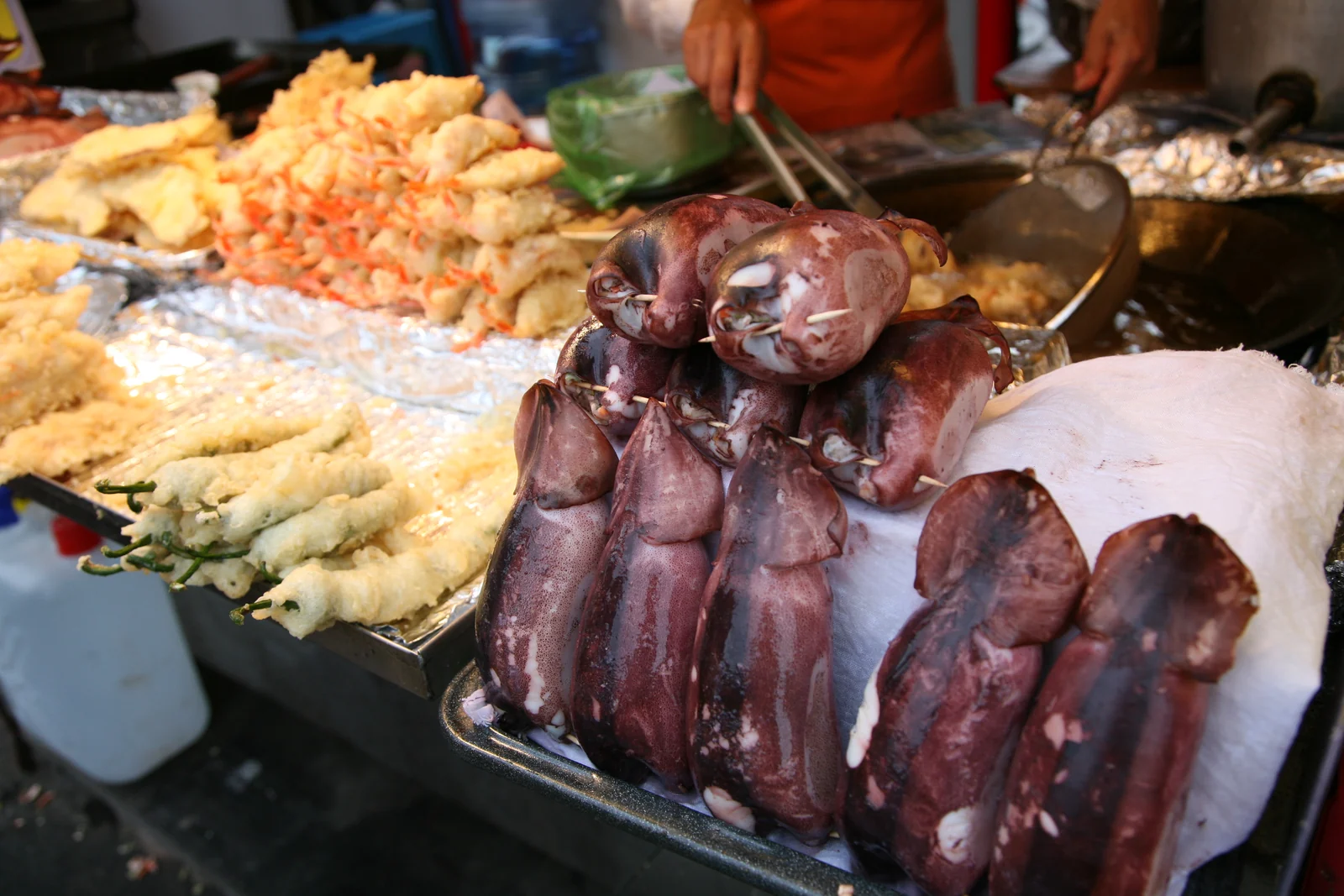
The squid was the fish of this coast, hung in rows to dry on every harbour wall. It is not gone, but it is scarce. Segye Ilbo reported the Gangwon coast's landings in June 2025. They were 8,652 tonnes in 2020, 6,035 in 2021, 3,504 in 2022, 1,365 in 2023 and 852 in 2024. A 2023 report in the same paper gives the longer slide: about 22,000 tonnes in 2004, 9,461 in 2014.
The city's Jangsa Port festival, where visitors caught squid with their bare hands for twenty years, has not been held since 2020. A single squid for sashimi sold at about ₩10,000 in August 2023 and touched ₩25,000 at the peak. Fishermen blame warmer water and foreign fleets; the science is still arguing. The practical point for a passenger is that the dried squid on the stalls may have been landed somewhere else.
The one squid dish that is pure Sokcho is ojingeo sundae. When the refugees could not get pork intestine for their Hamgyeong sausage, they stuffed a whole squid instead. The filling is glutinous rice, radish leaves, carrot, onion and perilla. Steamed, sliced and dipped in mustard-vinegar sauce, it is the dish to order in Abai Village.
Pollack and the drying yards
Pollack is the other ghost. In 1981 the East Sea catch reached a record 160,000 tonnes; Goseong County alone, the next county north of Sokcho, landed 20,000 tonnes that year. By 2007 Goseong's catch was 1,000 tonnes. A 2010 report in the Korea JoongAng Daily blames a 1970 decision to allow the catching of juveniles. Fleets took the young fish through the 1980s. Rules tightened in 1996 did not bring the stock back. By 2010 the national fisheries institute was offering ten times the market price for a single live pollack to breed from.
By 2010 the fisheries institute was offering ten times the market price for one live pollack to breed from.
The pollack trade survives in the drying yards, the deokjang, in the mountains behind the coast. The tourism organization describes the yards at Hoenggye, under the Daegwallyeong pass. Log frames go up in December and the fish are hung from early January. Nights below minus ten freeze them; the sun thaws them by day. Three or four months of that turns the flesh yellow, and the fish becomes hwangtae. The fish come up from the coast at dawn in trucks. The yards once held a million pollack a winter; about twenty remain, and much of the raw fish is now imported.
In Sokcho you meet hwangtae at the table: grilled with chilli paste, or in the breakfast soup hwangtae haejangguk served in the tofu villages. Hamheung naengmyeon, the refugees' cold noodle, is finished with a spicy dressing of raw pollack. The city lists both among its signature dishes.
Mulhoe and the harbour stalls
Mulhoe is raw fish in iced broth, sharp with chilli and vinegar. The city's food page says it is a summer dish, sold wherever live fish is sold. That means Seorak, Daepo, Oeongchi, Dongmyeong and Jangsa harbours, the Abai fish centre and the main market. The autumn cruise calls arrive after the season, but the stalls serve it on request.
Daepo Port, ten minutes south by taxi, is the harbour for this. The city describes it as a fishing port redeveloped as a tourist harbour. At the fish centre you pick the fish and eat it upstairs. The Korean tourism portal adds a 15 to 20 minute path above the harbour with a view back to Ulsanbawi. The grilled-fish houses of Abai Village and the Gaetbae landing serve the day's catch whole. Spanish mackerel, saury, mackerel, sandfish and sand lance come five or six kinds at a sitting.
Dakgangjeong
The dish most Koreans associate with Sokcho is not fish. Dakgangjeong is chicken, fried in a cauldron and tossed in a sweet-hot glaze, sold cold by the box. The city's market, the Sokcho Tourist & Fishery Market and formerly Jungang Market, has a whole alley of it. Each shop fries differently and adds its own touch: perilla, deodeok root, nuts.
The famous name is Mansuk, which a 2015 Gyeongbuk Maeil report dates to 1983 at the market. It fries unfrozen domestic chicken in an iron cauldron above 200 degrees and sauces it in the pan. In 2015 a box was ₩17,000, or ₩18,000 spicy, and the paper noted queues of over an hour on weekdays. The market itself was selected in 2026 for the national K-Tourism Market programme. It has about 450 shops, with fish in the basement and chicken on the street.
What is in season when the ship calls
April: the squid boats are tied up, because April is the closed season. The Korea JoongAng Daily photographed the first catch after it in May 2018. The tofu villages at Haksapyeong and Sinheung are the spring call, with sundubu made from seawater brine. Gomchi-guk, a soup of soft-fleshed snailfish with sour kimchi, is the hangover breakfast of the coast and is served year round.
October: red snow crab. The city's food page says the crab festival comes "with the Seorak foliage" in October. The crab is cheaper than its Yeongdeok cousin and sold by the pile. The 60th Seorak Culture Festival ran from 24 to 26 October 2025 on the Expo lawn and Rodeo Street. A city food week ran around it. Mulhoe is finishing and the winter fish are starting. The sandfish and sand-lance trade runs from November to mid-December, when the city's winter festival sells them grilled on the quay.
How it happened
- 1951The Abai kitchens arrive
Hamgyeong refugees bring sundae, naengmyeon and sikhae; squid stands in for pork intestine
- 1981Peak pollack
A record 160,000 t landed in the East Sea; Goseong alone 20,000 t
- 1983Mansuk Dakgangjeong opens
At Jungang Market, now the Sokcho Tourist & Fishery Market
- 2004Gangwon squid about 22,000 t
The reference year for the decline that follows
- 2007Goseong pollack down to 1,000 t
Twenty-six years after the peak
- 2020Jangsa squid festival stops
Not held since; the coast lands 8,652 t that year
- 2024Gangwon squid 852 t
A tenth of 2020
- 2026The market joins the K-Tourism Market programme
Second phase, with cruise-linked events
Where this becomes real on your port day
On a ten-hour call: sundae in Abai Village at lunch and dakgangjeong from the market to take aboard. Add raw fish at Daepo Port if the taxi budget allows. Carry won; stalls and the Gaetbae machine may not take a foreign card.
The vocabulary of the Sokcho table
- Ojingeo sundae 오징어순대
- Whole squid stuffed with glutinous rice and vegetables and steamed; Sokcho's refugee invention.
- Hwangtae 황태
- Pollack dried through winter freeze-thaw in mountain yards until the flesh turns yellow; grilled or in soup.
- Mulhoe 물회
- Raw fish in iced, sharp broth; a summer dish sold at every live-fish harbour in Sokcho.
- Dakgangjeong 닭강정
- Cauldron-fried chicken in sweet-hot glaze, sold cold by the box in the market's chicken alley since 1983.
- Hongge 홍게
- Red snow crab, the autumn crab of this coast; the city's crab festival comes with the October foliage.
FAQ
What food is Sokcho famous for?
Abai sundae and squid sundae from the refugee village, and dakgangjeong fried chicken from the market's chicken alley. Then raw fish and mulhoe at Daepo Port, and dried pollack dishes from the mountain yards. Red snow crab is the autumn speciality.
Why is squid so expensive in Korea now?
Because the catch has collapsed. The Gangwon coast landed about 22,000 tonnes in 2004 and 852 tonnes in 2024. Warmer water and foreign fleets are blamed. A single sashimi squid sold for ₩10,000 to ₩25,000 in summer 2023.
What is dakgangjeong?
Chicken fried in a cauldron and coated in a sweet, mildly hot glaze, sold cold by the box. Sokcho's market has an alley of shops; the best known, Mansuk, dates to 1983 and had hour-long weekday queues by 2015. It keeps well enough to take back aboard.
What is in season in Sokcho in October?
Red snow crab, whose festival the city ties to the Seoraksan foliage. The late-October Seorak Culture Festival brings a food week to the market area. Mulhoe is ending and the winter sandfish season begins in November.
More from Sokcho
Granite, a 1,300-year-old temple and the queue for a five-minute cable car
Read →
A sandbar settled in 1951 by people who expected to go home by spring
Read →
A seventh-century temple on a sea cliff, burned to the ground in 2005 and rebuilt from a painting
Read →