
Seoraksan
Granite, a 1,300-year-old temple and the queue for a five-minute cable car
Korea's favourite mountain is 14 kilometres from the cruise berth. Its most famous rock is said to have arrived late.
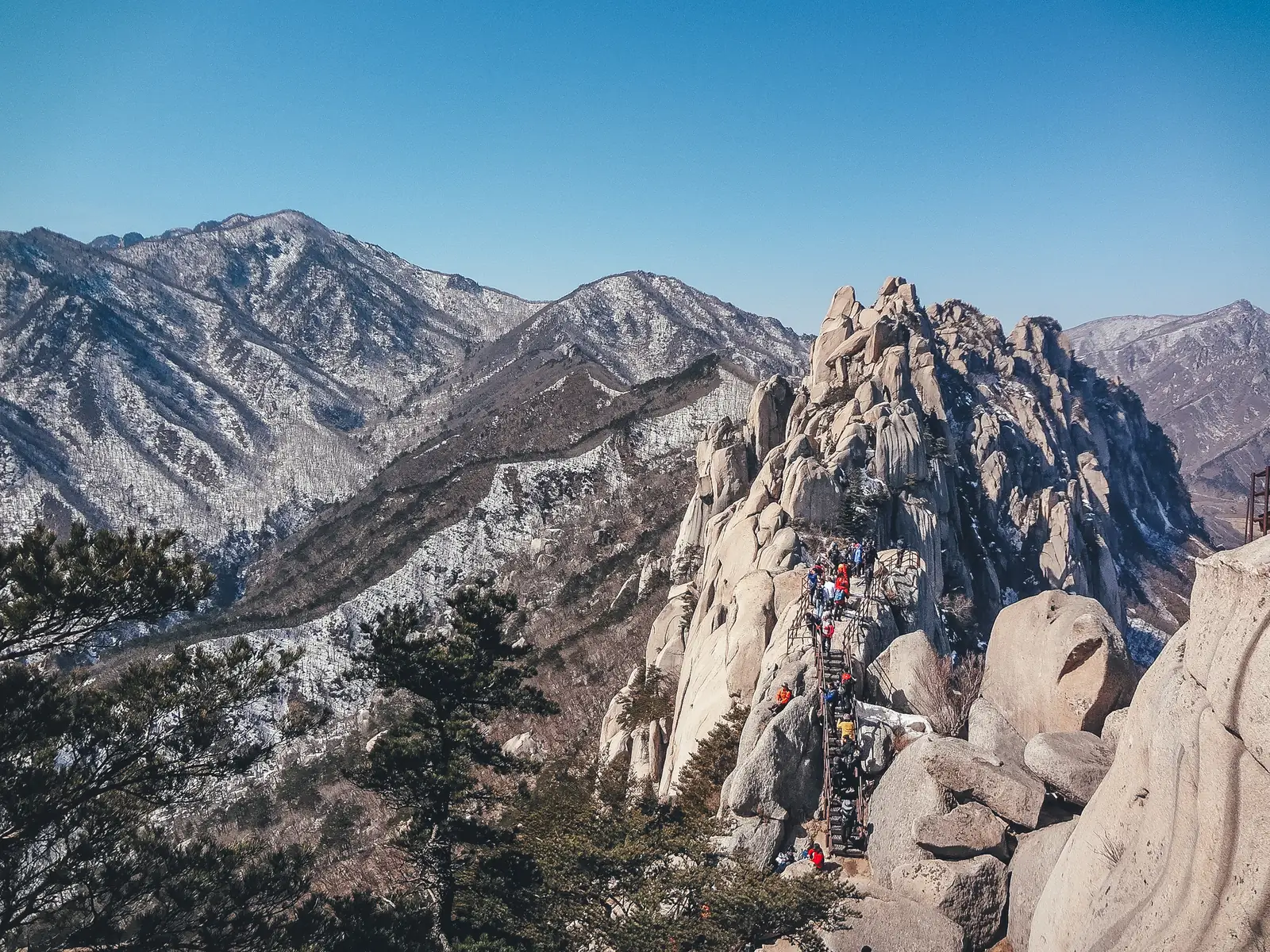
Seoraksan is the mountain behind Sokcho. Its main peak, Daecheongbong, stands at 1,708 metres, and the park service says it is snow-covered for five or six months a year. The name means "snow rock mountain". The park covers about 400 square kilometres across Sokcho, Yangyang, Goseong and Inje, and the park service counts more than thirty high peaks inside it.
The side you see from the ship is Oeseorak, the outer range. Its gate is a park entrance called Sogongwon in the Seorak-dong district. Everything in this story starts there.
Three designations in seventeen years
The mountain was made a Natural Monument in 1965. In 1970 it became Korea's fifth national park, after Hallyeohaesang. In 1982 UNESCO listed it as a biosphere reserve, the first in the country. The Korea Tourism Organization adds that it is on the IUCN Green List of well-managed protected areas.
Those dates matter on a port day. A biosphere reserve is managed for its plants and animals, not for visitors. Trails close in the fire season and the thaw, and the high routes above Biseondae are shut for weeks at a time. The park gate itself stays open.
The rock that arrived late
Ulsanbawi is a wall of six granite peaks on the northern edge of the park. The tourism organization gives its circuit as about four kilometres and its top at roughly 900 metres. A 2013 travel report records it as Scenic Site No. 100 and quotes a height of 873 metres.
The legend explains the name. The god of the sky called every fine peak in Korea to the Geumgang mountains, now in the North. He meant to build the finest range of all. A rock from Ulsan, far down the south-east coast, set off. It was heavy and slow, and it arrived after the places were taken. Too ashamed to go home, it settled in Seoraksan. The tourism organization also offers two plainer readings: the shape of a fence, or the sound of wind crying through the rock.
A rock from Ulsan, heavy and slow, arrived after the places were taken.
The walk to its top from Sogongwon is 3.8 kilometres each way. The park service allows two hours for the climb, with the last kilometre on iron stairs. Most passengers will stop at Heundeulbawi, the rocking boulder, 2.8 kilometres in and an hour's gentle walk. From there the whole wall of Ulsanbawi fills the view.
Sinheungsa and the Buddha of 1997
Ten minutes inside the gate is Sinheungsa, head temple of the Jogye Order's third district. A December 2025 Herald Economy history dates its origin to 652, when the monk Jajang founded Hyangseongsa about a kilometre east of the present site. Fire destroyed it in 698. The monk Uisang rebuilt it nearby around 701 as Seonjeongsa, and that temple stood for roughly nine centuries.
Fire took it again in 1642. Three monks rebuilt it on the present ground in 1644 and named it Sinheungsa. The Geukrakbojeon hall of 1647 survives and is a designated Treasure. In 1995 the temple changed one Chinese character of its name, swapping "divine" for "new" to mark a fresh start for Buddhism on this coast.
What stops every visitor is the Unification Buddha in the forecourt. Work began in 1987 and the eyes were painted at a consecration on 25 October 1997. The seated bronze figure is 14.6 metres tall and weighs about 108 tonnes, on a 4.3-metre pedestal carved with sixteen arhats. The halo behind it is 17.5 metres high. A 1997 newspaper noted it outranked the Kamakura Buddha in Japan, then the largest seated bronze in the world.
The cable car, since 1971
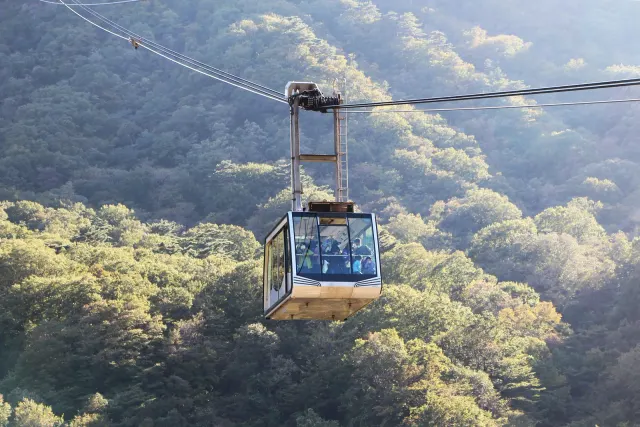
The Seorak cable car leaves from beside the park gate and has run since 1971. It is privately owned. A 2026 Kyunghyang Shinmun report describes a 54-year monopoly on the route. A new law limits cableway permits to twenty years and forces a review of the licence. No change to the service has been announced.
The ride is short: 1,128 metres of cable, about five minutes, to a top station at 699 metres. Tickets are return only; there is no path down. From the top a walk of twenty to thirty minutes over bare rock reaches Gwongeumseong, a ruined hill fort. The tourism organization records a wall of about 2,100 metres, now mostly fallen, and a Goryeo-era date, though the first record is lost.
The legend is simpler than the history. Two strong men, Kwon and Kim, fled up the mountain with their families to escape a war. Kwon fetched stones from the stream below and threw them up; Kim caught them and laid the wall. By morning the fort was built. The name joins their two surnames.
October, and the queue
The park service says the Ulsanbawi route is at its best from mid-October to early November. In 2026 the Korea Forest Service predicted the Seoraksan peak for 20 October, with first colour at Daecheongbong on 28 September. The autumn cruise calls land inside that window.
So do the crowds. Sokcho had 26 million visitors in 2025, and almost all were Korean. The cable-car company's own FAQ says most weekends are busy. The tourism organization warns that in foliage season you can wait more than an hour after buying a ticket. The operator treats 19 September to 15 November as a peak period, when its discounts are suspended. Buy the timed ticket first and walk to Sinheungsa while you wait. If the posted delay passes ninety minutes, let the ride go and walk to Heundeulbawi instead.
How it happened
- 652Hyangseongsa founded
The monk Jajang builds the temple that becomes Sinheungsa, about 1 km east of today's site
- 1644Sinheungsa rebuilt on the present ground
Two years after fire destroyed Seonjeongsa; the Geukrakbojeon hall follows in 1647
- 1965Natural Monument
The first of three national and international designations
- 1970National park
Korea's fifth, after Hallyeohaesang
- 1971The cable car opens
A private company runs the 1,128 m line to Gwongeumseong from then on
- 1982UNESCO biosphere reserve
The first in Korea
- 1997The Unification Buddha
Ten years of work end with the consecration on 25 October; 14.6 m, about 108 tonnes
- 2026Licence review
A new cableway law caps permits at 20 years and sends the 1971 licence to review
Where this becomes real on your port day
From the ship it is a taxi of about 26 minutes to the Sogongwon gate. The cable car, Sinheungsa and the walk to Heundeulbawi fit a ten-hour call; Ulsanbawi's summit does not, unless you give it the whole day.
The vocabulary of Seoraksan
- Seoraksan 설악산
- "Snow rock mountain"; its main peak Daecheongbong is 1,708 m, snow-covered five or six months a year.
- Ulsanbawi 울산바위
- The six-peaked granite wall named for a rock from Ulsan that arrived too late for the Geumgang mountains.
- Sogongwon 소공원
- The park entrance in Seorak-dong where the cable car, Sinheungsa and the trails begin.
- Gwongeumseong 권금성
- The ruined hill fort at 699 m above the cable car's top station; legend says Kwon and Kim built it in a night.
- Tongil Daebul 통일대불
- The Unification Buddha at Sinheungsa, 14.6 m of bronze consecrated in 1997 as a prayer for one Korea.
FAQ
Can you see Seoraksan from a cruise ship in Sokcho?
Yes, on a clear day the range stands behind the town, 14 km from the berth. The best close view for a passenger is Heundeulbawi, an hour's gentle walk inside the park, where the wall of Ulsanbawi fills the sky.
How long does the Seoraksan cable car take?
Five minutes each way on 1,128 m of cable to a station at 699 m. Add twenty to thirty minutes on foot to the Gwongeumseong fort. In foliage season or on a weekend, add an hour or more of queue after buying the timed ticket.
What is the legend of Ulsanbawi?
The sky god summoned every fine peak to the Geumgang mountains in the North. A heavy rock from Ulsan in the south-east arrived after the places were taken and, ashamed, stayed in Seoraksan. The park's tourism pages also offer plainer readings: a fence shape, or the wind crying through the stone.
When is autumn colour at Seoraksan?
The park service calls mid-October to early November the best time on the Ulsanbawi route. For 2026 the Korea Forest Service predicted the peak on 20 October. Expect the cable car's peak-season rules and long queues in those weeks.
More from Sokcho
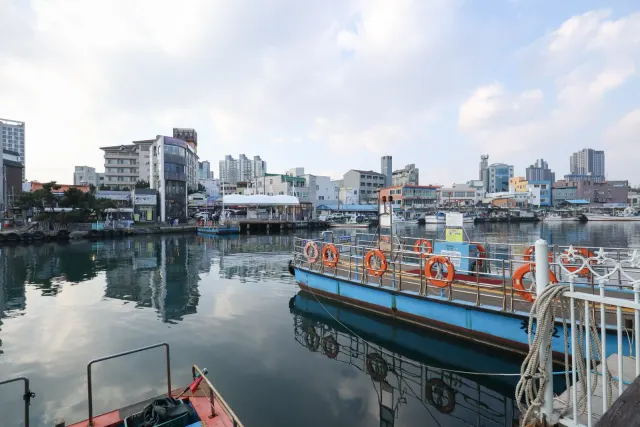
A sandbar settled in 1951 by people who expected to go home by spring
Read →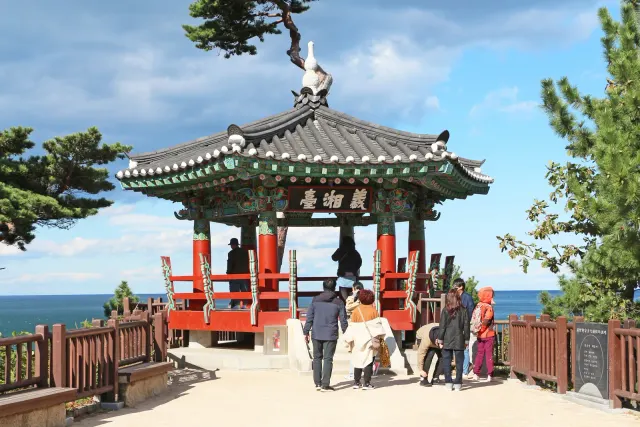
A seventh-century temple on a sea cliff, burned to the ground in 2005 and rebuilt from a painting
Read →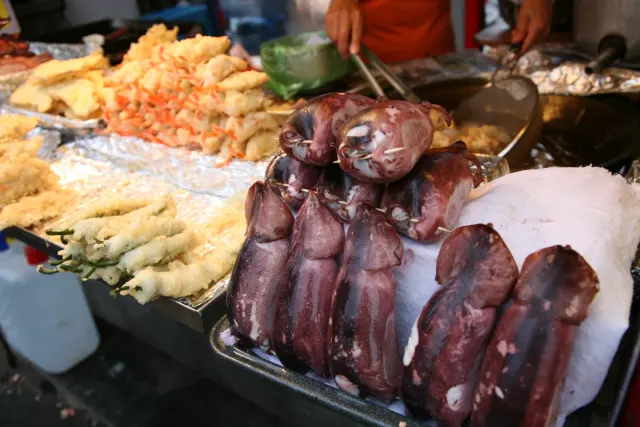
Squid that is vanishing, pollack that already has, and a chicken alley that queues for an hour
Read →