The Yeosu table
Crab that steals rice, sole in vinegar, and a street of carts that opens after you sail
The city publishes a list of ten dishes and calls one of them a rice thief. The rest of the list is a calendar of what the boats bring in, and your call date decides which page you are on.
Yeosu City keeps an official list, the ten tastes of Yeosu. Read it as a menu and a calendar at once. The list runs: Dolsan mustard-leaf kimchi, gejang baekban, seodae-hoe, the seafood table d'hôte called hanjeongsik, and pike eel raw or in shabu-shabu. Then grilled oysters, grilled eel and eel stew, braised hairtail, cockle shabu-shabu, and gizzard shad. Three of the ten are things you can eat on any port day. The others depend on the month.
The rice thief
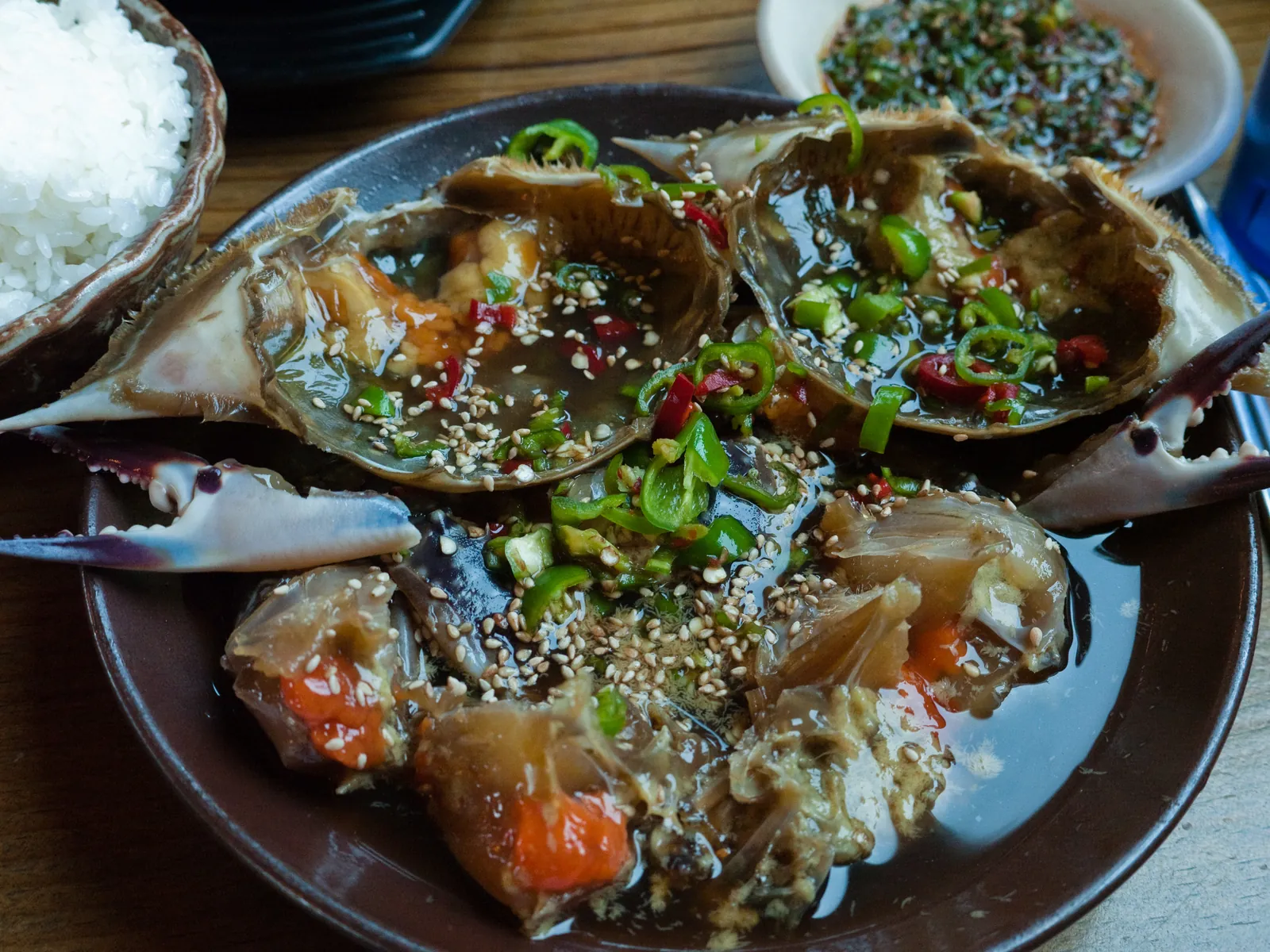
Gejang is raw crab marinated in soy sauce. The city's page calls it a bap-doduk, a rice thief, meaning the sort of side dish that makes a bowl of rice disappear. In Yeosu it is made from a small local crab the fishermen call dolge, stone crab, rather than the blue crab used in Seoul. A baekban is a set: a plate of crab, rice, soup, mustard-leaf kimchi and a dozen small dishes.
The place to eat it is Bongsan-dong, by the harbour, where boats land seafood all year. The restaurants there specialised in crab until the lane was known as gejang alley. In 2009 the city formalised it as the Gejang Baekban Street. The best-known house, Hwangso Sikdang, opens at 08:00 every day and will refill the crab once. The street is a nine-minute taxi from the cruise berth.
A rice thief is a side dish that empties the bowl. Yeosu's is a small crab in soy.
Sole in a year-old vinegar
Seodae is a flatfish, a sole. Yeosu slices it raw and dresses it in a red sauce of chilli paste, ginger and garlic, sharpened with vinegar made from makgeolli, rice wine. That is seodae-hoe. The oldest house, Samhakjip, founded in 1947 by the old-town marine park, brews its own vinegar and ages it for more than a year. The custom is to order a bowl of rice and mix the fish into it with sesame oil and crumbled seaweed. The dish costs about ₩15,000 and the kitchen runs 09:00 to 21:00 daily.
Hairtail
Galchi, the silver hairtail, is the fish of autumn. The boats work the water south-east of the island of Geomundo from July to November. The catch peaks in September and October, around the harvest festival of Chuseok. The Yeosu way is galchi-jorim, thick steaks braised in a chilli broth with radish, and the city lists it among the ten. Samhakjip also grills it plain.
The carts under the bridge
In May 2016 the city set up a row of food carts on the old-town waterfront at Jongpo Marine Park and called it Romantic Pocha. A pocha is a tent bar, the Korean answer to a pub. The carts were a hit, which was the problem. Residents complained of traffic, litter and noise. On 1 October 2019 the row moved a kilometre along the shore to the space under the Geobukseon Bridge. The bridge's managers objected, worried about fire, and lost.
Today there are 18 carts at 102 Hamel-ro, serving seafood in the Yeosu style under the bridge lights with the cable car passing overhead. VisitKorea gives the hours as 18:00 to 01:00 from March to October and 17:00 to midnight from November to February. It closes the first Wednesday of most months. Those hours matter. A ship sailing at 17:00 cannot eat here. The Azamara calls that sail at 20:00 or 22:00 can.
The market by the ferry terminal
The Gyodong fish market sits beside the coastal ferry terminal in the old town. It is a morning market with a history of more than 45 years. In 2013 it was rebuilt under a new arcade for ₩930 million, with shopfronts designed to look like boats. Since 2009 a pipeline 400 metres offshore has fed clean seawater to the live tanks. The hours are 06:00 to 21:00, closed the second and fourth Tuesdays; every cruise call on the current list falls on an open day. Buy a fish downstairs and carry it upstairs, where rooms will cut it and charge for the table and sauces.
March and October
The Westerdam call on 8 March 2027 lands at the end of cockle season. The saejogae of Gamak Bay are dug from January to March. The province recommends them with Dolsan spinach grown in the sea wind, dipped in chilli-vinegar sauce or swirled through a hot broth. The Odongdo camellias peak the same month. Oysters are at the tail of their winter run.
The October calls get the hairtail at its best and the gizzard shad, jeoneo, that the city lists for autumn. Pike eel, the summer fish, is finishing. Gejang, seodae-hoe and mustard-leaf kimchi are there in either month, which is why they anchor the list.
How it happened
- 1947Samhakjip opens
The seodae-hoe house by the old-town marine park; vinegar still brewed in-house
- 2009Gejang Baekban Street
The city formalises the crab lane in Bongsan-dong
- 2009Seawater pipeline for the market
Clean seawater piped 400 m offshore to the Gyodong live tanks
- 2013Gyodong market rebuilt
New arcade for ₩930 million; shopfronts shaped like boats
- 2016Romantic Pocha opens
May; food carts on the Jongpo Marine Park waterfront
- 2019The carts move under the bridge
1 October; relocated to the Geobukseon Bridge after complaints about noise and litter
Where this becomes real on your port day
Gejang in Bongsan-dong or seodae-hoe at Samhakjip is a nine-minute taxi from the berth and fits any call. The pocha street opens at 18:00 from March to October, so it needs a late sailing.
The vocabulary of the table
- Gejang baekban 게장백반
- Soy-marinated raw stone crab served as a set with rice and side dishes; the city's "rice thief".
- Seodae-hoe 서대회
- Raw sole in a chilli dressing sharpened with makgeolli vinegar; mixed into rice at the table.
- Galchi-jorim 갈치조림
- Hairtail braised in chilli broth with radish; the autumn dish, peak September–October.
- Pocha 포차
- Short for pojangmacha, a tent or cart bar; Yeosu's "Romantic Pocha" row has 18 of them.
- Gat-kimchi 갓김치
- Mustard-leaf kimchi from Dolsan island, sharp and peppery; on every Yeosu table.
FAQ
What is gejang and is it safe to eat?
Raw crab cured in soy sauce, served cold with rice. In Yeosu it is made from small local stone crab. Soy curing is the traditional preservation method, and the Bongsan-dong restaurants turn over large volumes daily. Anyone who avoids raw shellfish should order the braised hairtail set instead.
Can I eat at the Romantic Pocha street on a cruise call?
Only on a late sailing. The carts open at 18:00 from March to October and 17:00 from November to February. Westerdam and Noordam sail at 17:00; the Azamara calls sailing at 20:00 or 22:00 can fit an early dinner there.
What is in season in March?
Cockles from Gamak Bay, dug from January to March and eaten with Dolsan spinach, and the last of the winter oysters. Gejang, seodae-hoe and mustard-leaf kimchi are year-round.
Is the fish market open on my call day?
The Gyodong market closes on the second and fourth Tuesdays. None of the listed 2026–27 calls falls on one. Hours are 06:00 to 21:00 and the market takes cards.
More from Yeosu
The naval base, the turtle ship and the hall that took ten years to put back
Read →
A cliff, a sunrise and seven gaps in the rock
Read →
Eight million visitors, two cement silos and the reason your ship docks where it does
Read →