Yi Sun-sin and Yeosu
The naval base, the turtle ship and the hall that took ten years to put back
Korea has one undefeated admiral, and this was his harbour. The war fleet sailed from here and the turtle ship was built here. The hall that marks the spot has just come back from a ten-year rebuild.
Every Korean child can name Yi Sun-sin. He is the admiral who never lost. He fought at least 23 naval battles against the Japanese invasion of 1592–98 and won every one, and historians still argue the count upwards. Yeosu is where he did the work.
In March 1591 Yi arrived in Yeosu to take up the post of Left Naval Commander of Jeolla. The province was split into two naval districts, left and right, as seen from the king in Seoul. The left district faced the Japanese side. Its headquarters, the Jeolla Jwasuyeong, stood on the slope above the present old-town harbour. Yi spent the year before the invasion rebuilding ships, training crews and worrying in his diary about sail cloth.
A ship with a lid on it
The geobukseon, the turtle ship, was not Yi's invention. The name appears in court records a century earlier. What Yi did was revive it as a working warship and bring it into the line. His diary for 1592 records 29 bolts of cloth delivered for the sails in the second month. Sail-making began on the first day of the fourth month. The Japanese landed at Busan days later.
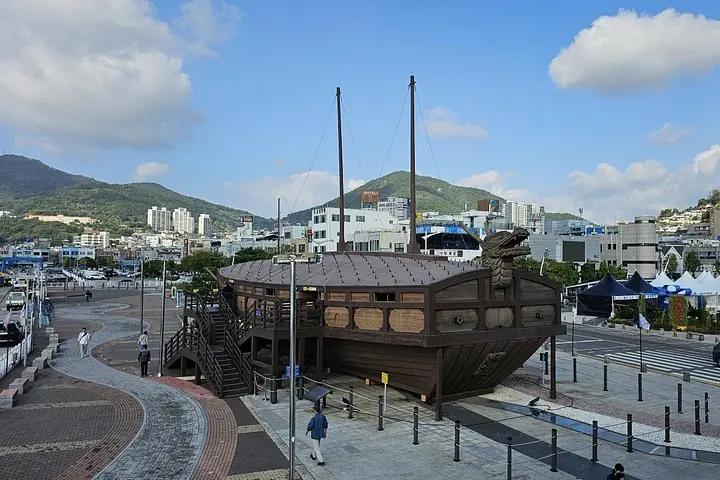
The city's own account describes the design. A board deck covered the rowers, fitted with spikes or blades so that boarding parties had nowhere to stand. A dragon head at the bow held a cannon, and a tail at the stern held another. Six gun ports opened on each side. About ninety men rowed. At the start of the war the Jeolla Left command had three of them. One was its own, one came from Suncheon and one from the Bangdap station on Dolsan island.
The building yards survive. The Yeosu Seonso site has been a Historic Site since 20 April 1995. It keeps the gulgang, a stone-walled basin where ships were built and repaired, hidden behind two small islands. The heritage administration credits Yi and the shipwright Na Dae-yong with building turtle ships here. Two other yards did the same: the main base in what is now Jungang-dong, and Bangdap on Dolsan.
Three turtle ships, one harbour, and a diary that worried about sail cloth.
The summer of 1592
The fleet sailed from Yeosu in June. On 17 June 1592 it destroyed a Japanese force at Okpo, the first Korean victory of the war. About three weeks later, at Sacheon, the turtle ship led the charge for the first time. In mid-August the combined Korean fleet drew the Japanese out into open water off Hansan Island and sank or captured 59 ships. In 1593 the court made Yi commander of the navies of all three southern provinces. He kept the Yeosu base and set up his new headquarters office here in August that year. The main fleet then moved forward to Hansan Island.
The end of the story is well known. Dismissed and imprisoned in 1597 on a false charge, Yi was reinstated after his replacement lost the fleet. With thirteen ships he held the Myeongnyang strait against a Japanese fleet counted at 133 warships. On 16 December 1598, in the last battle of the war at Noryang, a bullet killed him on deck.
Jinnamgwan
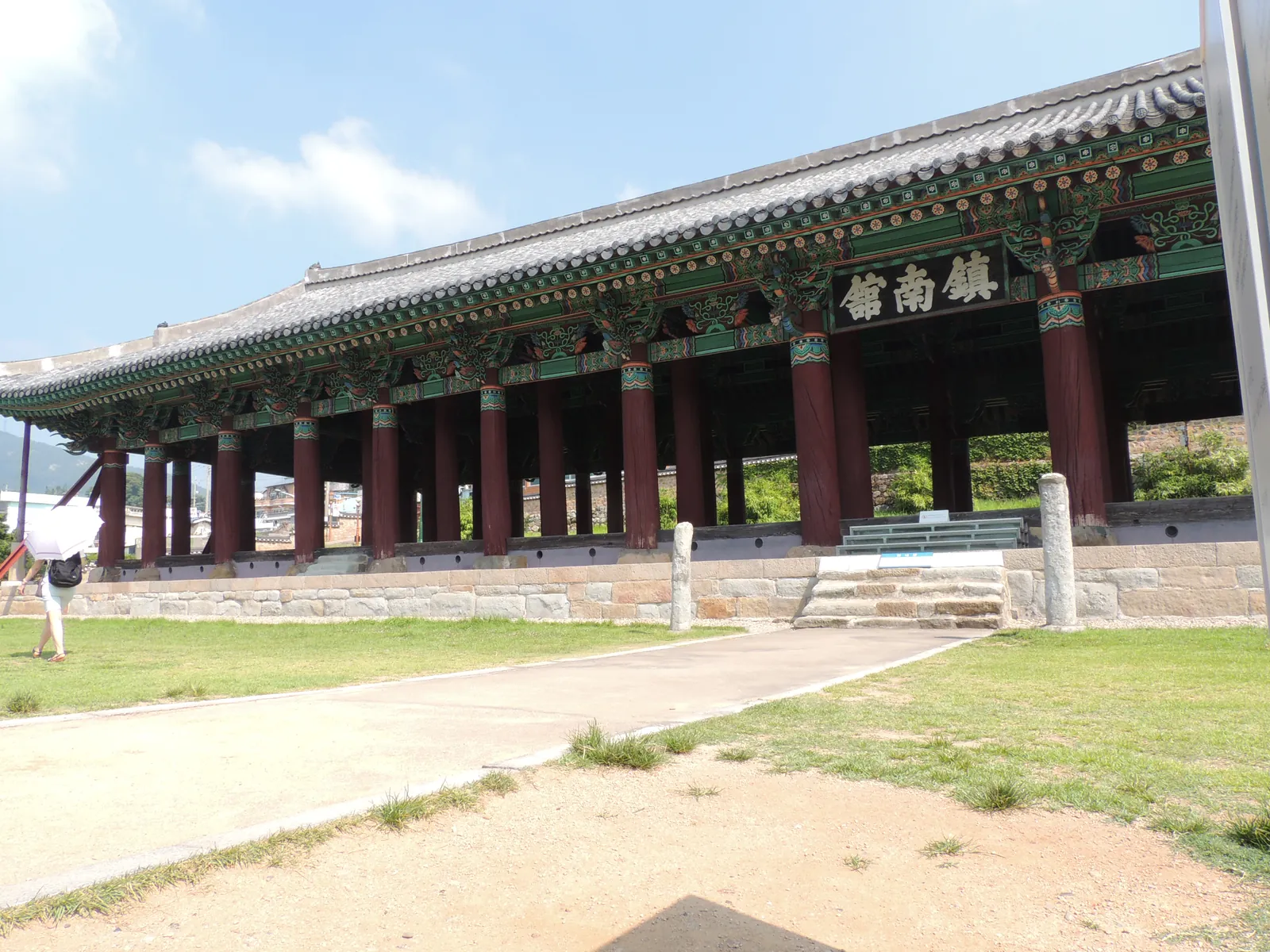
The headquarters building Yi used, Jinhaeru, burned near the end of the war. His successor as commander, Yi Si-eon, built a new hall on the site in 1599 and named it Jinnamgwan, "the hall that pacifies the south". It was a gaeksa, a government guesthouse. Fire took it in 1716 and commander Yi Je-myeon rebuilt it in 1718. That is the building you see.
The numbers are the point. The hall is fifteen bays long and five deep, about 75 metres by 14 metres high, on 240 pyeong of floor. The city notes that outside temples, palace galleries and one royal storehouse, no other Korean building runs to fifteen bays. It calls Jinnamgwan the largest surviving provincial government hall in the country. Dragon heads are carved on the corner and centre columns. It became a Treasure in 1959 and National Treasure No. 304 on 17 April 2001.
In 1911 the Japanese colonial government turned the hall into a primary school and cut away two of its columns. A century of sea air, termites and the lost columns left it unsafe. On 9 December 2015 the city began taking it apart, piece by piece. The job cost ₩19.5 billion. Ten rotten columns were replaced and the two cut by the school were put back, so the count returned from 68 to the original 70. About 54,000 roof tiles were fired by hand in the old way. The city set the public reopening for May 2025, ten years after the scaffolding went up. A small museum on the Imjin War stands at the entrance. Admission is free.
The festival
Yeosu has held a festival for the admiral since 1967, first as the Jinnam Festival, now the Jinnam Geobukseon Festival. It falls in early May to mark the departure for Okpo. It opens with ancestral rites at Chungminsa, then moves to the statue and to a memorial for unknown naval dead. The best-known event is a night street procession in the costume of the naval command. The 60th edition ran from 1 to 3 May 2026 at Yi Sun-sin Square, with a naval departure ceremony and fireworks over the harbour. The city expected 250,000 people. Dates for 2027 were not announced at the time of writing.
The square itself, by the old-town harbour, holds a full-size turtle ship you can board, free. It is a 35-minute walk or a seven-minute taxi from the cruise berth, and Jinnamgwan is five minutes further up the hill.
How it happened
- 1591Yi Sun-sin takes command at Yeosu
Arrives in March as Left Naval Commander of Jeolla; rebuilds the fleet
- 1592The turtle ship goes to war
Sail cloth delivered in the second month; first charge at Sacheon in July
- 1593Commander of three provinces
Headquarters office set up in Yeosu in August; the fleet moves forward to Hansan Island
- 1598Death at Noryang
Killed on 16 December in the last battle of the war
- 1599Jinnamgwan built
Yi Si-eon raises the hall on the burnt site of Jinhaeru
- 1718Rebuilt after fire
Yi Je-myeon rebuilds the hall destroyed in 1716; this is the present building
- 2001National Treasure No. 304
Designated 17 April; a Treasure since 1959
- 2015–2025Taken apart and put back
Dismantled from 9 December 2015; ₩19.5 billion; 70 columns and 54,000 new tiles
Where this becomes real on your port day
Jinnamgwan and Yi Sun-sin Square are free, walkable from the berth and open every day. Together they take about ninety minutes. The Seonso shipyard site is a taxi ride west and is for the committed.
The vocabulary of Yi Sun-sin's Yeosu
- Geobukseon 거북선
- The turtle ship: a covered, spiked warship revived by Yi Sun-sin; first in action at Sacheon in 1592.
- Jeolla Jwasuyeong 전라좌수영
- The Jeolla Left Naval Command, the base at Yeosu from which the 1592 fleet sailed.
- Jinnamgwan 진남관
- "The hall that pacifies the south": the 1599 guesthouse on the headquarters site, rebuilt in 1718.
- Gulgang 굴강
- The walled basin at the Seonso site where turtle ships were built and repaired.
- Gaeksa 객사
- A government guesthouse that also held the king's tablet; Jinnamgwan is the largest surviving one.
FAQ
Was the turtle ship really built in Yeosu?
Yes. The heritage administration lists three building sites in Yeosu. They are the Seonso basin, the main naval base in what is now Jungang-dong, and the Bangdap station on Dolsan. Yi's own diary records sail cloth arriving for the ship in early 1592.
Is Jinnamgwan open again?
Yes. The hall was dismantled for restoration from December 2015 and the city set its public reopening for May 2025. Hours are 09:00 to 17:00 in winter and to 18:00 in summer, every day, free.
Why is Jinnamgwan a National Treasure?
It is a fifteen-bay, single-storey timber hall about 75 metres long, the largest surviving provincial government building in Korea. Outside temples and palaces, no other Korean building has fifteen bays. It was named National Treasure No. 304 in April 2001.
When is the Geobukseon Festival?
Early May each year, timed to the fleet's departure for the Battle of Okpo. The 60th edition was 1 to 3 May 2026. No cruise call on the current list falls in that window.
More from Yeosu
A cliff, a sunrise and seven gaps in the rock
Read →
Eight million visitors, two cement silos and the reason your ship docks where it does
Read →
Crab that steals rice, sole in vinegar, and a street of carts that opens after you sail
Read →