A lacquer they call idiotic, embroidery that dodged a law, and glass born from fishing floats
Three crafts from one cold corner of Japan, each of which exists because someone was denied something: warmth, cotton, or a market that had just vanished.
Craft traditions usually get explained by aesthetics. Tsugaru's are better explained by constraint. Every one of the three began with a prohibition or a collapse, and every one of them turned the problem into the product.
In the Edo period, peasants in the Tsugaru domain were forbidden to wear cotton or silk. Hemp only — in one of the coldest inhabited regions of Japan. Hemp cloth is thin, it frays, and it does not hold heat.
The women found the gap in the law. Cotton cloth was banned; cotton thread was not. So they embroidered white cotton thread densely into indigo hemp, counting over odd numbers of warp threads, until the fabric thickened, insulated and held together. Three hundred years later, kogin-zashi is one of Japan's most admired textile traditions, and its diamond geometry is a survival hack that outlived the law it evaded.
The base motifs are called modoko, and they carry names as domestic as their origins: neko no ashi, cat's paw. Eastern and western Tsugaru developed different pattern vocabularies, and the neighbouring Nambu domain went its own way with hishi-zashi, worked over even thread counts and using colour more freely.
Cotton cloth was illegal. Cotton thread was not. Three hundred years of beauty came out of that loophole.
Lacquerware came to Tsugaru under the fourth lord of the Hirosaki domain in the mid-Edo period, when the lacquerers Ikeda Genbei and his son developed the technique regarded as the origin of Tsugaru-nuri. It reached the Vienna World Exposition in 1873, and in 1975 became a nationally designated Traditional Craft — still the only one in Aomori Prefecture.
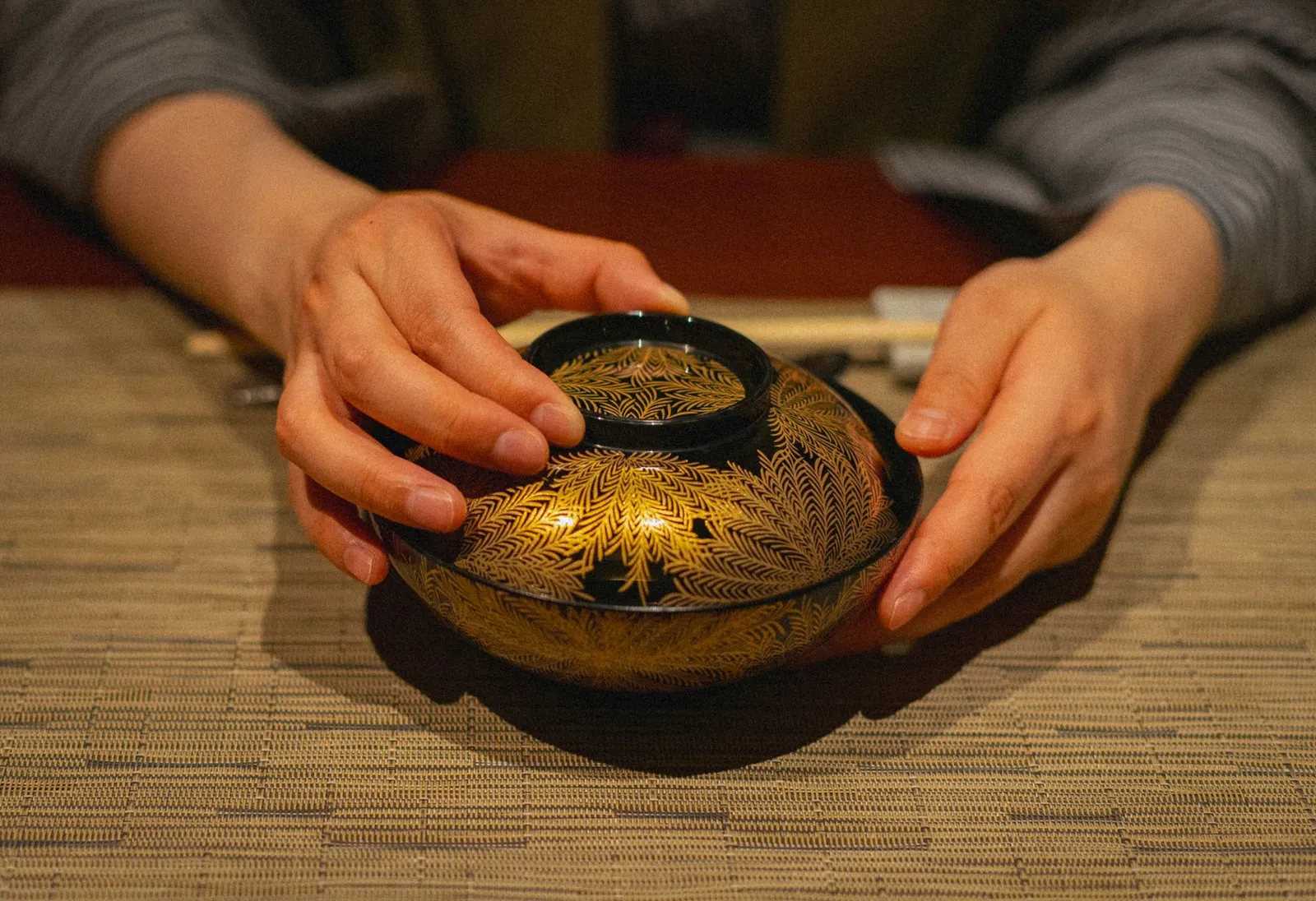
The method is what earns the reputation: forty-eight steps over roughly two months. Many layers of differently coloured lacquer are built up on a base of local hiba cypress, then ground and polished back down until the pattern emerges out of the layers. The pattern is not painted on. It is excavated.
Locals call it baka-nuri — "fool's lacquer," or more bluntly, idiot lacquering, because only a fool would put that much labour into one bowl. They say it with pride. The justification is that the result survives decades of daily use, which the alternative does not.
Four styles survive, all still made: kara-nuri, the famous mottled marbling; nanako-nuri, "fish-roe lacquer," patterned with rapeseed seeds pressed into wet lacquer and lifted out; monsha-nuri, gloss black on matte black; and nishiki-nuri, the elaborate "brocade" built on a nanako base.
This is my favourite of the three, because nothing about it was planned. A glassworks opened in Aomori in 1949 making glass floats for the fishing industry — scallop aquaculture was booming in Mutsu Bay and the fleet needed them by the thousand. By 1973 the company was the largest producer of glass fishing floats in Japan, on a reputation for floats that did not break.
Then plastic arrived and the business died overnight.
What survived was the skill: free-blowing, perfected on millions of floats. The craftsmen turned it on vases and vessels instead, and in 1977 the line was reborn as Tsugaru Vidro — vidro being the Portuguese word for glass, a loanword left behind by sixteenth-century contact. A 1949 float factory in the far north of Japan ended up carrying a four-hundred-year-old Portuguese name.
And the colours were an accident. The glass was originally clear; a craftsman experimented with a handful of sand from a beach on the Sea of Japan coast and it came out an unrepeatable green. Because Aomori was too isolated to buy coloured glass reliably, the works began making and stocking its own — which is why the palette today runs to dozens of proprietary colours nobody else has.
Kogin-zashi begins as a way to make hemp survivable in the northern cold
Under the fourth lord of Hirosaki; forty-eight steps, two months per piece
Tsugaru lacquer's first international recognition
Scallop aquaculture in Mutsu Bay is booming
Then plastic floats end the market entirely
Still the only nationally designated craft in Aomori Prefecture
The float-blowing technique becomes an art glass line, coloured by beach sand
Craft shops cluster in the waterfront complexes near the berth and in Hirosaki. Small vidro pieces and kogin accessories travel best; lacquer is the investment.
A counted embroidery from Aomori's Tsugaru region: dense white cotton thread stitched into indigo hemp in diamond geometry. It began as a workaround for an Edo-period law that forbade peasants from wearing cotton cloth — cotton thread was permitted, so women used it to thicken and insulate hemp against the northern cold.
Because it takes forty-eight steps and about two months to make one piece: many coloured layers are built up and then ground back until the pattern emerges. Locals call it baka-nuri — only a fool would work that hard on a bowl — and they say it with pride, since the result survives decades of daily use.
Aomori art glass that began in 1949 as a factory making glass floats for the fishing industry. When plastic floats destroyed that market, the craftsmen redirected their free-blowing skill into vases and tableware, launching Tsugaru Vidro in 1977. Its signature colours came from an experiment with sand from a local beach.
The six nights Aomori builds all year for
Read →
The three-string instrument that learned to shout
Read →
The town that stood here for 1,700 years, without farming
Read →
Three saplings, some unemployed samurai, and 60% of Japan's crop
Read →No typing needed — jump straight in:
Just docked? — the gangway toolStart from your shipThe ride from every berthAsk the editorGlossary