
Home / Fushiki–Toyama / Culture
Culture & history · Fushiki–ToyamaOwara Kaze no Bon
Three nights to calm the wind, and a float given by a warlord
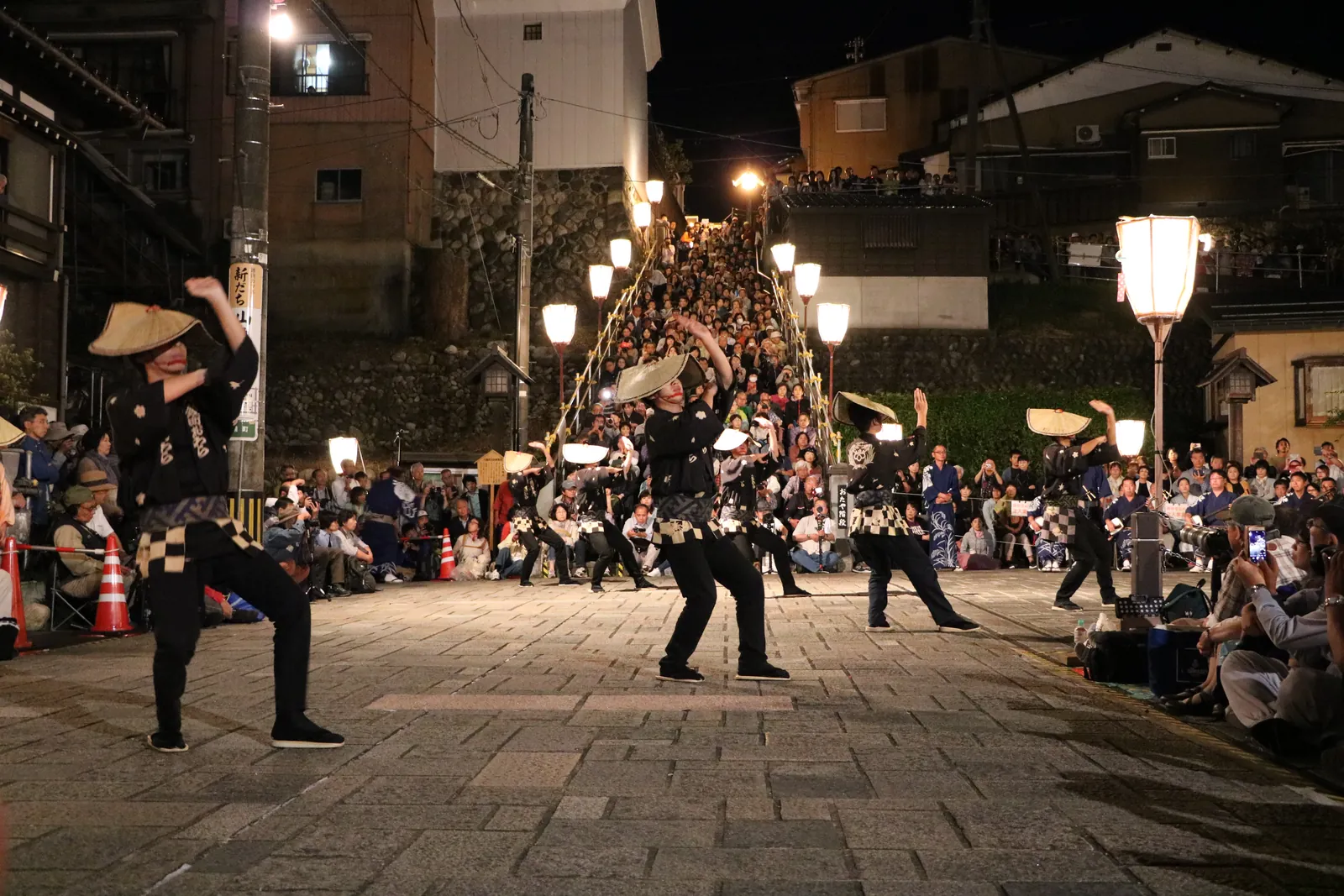
On the 210th day of the year, when the typhoons come, a hill town dances all night under straw hats. The fiddle sounds like grief. Nobody shouts. That is the point.
From 1 to 3 September, the old town of Etchū Yatsuo, south of Toyama, puts lanterns along its sloping streets and dances. The dancers wear matching yukata or happi coats and deep woven straw hats, amigasa, pulled low over the face. Behind them walk the musicians: singers, a chant leader, shamisen and a drum. Then comes the instrument that gives the festival its sound, the kokyū, a small bowed fiddle. The committee that runs the event describes the shamisen as carrying the tune and the kokyū as following it with a mournful tone.
Eleven neighbourhoods each take their own route from about five in the evening. In 2026 the streets are given over to it from 17:00 to 23:00 on the first two nights and from 19:00 on the third.
Why the wind
1 September is nihyaku-tōka, the 210th day counted from the start of spring in the old calendar. It falls in typhoon season and was feared as the day the wind came for the rice. The festival is a prayer to the wind god to stay calm until harvest. "Bon" here is not the Buddhist festival of the dead. In Yatsuo dialect a bon was simply a day off, as in "sowing bon" and "planting bon". A wind holiday.
Three hundred years, loosely
The committee is candid that no clear document records when Owara began. Its own account starts in March 1702. Townspeople paraded for three days and nights to celebrate the return of the permit that had founded the town. The Toyama City museum pamphlet says the song dates from the Genroku era, 1688 to 1703, and claims "more than 300 years". Both are careful with the word "said".
The dancing is far younger than the song. The committee dates it to 1911, when geisha improvised steps at a newspaper's anniversary party. The three dances you see today were shaped in the twentieth century. The old toyonen dance keeps gestures of sowing and reaping. The men's dance was choreographed by the Japanese-dance master Wakayagi Kichisaburō. The women's dance was made by the painter Kosugi Hōan for his song cycle Yatsuo Shiki, later extended with a sequence of catching fireflies. A mixed dance was added by one neighbourhood in 1968.
The man credited with pulling all this together is Kawasaki Junji, remembered as the father of Owara's restoration. The Yatsuo Owara Museum stands on the site of his house at 2105-1 Higashi-machi. It shows the writers and artists he brought to town, among them the poet Noguchi Ujō. It opens 9:00 to 17:00 for ¥210.
The song is three hundred years old. The dance is a hundred. The hats are the reason you cannot tell.
How to watch it
The prefecture counted 190,000 visitors over the three nights in 2025. This is a town with few restaurants, no convenience stores and narrow streets where stalls are not allowed on the road. The committee's advice is practical: bring water and a snack, bring a torch for the slopes, keep your phone down, and do not shout. The dancers pass close enough to touch; do not.
The pre-festival evenings in late August were not held in 2026. Travel agencies sell evening packages from Toyama Station with reserved viewing; the committee lists them. If you are here only by day, the museum's film is the honest substitute.
The other festival: a warlord's cart
Takaoka's spring festival is the opposite in every way: one day, by daylight, loud, and built around objects rather than steps. The Mikurumayama are seven festival floats paraded through central Takaoka on 1 May from 11:00 to 18:00, fifteen minutes on foot from Takaoka Station.
The origin is a gift chain. In 1588 Toyotomi Hideyoshi welcomed the emperor to his Kyoto palace, Jurakudai, with an ox-drawn court carriage. The carriage passed to Maeda Toshiie, founder of the Kaga domain. When his son Toshinaga built Takaoka Castle in 1609, he gave it to the townspeople. They copied it and mounted a spear on top in the Kyoto Gion manner. Then they covered the result in the metalwork, lacquer and textiles Takaoka was becoming famous for. Ten merchant wards still own and pull the seven floats; the Nibanchō float is the only one on two wheels.
The designations are a collector's set. In 1960 the floats became the first in Japan listed as Important Folk Cultural Materials. In 1976 they were re-designated Important Tangible Folk Cultural Property. In 1979 the festival itself became an Important Intangible Folk Cultural Property, a double listing held by only five festivals nationally. On 1 December 2016 UNESCO inscribed it among the 33 Japanese float festivals on its Intangible Cultural Heritage list. The prefecture counted 128,000 visitors in 2025.
Outside May, the Takaoka Mikurumayama Kaikan, opened in 2015 at 47-1 Moriyama-machi, shows a real float all year, rotating the display every three months. Admission is ¥450, hours 9:00 to 17:00, closed Tuesdays.
How it happened
- 1588A carriage at Jurakudai
Hideyoshi's court cart for the imperial visit; later given to Maeda Toshiie
- 1609Toshinaga gives it to Takaoka
The townspeople turn the cart into festival floats
- 1702Yatsuo parades for three nights
The committee's own starting point for Owara, March of that year
- 1911Owara gains a dance
Geisha improvise steps at a newspaper anniversary
- 1960First floats designated in Japan
Mikurumayama listed as Important Folk Cultural Materials
- 1979The Takaoka festival itself is listed
Important Intangible Folk Cultural Property; one of five double listings
- 2016UNESCO
1 December: Mikurumayama among 33 Japanese float festivals inscribed
Where this becomes real on your port day
Owara needs the first three nights of September and a late sailing or an overnight. Mikurumayama needs 1 May. The two museums cover every other day of the year.
The vocabulary of the festivals
- Owara おわら
- The Yatsuo folk song and its festival; the name's origin is disputed between "laughter", "straw" and a village.
- Kaze no Bon 風の盆
- "Wind holiday" — bon here is dialect for a day off, held on the 210th day when typhoons threaten the rice.
- Amigasa 編笠
- The deep woven straw hat that hides every dancer's face.
- Kokyū 胡弓
- The small bowed fiddle that follows the shamisen; the sound the festival is known for.
- Mikurumayama 御車山
- Takaoka's seven festival floats, descended from a 1588 court carriage, paraded every 1 May.
FAQ
When is Owara Kaze no Bon?
1 to 3 September every year in Etchū Yatsuo, Toyama City. In 2026 the street dancing runs 17:00 to 23:00 on 1 and 2 September and 19:00 to 23:00 on 3 September. The late-August pre-festival evenings were not held in 2026. Rain stops the dancing.
How crowded is it?
The prefecture counted 190,000 visitors over the three nights in 2025, in a small hill town with few restaurants and no convenience stores. Bring water, a snack and a torch, keep quiet, and do not touch the dancers. Travel agencies sell evening packages from Toyama Station with reserved viewing.
What is the Takaoka Mikurumayama festival?
A procession of seven ornate floats through central Takaoka on 1 May. They descend from a court carriage Hideyoshi used in 1588, given to the town by Maeda Toshinaga in 1609. It holds both tangible and intangible national designations and was inscribed by UNESCO in 2016. A real float is displayed all year at the Mikurumayama Kaikan, admission ¥450.
More from Fushiki–Toyama
Hell, paradise and a wall of snow, 3,000 metres above the bay
Read →
Seven casters, one lord, and four centuries of bronze
Read →
A fish tank a kilometre deep, and the three creatures that define it
Read →
Use it first, pay later: the sales idea that built a prefecture
Read →