
Home / Fushiki–Toyama / Culture
Culture & history · Fushiki–ToyamaTateyama
Hell, paradise and a wall of snow, 3,000 metres above the bay
For a thousand years people believed hell was up there, in the steaming valley behind the peaks. Then a road went through it, and the view from the beach has not changed at all.
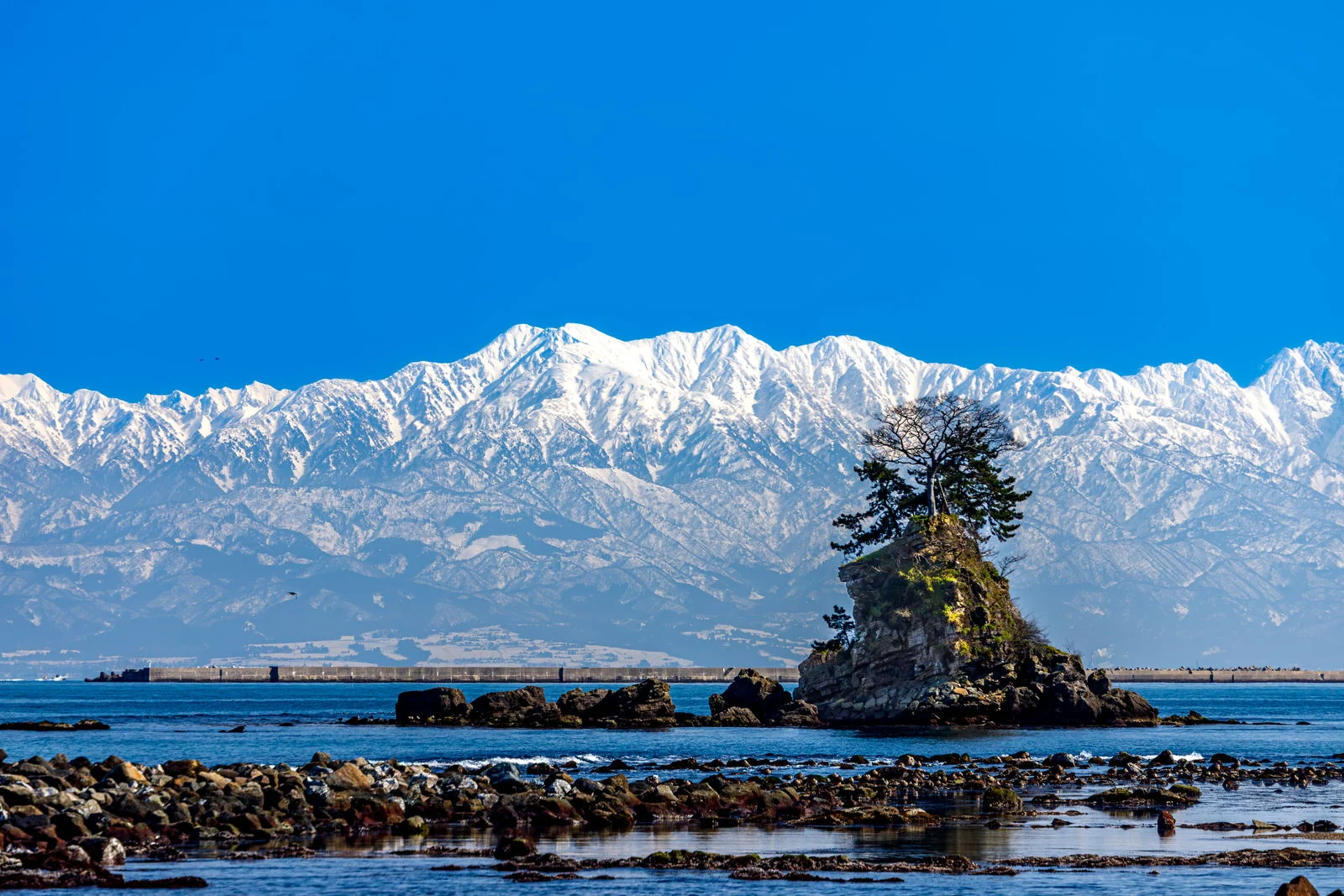
Stand on the shore at Amaharashi on a clear winter morning and the mountains appear to rise out of the water. They are the Tateyama range, a line of 3,000-metre peaks at the northern end of the Japan Alps. The prefecture likes a single number for this. The summits stand at about 3,000 metres and the bay floor drops to 1,000, a 4,000-metre fall within one small prefecture. The prefectural fisheries institute calls the distance from alpine ground to deep sea simply "short".
Mount Fuji and Mount Hakusan complete the set of Japan's three sacred mountains. Tateyama is the one you can see from a cruise berth.
A mountain with a hell in it
From the earliest poetry, Tateyama was a place where gods lived, and people worshipped from shrines at its foot rather than climbing. From the Heian period Buddhism arrived, and the mountain became a centre of shugendō, the ascetic mountain faith. Pilgrims practised Tateyama zenjō, a climb towards enlightenment. On the way they passed Jigokudani, a valley of boiling springs and sulphur, and a rust-red pond called the Blood Pool. They took these as literal hell.
The eleventh-century tale collection Konjaku Monogatari states it flatly: in Japan, those who sin fall into the hell of Tateyama. The Tateyama Museum of Toyama used the line as the opening of its 2026 exhibition on the subject.
Hell, paradise and the founding legend, all on one painted scroll, carried door to door across Japan.
The mandala as a sales tool
In the Edo period the Kaga domain protected the mountain faith, repairing the summit shrine and maintaining lodgings and bridges. Monks from the two temple villages at the foot, Iwakuraji and Ashikuraji, travelled the country to spread it. Their instrument was the Tateyama mandala, a large painting showing the hells, the paradise and the story of the mountain's opening. A monk would unroll it in a village, explain each scene, and invite the listeners to make the pilgrimage.
The two villages grew rich on the pilgrims who came. The museum's permanent collection holds several of the mandalas, including one designated an Important Tangible Folk Cultural Property.
The women who were not allowed up
Women were barred from climbing Tateyama until the ban was lifted in March 1872. Edo-period teaching went further, telling women that they faced "five obstructions and three obediences" and that falling into hell was certain for them. Ashikuraji's answer was a ceremony: the Nunobashi Kanjōe, held each year on the middle day of the autumn equinox.
The women dressed in white, the colour of burial shrouds. At the Enma Hall, in "this world", they received judgement from the king of hell. Then, blindfolded, they were led across the Nunobashi, the cloth bridge, along a strip of white cloth about a metre wide. The bridge stood for the river between the living and the dead. Serpents were said to wait below, and a foot off the cloth meant hell. On the far bank, in "the other world", stood the Uba Hall. To cross and return was to die and be reborn, and so to be assured of paradise.
The Meiji government's separation of Shinto and Buddhism destroyed the Uba Hall and ended the rite. It was revived in 1996, after 136 years, and has been held every third year since. The 2026 ceremony falls in September; the next after that is due in 2029. In 2011 it was registered as a Future Heritage.
The road through hell
The Tateyama Kurobe Alpine Route began as an industrial plan. Toyama Prefecture drew it up in 1952. The first cable car opened in 1954 and the highland bus reached Murodo in 1964. The tunnel under the summit ridge opened in April 1971. The whole route, 37.2 kilometres from Tateyama Station in Toyama to Ōgizawa in Nagano, opened on 1 June 1971. It uses six different vehicles, including cable cars, a ropeway and electric buses in tunnels, and climbs a maximum of 1,975 metres.
The high point for most visitors is Murodo, at 2,450 metres. From there a path climbs in about two hours to the summit shrine on Mount Oyama, 3,003 metres, the sacred heart of the old faith. The highest of the three Tateyama peaks is Ōnanji, at 3,015 metres. The snow-free climbing season runs from mid-July to mid-September.
The snow wall
When the route opens each spring, the road to Murodo is cut through drifts. The walls stand over 15 metres, and close to 20 in heavy years. Visitors walk the cutting, known as Yuki no Ōtani, the Great Snow Valley. In 2026 the route opened on 15 April and the wall measured 12 metres. Murodo is about fifteen degrees cooler than the lowlands, so the walls last until around late June.
Seeing it from the sea
Toyama Bay joined the Most Beautiful Bays in the World club in October 2014, one of five Japanese bays in the group. The prefecture says the view of 3,000-metre peaks across open water is close to unique. It adds that the steepness of the drop from summit to sea floor has no equal anywhere.
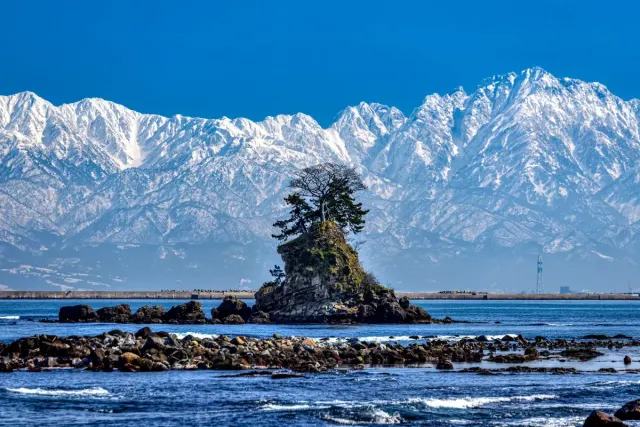
The place to see it is Amaharashi coast in Takaoka, five minutes on foot from Amaharashi Station on the JR Himi Line. Poets have praised the spot since the eighth century. It is one of the scenic places linked to Bashō's Narrow Road to the Deep North. The small pine-topped islet in the foreground is Onna-iwa. Photographers come at sunset; in 2025 the coast drew 400,000 visitors. Parking at the roadside station is free.
How it happened
- 11th centuryTateyama hell enters literature
"Konjaku Monogatari" states that Japan's sinners fall into the hell of Tateyama
- Edo periodMandala monks travel the country
Iwakuraji and Ashikuraji spread the faith under Kaga domain protection
- 1872Women allowed on the mountain
The ban is lifted in March; Meiji policy has already ended the bridge rite
- 1952The Alpine Route is planned
A prefectural development scheme; cable-car construction begins in December
- 1971Full route opens on 1 June
37.2 km across the Alps, six vehicles, maximum climb 1,975 m
- 1996The cloth bridge ceremony returns
Revived after 136 years; now held every three years
- 2014Toyama Bay joins the Most Beautiful Bays club
October; the view of the range across the water is cited
Where this becomes real on your port day
Amaharashi is the practical choice on a port day: a short train ride and a beach. The Alpine Route is a full day and needs the route to be open, mid-April to November.
The vocabulary of Tateyama
- Tateyama 立山
- The sacred range east of Toyama; its main peak Oyama is 3,003 m, its highest, Ōnanji, 3,015 m.
- Tateyama mandara 立山曼荼羅
- The painted scroll of hells, paradise and the founding legend, used by monks to preach across Japan.
- Jigokudani 地獄谷
- "Hell valley" — the steaming sulphur valley near Murodo that pilgrims took for the real thing.
- Nunobashi Kanjōe 布橋灌頂会
- The cloth-bridge rite for women barred from the mountain; revived 1996, held every third year.
- Yuki no Ōtani 雪の大谷
- The snow wall cut for the road to Murodo each spring; 12 m in 2026, up to about 20 m in heavy years.
FAQ
Can you see the Tateyama mountains from Toyama Bay?
Yes, on clear days. The peaks stand at about 3,000 metres and the bay floor drops to 1,000 metres, so the range rises almost straight out of the water. The classic viewpoint is Amaharashi coast in Takaoka, five minutes on foot from Amaharashi Station; winter and early spring give the clearest air.
When does the Tateyama Kurobe Alpine Route open?
The route opens in mid-April each year; in 2026 it opened on 15 April. The snow wall at Murodo is at its tallest then: over 15 metres in a normal year, 12 metres in 2026. It lasts until around late June.
What is the Nunobashi Kanjoe?
A ceremony created in the Edo period for women, who were barred from climbing Tateyama until 1872. Dressed in white and blindfolded, they cross a cloth bridge from "this world" to "the other world" and back, a symbolic death and rebirth. It was revived in 1996 and is held every three years, most recently in September 2026.
Is the Alpine Route possible on a cruise call?
Only on a long call. Toyama Station to Murodo takes about two and a half hours each way, and the route is weather-dependent. The museum in Ashikuraji and the view from Amaharashi are the realistic ways to meet the mountain in a day.
More from Fushiki–Toyama
Seven casters, one lord, and four centuries of bronze
Read →
A fish tank a kilometre deep, and the three creatures that define it
Read →
Use it first, pay later: the sales idea that built a prefecture
Read →
Three nights to calm the wind, and a float given by a warlord
Read →