Updated 1 October 2026 · 25 official and operator sources · Researched from official timetables, operators and the port authority · Takumi Yamada
Miyako, on Iwate's Sanriku coast (not Miyakojima in Okinawa), is a small port with two big reasons to get off: Jodogahama, a cove of white rock spires and pines ten minutes by taxi from the ship, and Taro, 20 minutes up the coast by train, where a ten-metre seawall failed in 2011 and a guide shows you why. Every ship ties up at Fujiwara Wharf, about 3 km from Miyako Station. On the typical 9–10-hour call you can do both if you book the 60-minute Taro guide ahead and fit your day to a sparse train timetable. On an 8-hour call, do Jodogahama and lunch well, and add Taro only by taxi or on a tight train pairing with about ten minutes to spare. The one decision is whether you want the 2011 story as well as the scenery.
Your call, your day
What fits the time your ship gives you?
Pick your ship from the official Miyako schedule — or just the hours you have — and this page picks the plan and the tours that fit, with the hour before all-aboard already set aside.
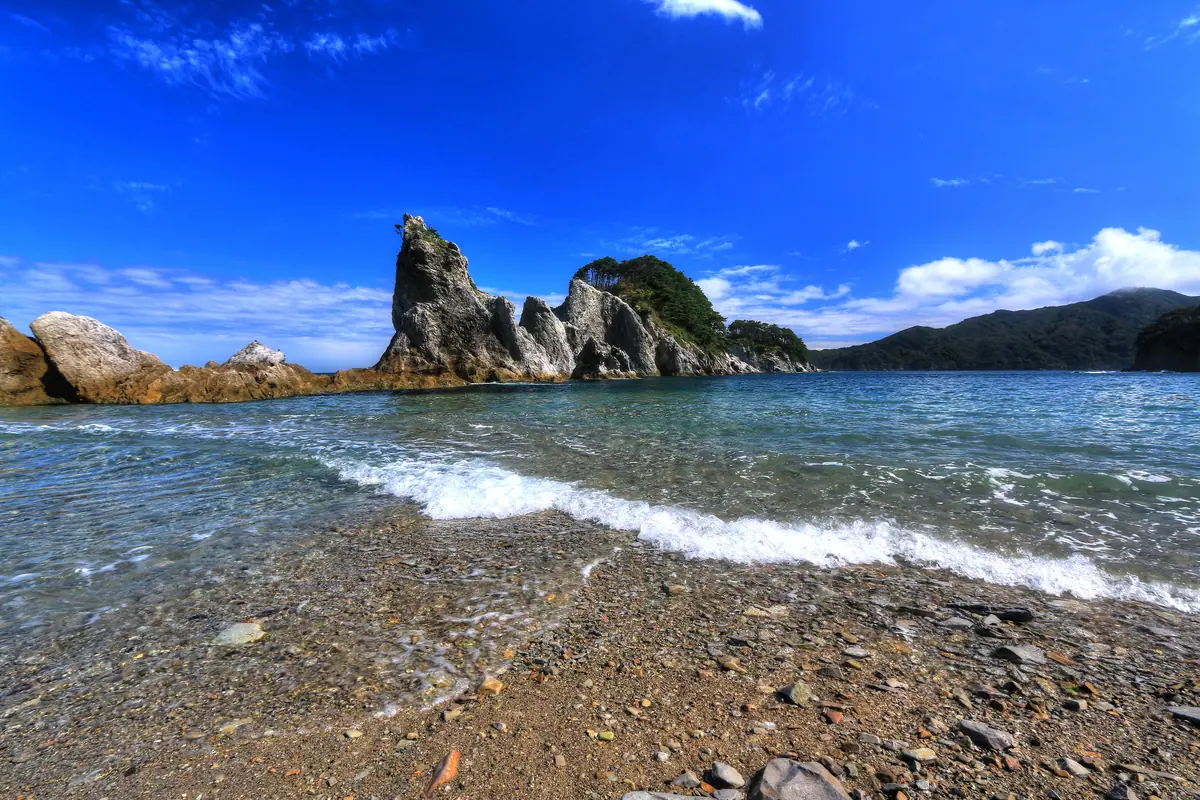
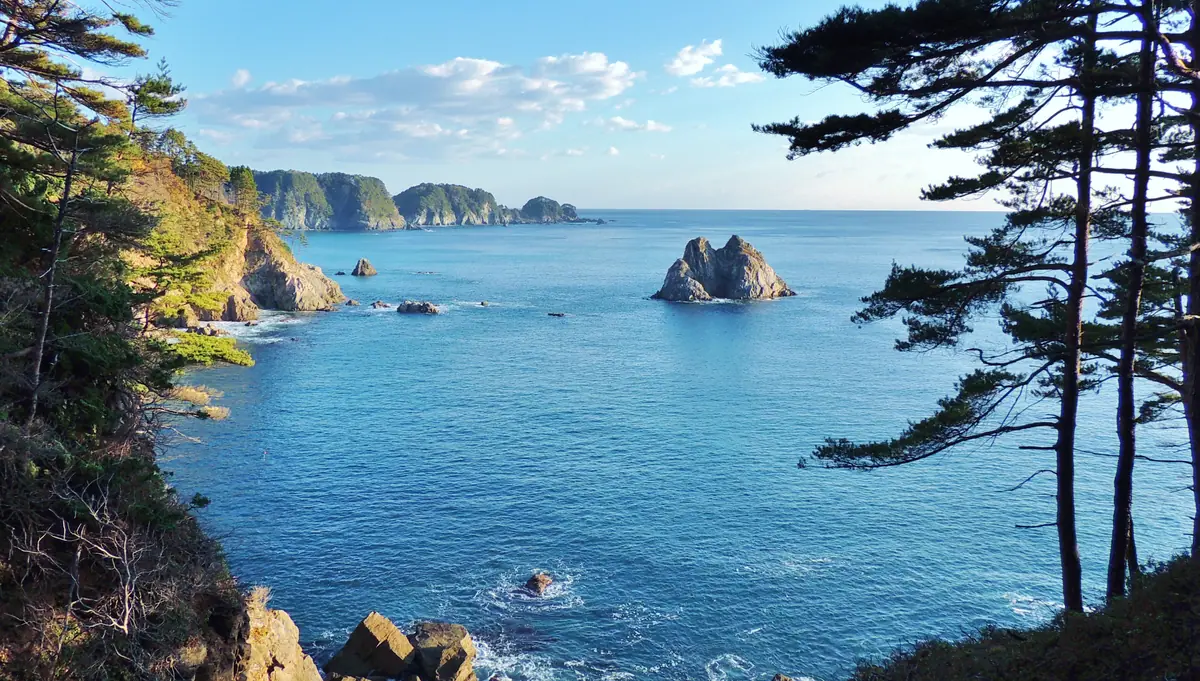
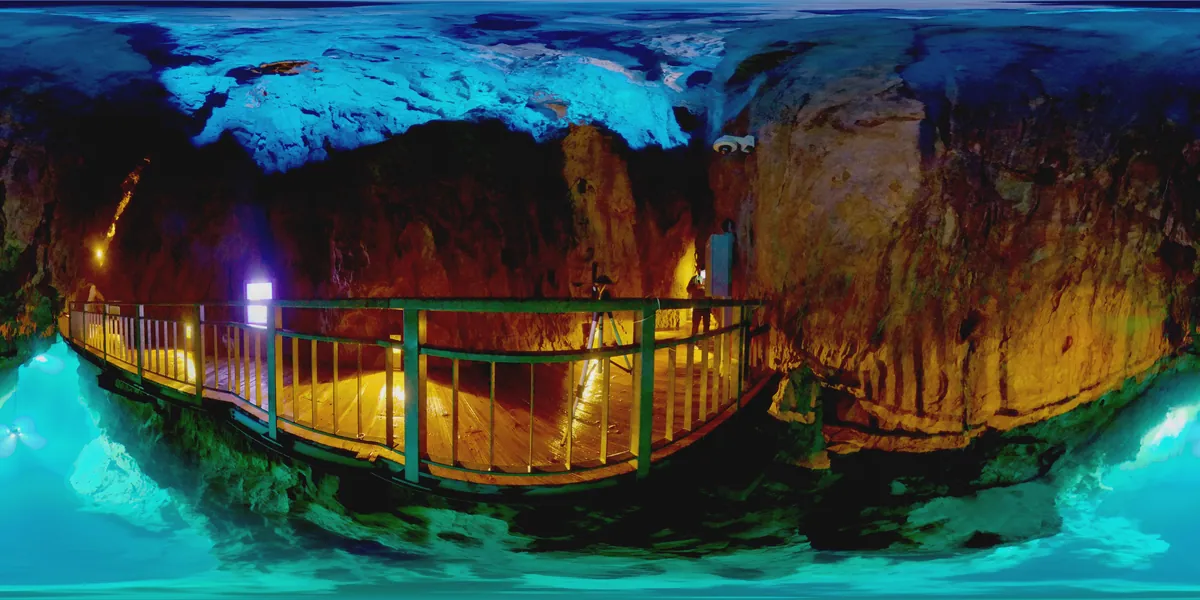
White rhyolite spires and pines in a sheltered cove, named in the 1680s by a monk who said it was just like the Pure Land, and a national Place of Scenic Beauty since 2012. A small open sappa boat takes you into the Blue Cave, where the water glows, in about 20 minutes.
From the shipTaxi from Fujiwara Wharf about 10–15 minutes (roughly ¥2,000–2,500, our estimate). Or the Umineko-maru boat from Desaki pier, 10 minutes and ¥600. Or the Kenpoku bus from Miyako Station, 24 minutes. The sappa boat costs ¥2,000, no reservations.
Taro built a 10 m, 2.4 km seawall after the tsunamis of 1896 and 1933. In 2011 the wave went over it and 181 people in Taro died. A local guide takes you onto the wall, shows footage filmed on the day and walks you through the Taro Kanko Hotel, flooded to its fourth floor and kept as it was.
From the shipSanriku Railway from Miyako Station, about 20 minutes and ¥510, but only four useful departures (9:22, 10:48, 12:37, 15:01). Taxi about 15–25 minutes (roughly ¥5,000–6,000 one way, our estimate). The 60-minute guide costs ¥5,000 for 1–9 people and must be booked.
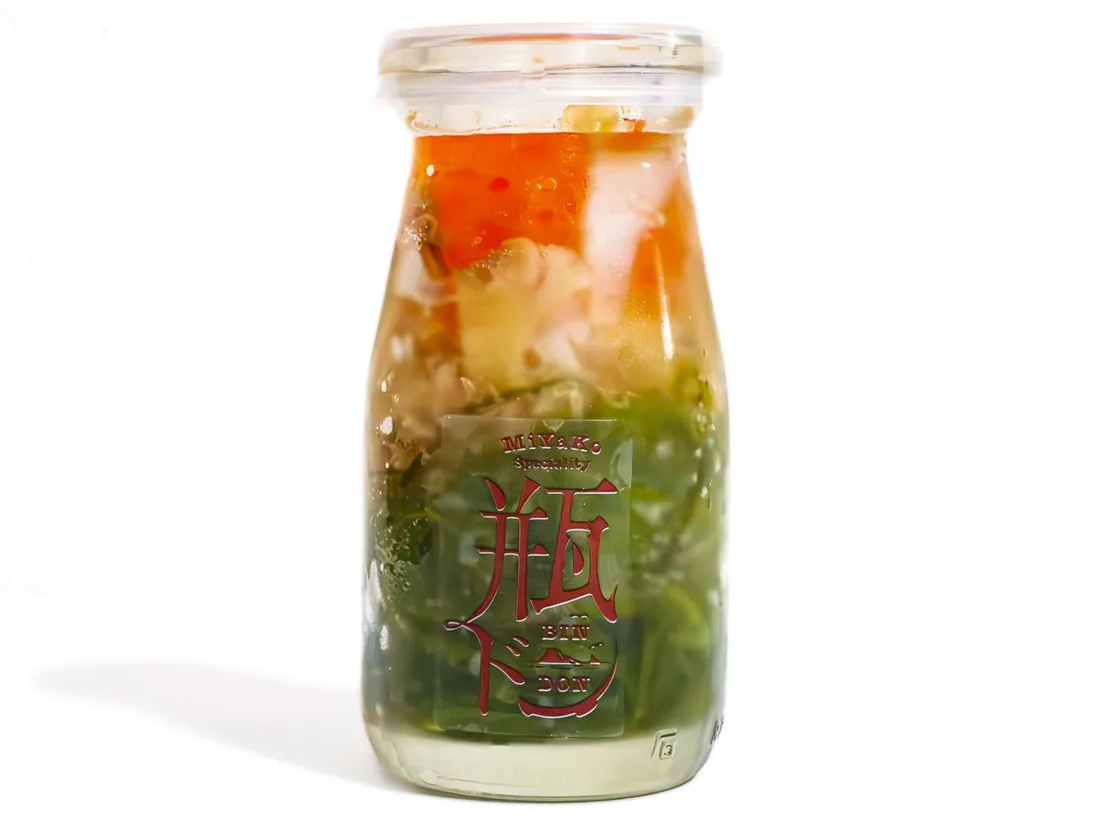
Seafood packed in a milk bottle and poured over rice, a local idea that grew from the habit of keeping fresh sea urchin in bottles. The Japan Tourism Agency calls it Miyako's new local dish; it is the thing to eat or carry home.
From the shipThe Gyosai Market is an 11-minute walk from Miyako Station (6:30–17:30, closed Wednesdays). Bottled bin-don products are sold at Seatopia Naado on Desaki pier, where the Umineko-maru leaves.
Start with the name, because cruise booking engines get it wrong: this is Miyako in Iwate, a fishing port on the Sanriku coast of northern Honshu, not Miyakojima in Okinawa. It is a small town with a big harbour and two reasons to cross the gangway.
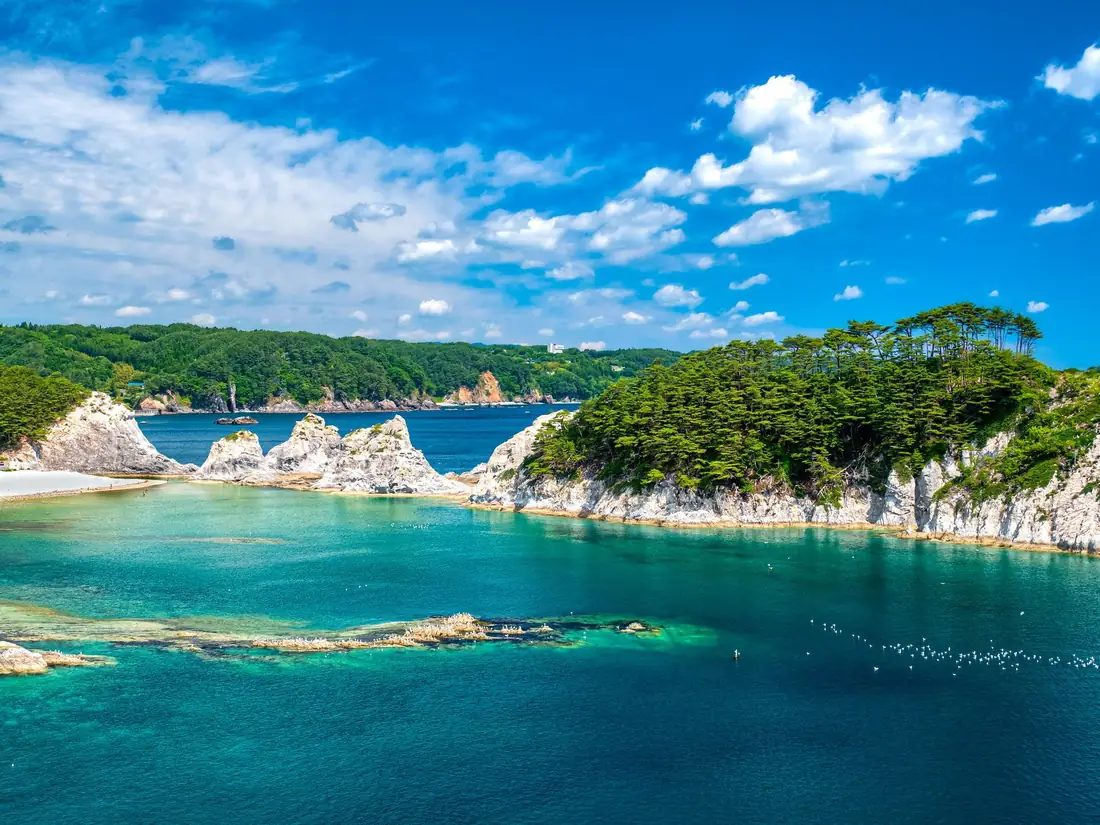
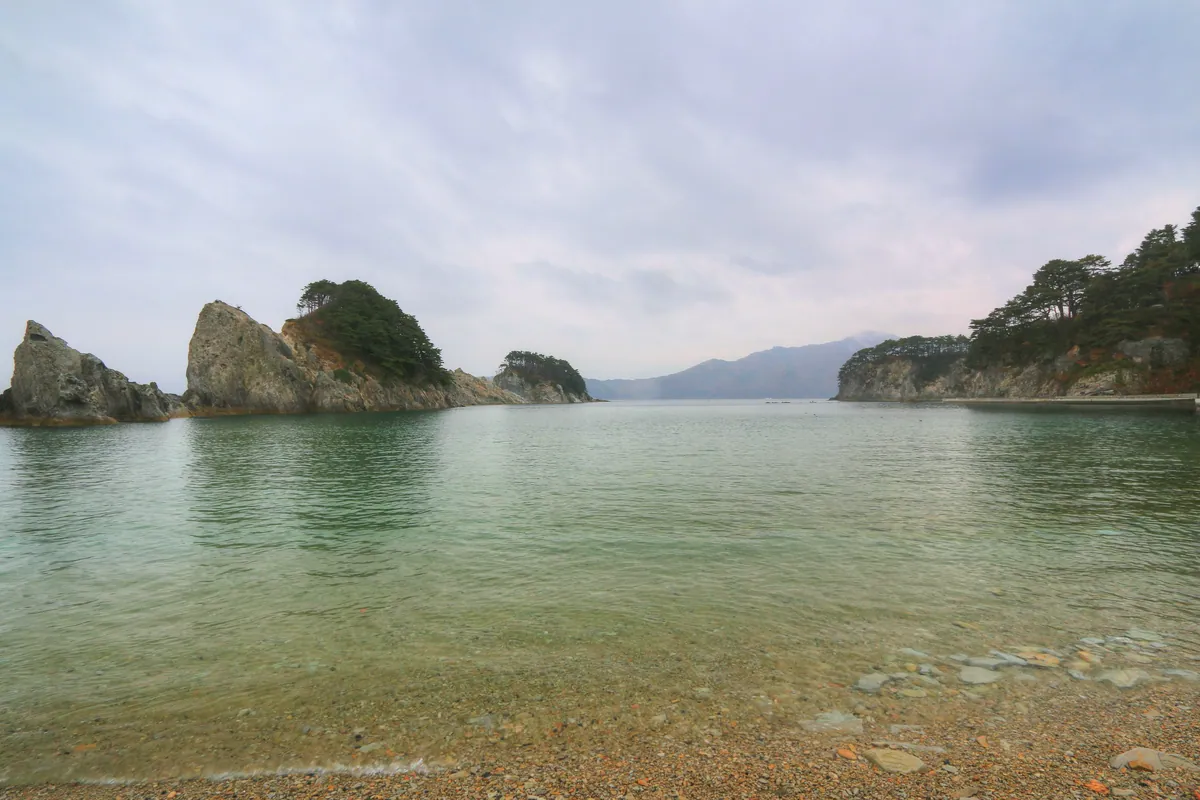
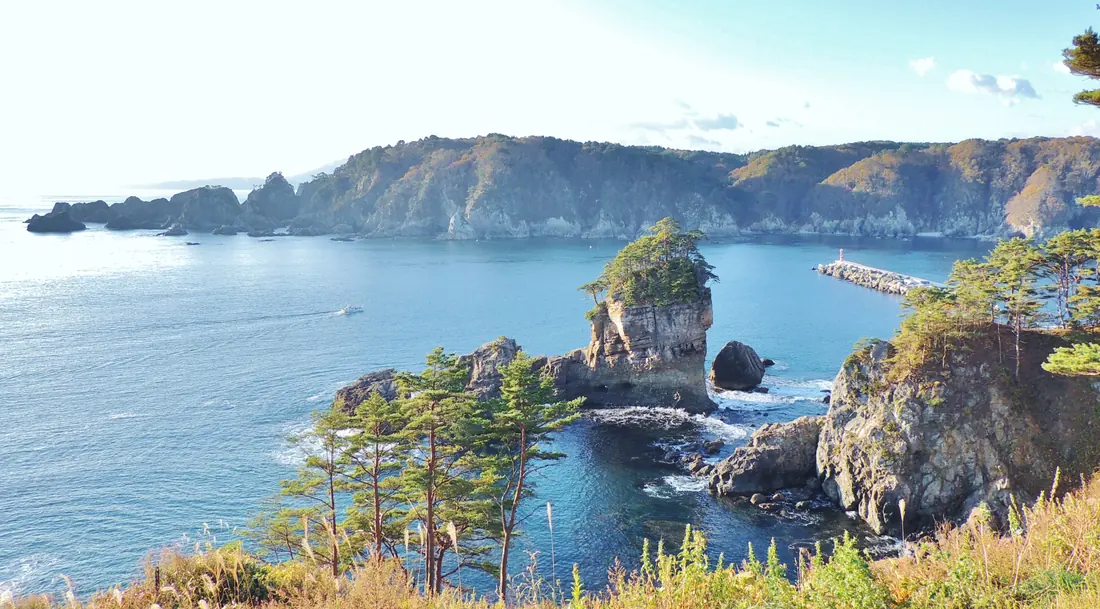
The first is Jodogahama, ten minutes from the ship: a sheltered cove of white rhyolite spires and pines, named in the 1680s by a monk who said it looked just like the Pure Land. It has been a national Place of Scenic Beauty since 2012, and a little open boat, the sappa, takes you into the Blue Cave, where the water turns an unreal blue.
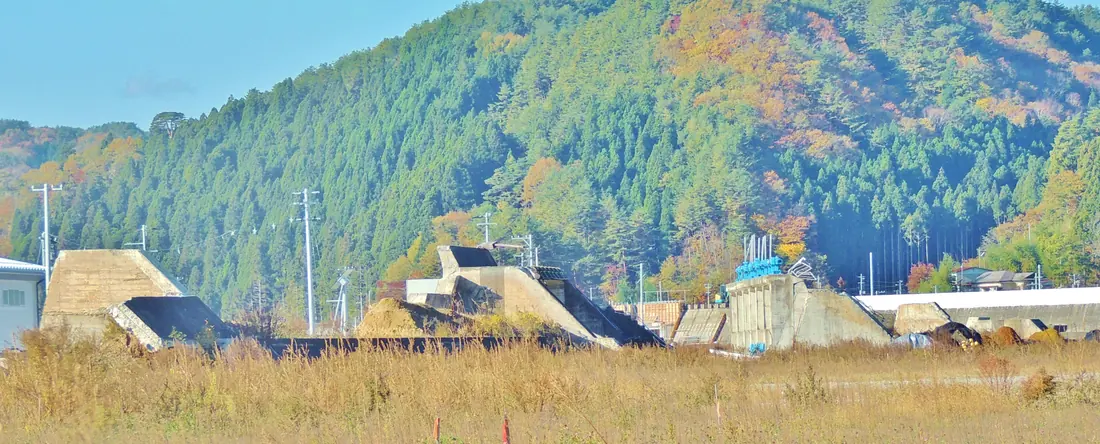
The second is Taro, 20 minutes up the coast by the Sanriku Railway. For a century Taro was the town that took tsunamis seriously: after the waves of 1896 and 1933 it built a 10 m seawall 2.4 km long. On 11 March 2011 the wave went over it. 181 people died in Taro, and 517 across Miyako, with 96 still missing. A local guide takes you onto the wall, shows you footage filmed on the day and walks you through the Taro Kanko Hotel, flooded to the fourth of its six floors and kept as it was. It is not an easy hour. It is the one you will remember.
The pebble shore and white rock spires of Jodogahama under a blue skyPhoto: くろふね / CC BY 3.0
Around those two sits a good lunch: bin-don, seafood poured from a milk bottle over rice, and the fish stalls of the Gyosai Market.
What Miyako is not: a town you walk into from the ship, or a place with a menu of tours. Fujiwara Wharf sits in the port area 3 km from the station, trains up the coast run a few times a day rather than every hour, and our catalogue has no Miyako tours at all. That makes the day a matter of timetables. The answers below are built from the city's call schedule, the Sanriku Railway and Kenpoku Bus timetables, the Umineko-maru's sailing calendar and the published hours of every stop, checked on 30 September 2026.
First: which berth are you at?
This one is easy. Every cruise call in 2024, 2025 and 2026 is listed at Fujiwara Wharf, and there is no second cruise berth in any official list. The city names the berths F8 and F9; which of the two your ship uses changes little. The prefecture gives the cruise quay as 555 m long and 10 m deep, and lists a second section, 240 m long and 12 m deep; the largest ship it has handled is MSC Bellissima.
Next to the quay stands the Miyako Port Ferry Terminal, built in 2018 for the Muroran ferry. It is not a cruise terminal, but it is useful:
Floor
What is there
1F
Office and toilets
2F
Free public lounge with free Wi-Fi
3F
Meeting room; the prefecture's suggested spot to photograph your ship
Roof
Tsunami evacuation space
Its normal hours are weekdays 8:30–17:00, closed on holidays, so it may be locked on a weekend call. On ship days the prefecture lists a temporary tourist desk with bus and taxi help, English guide booklets, interpreters, souvenir stalls, a temporary currency exchange, a shuttle bus to the city centre and a taxi pool. It is a PR list, not a promise for every call, so check your ship's daily programme. The city's help line for ship days is 0193-68-9093.
Getting from Fujiwara Wharf into Miyako
Nothing useful is on foot except Sokei station. The station, the market and Jodogahama are all a short taxi ride away, and the city is small enough that taxis are the practical answer for most of the day.
To
How
Time
Cost
Miyako Station
Taxi
about 6–10 min
roughly ¥1,300–1,600 (our estimate)
Miyako Station
Walk to Sokei station, then Sanriku Railway one stop
16 min walk + 4 min train
¥220
Miyako Station
Port shuttle, if your call has one
about 10 min
ask on board
Jodogahama Visitor Center
Taxi
about 10–15 min
roughly ¥2,000–2,500 (our estimate)
Jodogahama by water
Taxi to Seatopia Naado (6 min), Umineko-maru from Desaki pier
10 min on the boat
¥600 boat
Jodogahama by bus
Kenpoku bus from Miyako Station to Oku-Jodogahama
24 min
new fare from 1 Oct; ¥500 day pass
Gyosai Market
Taxi, or 11 min walk from Miyako Station
about 6–10 min
roughly ¥1,500–1,800 (our estimate)
Taro
Sanriku Railway from Miyako or Sokei
about 20 min
¥510
Taro
Taxi
about 15–25 min
roughly ¥5,000–6,000 (our estimate)
We could not find the official taxi tariff for the Miyako area, so every taxi fare here is our estimate from map routing distances, and real times run longer than the routing's free-flow figures. The prefecture says the wharf has a taxi pool on ship days; on a busy call, ask the tourist desk or a shop to phone for a car on the way back.
Sokei trains into Miyako leave at 8:16, 9:11, 10:21, 12:17, 13:43 and 15:33. Walk out of the port area to Sokei (1.2 km) only if one of those suits you; otherwise a taxi is quicker.
Buses. Iwate Kenpoku Bus runs the Jodogahama line from Miyako Station. Buses take Suica and other national IC cards. Fares changed on 1 October 2026; the old ¥200 single to Jodogahama may have gone up. From the same day the company sells a Jodogahama & Miyako Port 1-day pass for ¥500, which also cuts the Umineko-maru loop to ¥1,500. The pass is sold at the station tourist office and in the RYDE PASS app. The operator's page lists its routes as Miyako Station–Seatopia Naado–Jodogahama–Miyako Hospital and Miyako Station–Omoe–Ishihama, and names no stop at Fujiwara Wharf, so do not count on boarding at the ship.
Miyako to Jodogahama and Taro: what is actually possible
Jodogahama fits every call. Taro fits most, but only if you plan around the train. The honest options:
Jodogahama by taxi. About 10 minutes each way. From April to October private cars may not drive into the beach area (permits are issued at the first car park for elderly and disabled visitors), so expect the driver to drop you at the Visitor Center stop (the rules do not say whether taxis are exempt). Allow 1–1.5 hours for the beach and Visitor Center, plus 30–40 minutes for the sappa boat and its queue.
Jodogahama by boat. Taxi to Seatopia Naado on Desaki pier and take the Umineko-maru: 10 minutes to Jodogahama for ¥600. In October it leaves Desaki at 9:00, 10:10, 11:10, 13:10, 14:10 and 15:10; in November the last is 14:10. No sailings on Tuesdays from September to December, holidays excepted.
Jodogahama by bus. From Miyako Station to Oku-Jodogahama at 9:30, 10:40, 11:40, 12:40, 13:40 and 15:40, 24 minutes. Back from Oku-Jodogahama at 10:00, 11:10, 12:10, 13:10, 14:10, then nothing until 16:10. These are from the operator's timetable of July 2022, which it still links as current; treat them as a guide and check at the station.
Taro by train. Miyako → Taro at 9:22, 10:48, 12:37 and 15:01; Taro → Miyako at 11:41, 13:28 and 15:03 (and 17:30, too late for any call). ¥510, about 20 minutes. The workable pairs are 9:22 out and 11:41 back (the best), 10:48 and 13:28, or 12:37 and 15:03 (only if your ship leaves at 17:30 or later).
Taro by taxi. About 15–25 minutes each way on the Sanriku expressway (routing says 15, the national port guide 25). With a taxi both ways, Taro and Jodogahama fit a 7–8-hour call.
Both by bus and train alone. Needs about 10 hours, because of the two-hour gaps in both timetables.
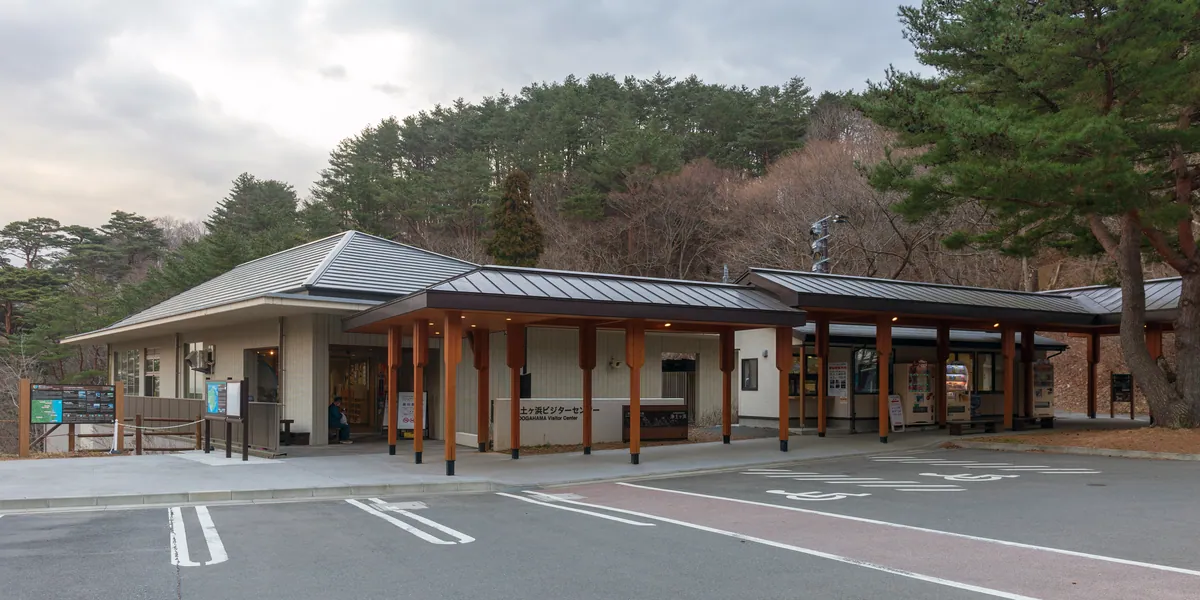
Jodogahama is open-air and free at all hours. The Visitor Center at the top of the park (9:00–17:00, free, closed 29 December – 3 January) is the indoor stop, lends wheelchairs and has two disabled parking spaces. Some older pages give it longer hours from 8:00; its own page says 9:00–17:00.
From the Visitor Center bus stop, a lift takes you down to a wooden deck and a short tunnel to Jodogahama Marine House, about five minutes on foot. That is where the sappa boats leave for the Blue Cave (Ao-no-dōkutsu):
¥2,000 per person, about 20 minutes on the water. The prefecture's 2024 pamphlet still says ¥1,500; the operator's own page says ¥2,000.
March to November, 8:30–17:00, no fixed closing day in season; closed December–February.
No reservations. You buy on the spot, and at busy moments you wait. The boats are small, 2–7 seats each, and take up to 18 people at a time.
Sea permitting. They do not sail in swell.
Bring cash, and a layer: the boats are open.
After the boat, walk the shingle beach to the spires, and on to Oku-Jodogahama at the far end, where the bus stop is. Marine House has a canteen (ramen, grilled scallops, 8:30–17:00 in season), and the Jodogahama Rest House (8:30–17:00) has a restaurant and shop. Give the whole visit about two hours with the boat.
For the sea view of the whole coast, the Umineko-maru is the city's sightseeing boat, launched in July 2022 to replace the Jodogahama ferry that had run for 58 years. Its loop runs from Desaki pier to Jodogahama pier, past the front of the beach, Koyasu Jizō, the back of Jodogahama with the Hachinohe-ana cave entrance and Rōsoku-iwa, a 40 m candle-shaped rock that is a national Natural Monument, and back to Desaki. The full loop costs ¥1,800, you may get off at Jodogahama and re-board, and from Jodogahama back round to Desaki takes about 30 minutes. From Jodogahama it leaves at 9:30, 10:30, 11:30, 13:30, 14:30 and 15:30 in October (the 11:30 ends at Desaki). It has a wheelchair boarding ramp and one wheelchair space, toilets on board, and gull bread for ¥200. It does not take individual bookings; buy at the counter at Seatopia Naado, which opens at 8:45 and accepts cards.
Taro: the seawall and the 2011 story
The Learning Disaster (Manabu Bōsai) guides are run through the Miyako Tourism and Cultural Exchange Association, and they are the reason to go to Taro rather than just look at it. Fees since 1 June 2026:
Course
Length
1–9 people
10–19 people
Standard: seawall, footage, Taro Kanko Hotel
60 min
¥5,000
¥8,000
Eco course (120-min version can add the city's disaster archive)
90–120 min
¥12,000
ask
Town walk from Roadside Station Taro
90 min
¥12,000
ask
E-bike course, up to 4 people
90 min
¥12,000
not offered
Booking is required for the seawall talk, the evacuation-route walk, the footage and the hotel ruin. Call 0193-77-3305; the walking and cycling courses are by phone only. No notice period is published, so book as soon as you have your date. Guides are cancelled if a tsunami warning or advisory is issued that day. The fee is per group, which is what makes it the best value on this coast: ¥2,500 each for a couple, about ¥830 each for six.
The hotel is about 10 minutes on foot from Taro station. The standard course fits neatly between the 9:42 arrival and the 11:41 train back, with time to walk the wall on your own afterwards.
Sanoiwa, three sea stacks off the Taro coast, the tallest 50 m, is a prefectural Natural Monument. It is about 2 km and 27 minutes on foot from Taro station by our map estimate, or 5 minutes by car. On the standard train pairing there is not time for both the guide and Sanoiwa on foot; with a taxi in Taro, there is.
Bin-don, the market and lunch
Bin-don is Miyako's own: seafood sealed in a milk bottle and poured over a bowl of rice at the table. The Japan Tourism Agency's port page calls it Miyako's new local dish, inspired by the local habit of keeping fresh sea urchin in bottles.
The Gyosai Market (fish and vegetable market), 11 minutes' walk from Miyako Station, is the place to see the catch. It opens 6:30–17:30 and closes every Wednesday; most shops take cards. Its one open eat-in counter at the time of writing is Oikawa (Donburi no Mise Oikawa), 10:00–15:30, closed Wednesdays; the market's other canteen, OiOi Shokudo, is temporarily closed. Oikawa serves seafood bowls; whether bin-don is on its menu on your day, ask at the counter. The market's own news has announced milk-bottle raw uni, but not the price.
The other good lunch is at Seatopia Naado, the roadside station on Desaki pier: its restaurant runs 10:30–15:30 on weekdays (last order 15:00) and 10:30–16:30 at weekends and holidays (last order 16:00), and the shop sells fish, bottled bin-don and local sake. It is where the Umineko-maru leaves, which makes it the natural lunch on the boat day.
Uni. Sea urchin is the Sanriku coast's summer catch. All the remaining 2026 calls are in October and November, after the season, so the bin-don you meet will be made with whatever is running, not summer uni.
Ryusendo Cave and Sanoiwa: the long-call extras
Ryusendo in Iwaizumi is one of Japan's three great limestone caves, with underground lakes of startling blue; the third lake is 98 m deep. It is open every day except after heavy rain, 8:30–17:00 from October to April (to 18:00 May–September), adults ¥1,100, children ¥550. There are about 270 steps up and down at the far end, the floors are wet, and the operator suggests anyone unsure of their legs turns back at the third lake.
It is about 50 minutes and 46–50 km each way by car. A taxi costs very roughly ¥15,000 or more each way by our estimate, so it makes sense for four people sharing a car on an 11-hour call (the two Silver Moon calls, 1 and 15 October). By public transport, the Sanriku Railway reaches Iwaizumi-Omoto (Miyako 9:22 → 9:57), but the cave is still about 20 minutes by car from there, and no official source lists a bus link that fits. Allow three hours from the ship, and do not pair it with Taro.
Fits 08:00–17:00 at Fujiwara Wharf (Westerdam on 22 October, Seven Seas Explorer on 17 October) and anything longer. The train times are the same on Saturdays.
Both of Miyako's reasons in one day, built around the train timetable rather than against it. Times assume an 08:00 arrival and a 17:00 departure, so all-aboard about 16:30 and our target back at the gangway 15:30. Book the Taro guide before you sail.
08:30Off the ship. Taxi to Miyako Station (about 6–10 minutes), or walk 16 minutes to Sokei station and take the 9:11 train one stop to Miyako (¥220).
09:22Sanriku Railway Miyako → Taro, arriving 09:42. ¥510, about 20 minutes along the coast.
09:50The Learning Disaster 60-minute standard course: the seawall, footage filmed on the day, and the Taro Kanko Hotel tsunami ruin. ¥5,000 for your group of up to nine.
10:50Walk the top of the seawall on your own, and look along the rebuilt town from it. Be at Taro station by 11:35.
11:41Train Taro → Miyako, arriving 12:01. The next one is not until 13:28, so do not miss it.
12:10Walk 11 minutes to the Gyosai Market. Lunch at Oikawa, the market's donburi counter (10:00–15:30, closed Wednesdays), and browse the fish stalls.
13:00Taxi to the Jodogahama Visitor Center stop, about 10 minutes. Take the lift down and follow the wooden deck and tunnel to Marine House, 5 minutes on foot.
13:15Blue Cave sappa boat, about 20 minutes, ¥2,000, if the sea allows. Queue at Marine House; there are no bookings.
13:40The beach and the white spires, then the Visitor Center (free, to 17:00). Ask the Visitor Center or Rest House to call you a taxi at about 14:40.
14:45Taxi back to the wharf, about 10 minutes. Back at the gangway about 15:00, 30 minutes ahead of the target.
Jodogahama by water: a slow day without Taro
Fits 08:00–17:00 on any day except a Tuesday (Seven Seas Explorer on 17 October, Westerdam on 22 October, the 11-hour Silver Moon calls). For 10:00 arrivals, see the note.
Miyako's scenery done slowly, with the city's sightseeing boat as your transport both ways and a proper lunch by the water. No trains, no bookings. Times assume an 08:00 arrival and a target back at the gangway of 15:30.
08:30Off the ship. Taxi to Seatopia Naado, the roadside station on Desaki pier, about 6 minutes. The Umineko-maru ticket office opens at 8:45 and takes cards.
09:00Umineko-maru Desaki → Jodogahama, arriving about 09:10. ¥600, and it is the prettiest way in.
09:15Walk to Marine House for the Blue Cave sappa boat (open from 8:30, ¥2,000, about 20 minutes). Early is the time to beat any queue.
09:45The beach, the spires and the pines, then the Jodogahama Visitor Center (opens 9:00, free), which lends wheelchairs and is the indoor stop if it rains.
11:30Umineko-maru from Jodogahama pier on the bay loop: past the back of Jodogahama, the Blue Cave entrance and Rōsoku-iwa, the 40 m candle rock, arriving Desaki at 12:00. ¥1,200 as a continuing fare.
12:00Lunch at the Seatopia Naado restaurant (weekdays to 15:30, last order 15:00; weekends to 16:30). Bottled bin-don and local sake are sold in the shop.
13:10Taxi to the Gyosai Market for an hour among the fish stalls, or straight back to the ship (about 6 minutes).
14:30Taxi from the market to the wharf, about 6–10 minutes. Back at the gangway by about 14:45, 45 minutes ahead of the target.
The 8-hour call from 10:00: Taro and Jodogahama with no slack
Fits the 10:00–18:00 Seabourn Encore calls (Tuesday 6 October, Sunday 1 November). Target back at the gangway 16:30.
A late arrival leaves one workable pair of trains to Taro. This day uses it, then takes taxis for everything else. It works on paper with about 10 minutes to spare, so treat Taro as the part you drop if the ship is late alongside. Book the Taro guide for 11:15.
10:30Off the ship. Taxi straight to Miyako Station, about 6–10 minutes. Do not try the walk to Sokei; there is no train that fits.
11:15The Learning Disaster 60-minute course: seawall, footage, tsunami-ruin hotel. ¥5,000 for up to nine people.
12:15An hour on your own: the seawall walk, or Roadside Station Taro. Be on the platform by 13:20.
13:28Train Taro → Miyako, arriving about 13:50.
14:00Late lunch at Oikawa in the Gyosai Market, 11 minutes on foot. It stops serving at 15:30.
14:40Taxi to the Jodogahama Visitor Center stop, about 10 minutes, then down to Marine House.
15:00Blue Cave sappa boat if the sea allows (¥2,000, about 20 minutes), then a short look at the beach.
16:05Taxi from Jodogahama to the wharf, about 10 minutes (have the Visitor Center call it). Back at the gangway about 16:20, 10 minutes ahead of the target.
How to think about your hours
Work backwards from the ship. Your all-aboard time is usually 30 minutes before departure (check the daily programme), you want to be back at the gangway an hour before that, and the first half hour after arrival goes on getting off. So the time you can actually use is the call length minus about two hours. Every call is at Fujiwara Wharf, so one table covers them all.
Call
Usable
What fits
4 hours
about 2
Jodogahama by taxi both ways: the beach and Visitor Center, the sappa boat only if there is no queue.
6 hours
about 4
Jodogahama with the sappa boat and lunch at Seatopia Naado or the market. Or Taro by taxi, not by train.
8 hours
about 6
Jodogahama and a market lunch, unhurried. Taro as well only with taxis or the tight 10:48/13:28 train pair.
9–10 hours
about 7–8
Both: Taro by the 9:22 train and back on the 11:41, then Jodogahama with the sappa boat. Or Jodogahama by boat with a long lunch.
11 hours
about 9
Everything in town plus the Umineko-maru loop. Or Ryusendo by taxi with Jodogahama.
In the 2026 schedule the commonest lengths are 9 hours (8 calls) and 10 hours (7 calls). The eight calls left this year run 8–11 hours: two Silver Moon calls of 11 hours (07:00–18:00, 1 and 15 October), Seabourn Encore for 10 hours on the 12 October holiday and 8 hours on 6 October and 1 November (both 10:00–18:00), and 9-hour calls by Seven Seas Explorer (17 October) and Westerdam (22 October). Mitsui Ocean Sakura starts a cruise from Miyako on 30 October. There are no overnights in 2026.
Tours, guides and taxis
There is no Miyako tour in our catalogue, and we will not pad this page with tours from other ports. You do not need one: the three model days above are designed to be done on your own, and Miyako's distances are short enough for taxis. The guided options that exist are local:
The Taro Learning Disaster guide (0193-77-3305). Per-group pricing, ¥5,000 for 1–9 people for the 60-minute standard course, reservation required, cancelled on tsunami-advisory days. This is the one to book if you book one.
A tsunami disaster-site educational tour listed on the tourism association's English page, 1–3 hours, from ¥2,500 per adult, booked through Guesthouse 3710. We could not confirm the details beyond that listing.
Your ship's excursions. Check the shore-excursion list on board; for Ryusendo, a ship tour or a shared taxi is the practical way.
A taxi for the morning. With four people sharing, a taxi to Taro and on to Jodogahama removes the timetable altogether; by our estimate the Taro leg alone is roughly ¥5,000–6,000 each way per car.
Who should do what: a couple on a 9-hour call should do the first model day with the 60-minute Taro guide (about ¥2,500 each). A group of six pays the same ¥5,000 for the guide (about ¥830 each) and needs two taxis. On the 8-hour calls, do Jodogahama and lunch, and add Taro only if you are happy with ten minutes of slack. For limited mobility, the Umineko-maru has a wheelchair boarding ramp and one wheelchair space, the Visitor Center lends wheelchairs, and permits let elderly and disabled visitors' cars into the beach area from April to October; skip the sappa boat (small open boats) and Ryusendo (about 270 steps).
About the return to the ship. None of these is a ship excursion, and none offers a return-to-ship promise; the ship will not wait for a train, a boat or a guide. The real risks in Miyako are timetable gaps: the Taro train back at 11:41 or 13:28, and the last useful bus from Oku-Jodogahama at 14:10. Before each leg, know the next departure and the one after it, have the Visitor Center, Rest House or a restaurant phone for a taxi in good time, and aim to be at the gangway an hour before all-aboard.
Money, cards and the practical stuff
Miyako is partly cashless. Carry about ¥10,000 in notes and coins for the day, more if you plan several taxis.
Place
Pay with
Kenpoku buses
Suica or other national IC card, or cash
Umineko-maru (Seatopia Naado office)
Card or cash
Gyosai Market
Card at most shops; cash at some
Sanriku Railway
Cash to be safe; card options not published
Blue Cave sappa boat
Cash to be safe; payment options not published
Taro guide
Ask when you book; bring cash
Taxis
Cash to be safe
Ryusendo Cave
Cash to be safe
ATMs. The nearest to the wharf are at Sokei Post Office (about 670 m) and a Lawson in Sokei 1-chome (about 950 m). Near Miyako Station there is Miyako Post Office (160 m from the station) and another Lawson (240 m). Japan Post machines generally take foreign cards. The prefecture also lists a temporary currency exchange at the wharf on ship days.
Opening days worth checking against your date. The Gyosai Market and Oikawa close on Wednesdays; no remaining 2026 call falls on one, but the Seabourn Encore call on Wednesday 10 March 2027 does, so plan lunch at Seatopia Naado that day. The Umineko-maru does not sail on Tuesdays from September to December, which catches 6 October. Marine House and the sappa boat close from December to February. The Miyako Station tourist information office opens 9:00–18:00 and sells the bus pass.
Wi-Fi and shelter. The ferry terminal's second-floor lounge has free Wi-Fi on weekdays; the prefecture also lists free Wi-Fi at the wharf on ship days. Its roof is the port's tsunami evacuation space; if a warning sounds while you are at the wharf, follow the staff there.
Autumn (October–November) is when every remaining 2026 call falls. October averages a high of 18.8 °C and a low of 9.2 °C, with 166 mm of rain; November 13.5 °C and 3.0 °C, and much drier. Pack a warm layer for the boats.
Typhoons approach the Tohoku region about three times a year, most often in September (and about once every two Octobers). September is also Miyako's wettest month. In August 2026 the Umineko-maru cancelled a whole day of sailings for typhoon swell, and two days later a ship call was cancelled on the day, so have a land plan ready.
Spring (March–May) brings almost half the year's calls: 11 of 23 in 2026, six of them in April. Cherry blossom is not recorded at Miyako itself; inland Morioka's normal full bloom is 24 April. The only 2027 call published so far is Seabourn Encore on Wednesday 10 March, 08:00–18:00; the sappa boat's season starts that month.
Summer is the uni season and the time of Miyako's summer festival and fireworks (July) and the Jodogahama night market (June). A free loop bus circles the Jodogahama park on summer weekends, July to September only.
Crowds. Most ships here carry 450–750 passengers, so the sappa-boat queue is the only crowd you are likely to meet; Westerdam, with about 1,960 passengers on 22 October, is the exception. Go to Marine House early or late.
Rain plan: the Visitor Center, the covered Gyosai Market, Seatopia Naado and, on weekdays, the ferry terminal lounge. The sappa boat and the Umineko-maru stop in swell; Ryusendo closes after heavy rain.
What other guides get wrong about Miyako
Things you will read about Miyako elsewhere — in older port guides, forum posts and some cruise-line pages — set against what the official source says today.
You may read
What the official source says
Source
The Blue Cave sappa boat at Jodogahama costs ¥1,500 per person.
It is ¥2,000 per person for about 20 minutes, sold only on the spot at Jodogahama Marine House (8:30–17:00, March to November, no reservations), and it sails only when the sea allows.
A guided visit to the Taro Kanko Hotel tsunami ruin costs ¥4,000 per group.
Since 1 June 2026 the 60-minute standard 'Learning Disaster' course is ¥5,000 for 1–9 people (¥8,000 for 10–19). It must be booked on 0193-77-3305 and is cancelled on any day with a tsunami warning or advisory.
The Jodogahama Visitor Center is open 8:00–18:00 from April to October.
The Visitor Center gives 9:00–17:00 all year, free, closed 29 December to 3 January. Do not plan an early-morning or post-17:00 stop there, or rely on it as a shelter or a place to call a taxi at those times.
Mixing up Miyako and Miyakojima.Booking engines put them side by side. Miyako is on the Sanriku coast of Iwate in northern Honshu; Miyakojima is a coral island in Okinawa, at the other end of Japan. Check which one your itinerary means before you research tours.
Treating the Taro train as hourly.It is not. The useful departures from Miyako are 9:22, 10:48, 12:37 and 15:01, and back from Taro 11:41, 13:28 and 15:03. Miss the 11:41 and you wait almost two hours.
Turning up in Taro without a guide booking.The seawall talk, the footage and the Taro Kanko Hotel ruin need a reservation (0193-77-3305). Without one you can still walk the wall, but you will not get inside the hotel.
Waiting for a 15:00 bus back from Jodogahama.There is none from the beach end. After the 14:10 from Oku-Jodogahama, the next is 16:10, too late for most calls. Take a taxi, or leave by the 14:10.
Planning the Umineko-maru on a Tuesday.From September to December it does not sail on Tuesdays (holidays excepted), which catches the 6 October call. In October the last sailing from Desaki is 15:10; in November, 14:10.
Trusting old prices.The sappa boat is ¥2,000, not ¥1,500, and the Miyako–Taro train is ¥510, not ¥460. Bus fares changed on 1 October 2026, so the ¥200 Jodogahama fare you read elsewhere may no longer be right.
Expecting summer sea urchin in October.Every remaining 2026 call is in October or November, after the summer uni season. Bin-don is still worth eating, but ask what is in the bottle rather than assuming fresh uni.
Walking to Miyako Station.It is about 3.3 km and 44 minutes along roads by the port. Take a taxi, or walk the 16 minutes to Sokei station and ride one stop.
Researched from official timetables, operators and the port authority. Every time and fare in this guide was checked against the sources listed above on 1 October 2026; where we had to estimate (a walk, a taxi in traffic), the text says so. Timetables change — if you find one that has, tell us and we will fix it.
Quick answers
Miyako cruise port questions
Is Miyako the same as Miyakojima?
No. This guide is Miyako in Iwate Prefecture, a port on the Sanriku coast of northern Honshu, known for Jodogahama and for Taro's seawall. Miyakojima is a coral island in Okinawa, at the other end of Japan, with its own cruise port and its own guide on this site.
Where do cruise ships dock in Miyako?
Alongside at Fujiwara Wharf (berths F8 and F9), which every cruise call from 2024 to 2026 has used, so Miyako is not a tender port. It is about 3.3 km by road from Miyako Station and 1.2 km from Sokei station on the Sanriku Railway. The 2018 Miyako Port Ferry Terminal stands beside it, with a free public lounge and Wi-Fi on the second floor on weekdays and a rooftop tsunami evacuation space.
Is Miyako worth getting off the ship, and what are the best things to do?
Yes. On a 9–10-hour call, do two things: Jodogahama, 10–15 minutes from the ship by taxi, with the ¥2,000 Blue Cave sappa boat, and Taro, 20 minutes up the coast by train, where a local guide shows you the 10 m seawall the 2011 tsunami overtopped and the Taro Kanko Hotel ruin. Add a bin-don seafood lunch at the Gyosai Market or Seatopia Naado, and the Umineko-maru bay cruise past Rōsoku-iwa, a 40 m candle rock. Ryusendo Cave, 50 minutes inland, suits only the longest calls. The full list is our Miyako top 10.
How do I get from the Miyako cruise port to Jodogahama?
A taxi takes about 10–15 minutes to the Visitor Center stop and costs roughly ¥2,000–2,500 (our estimate; we could not find the official local tariff). The prettier way is a 6-minute taxi to Seatopia Naado on Desaki pier and the Umineko-maru boat, 10 minutes and ¥600, not on Tuesdays from September to December. By bus, go first to Miyako Station and take the Kenpoku bus to Oku-Jodogahama, 24 minutes. Allow about two hours at Jodogahama with the sappa boat.
How do I get from the Miyako cruise port to Taro and the Sanoiwa rocks?
Take the Sanriku Railway from Miyako Station, about 20 minutes and ¥510. Useful trains leave Miyako at 9:22, 10:48, 12:37 and 15:01 and come back from Taro at 11:41, 13:28 and 15:03; you can also board at Sokei, 16 minutes' walk from the wharf. A taxi takes about 15–25 minutes, roughly ¥5,000–6,000 each way (our estimate). Sanoiwa, three sea stacks up to 50 m, is about 2 km and 27 minutes on foot from Taro station, or 5 minutes by car; on the train, there is not time for both it and the 60-minute guide.
Can I see Jodogahama and Taro in one port day?
Yes on a call of 9 hours or more: the 9:22 train to Taro, the 60-minute guide, the 11:41 train back, lunch at the Gyosai Market, then a taxi to Jodogahama and the sappa boat, back at the ship by about 15:00. On an 8-hour 10:00–18:00 call it works with the 10:48 and 13:28 trains and taxis, but with only about 10 minutes to spare. By bus and train alone you need about 10 hours.
How much time do I need in Miyako on a cruise stop?
Count on about two hours of any call going on getting off and being back at the gangway an hour before all-aboard. An 8-hour call, about 6 usable hours, covers Jodogahama with the ¥2,000 Blue Cave sappa boat and a seafood lunch without hurry. Adding Taro's seawall and 60-minute guide by train needs 9 hours or more, because only four useful trains leave Miyako (9:22, 10:48, 12:37, 15:01). On a 4-hour call, do Jodogahama by taxi only. Ryusendo Cave, 50 minutes inland, fits only the 11-hour calls.
Do I need to book the Taro tsunami guide, and is it in English?
Yes, booking is required: call the Miyako Tourism and Cultural Exchange Association on 0193-77-3305 for the seawall talk, the footage and the Taro Kanko Hotel ruin. The 60-minute standard course costs ¥5,000 for 1–9 people, ¥8,000 for 10–19, and is cancelled on any day with a tsunami warning or advisory. No notice period is published, so book as soon as you know your date. The association does not mention English, so ask when you book and have a translation app ready; Seabourn warns that the hotel's tsunami video has no subtitles.
How much is the Blue Cave sappa boat at Jodogahama?
¥2,000 per person for about 20 minutes, from Jodogahama Marine House (8:30–17:00, March to November). There are no reservations: you buy on the spot and may wait. The small boats take 2–7 people each and up to 18 at a time, and they sail only when the sea is calm. Carry cash.
Can I walk from the Miyako cruise port into town?
Not usefully. Miyako Station is about 3.3 km and a 44-minute walk from Fujiwara Wharf along port roads, and Jodogahama is about 6 km away. The one sensible walk is 1.2 km, about 16 minutes, to Sokei station on the Sanriku Railway, then one stop to Miyako for ¥220; trains leave Sokei at 8:16, 9:11, 10:21, 12:17, 13:43 and 15:33. Otherwise take a taxi to the station, about 6–10 minutes and roughly ¥1,300–1,600 (our estimate), or the port shuttle if your call has one.
Is there a shuttle bus or a taxi at the Miyako cruise port, and how much is a taxi?
Usually, by the prefecture's account. Iwate Prefecture lists a shuttle bus to the city centre, a tourist-information desk and a taxi pool at Fujiwara Wharf among its reception services for cruise calls, and puts Miyako Station about 10 minutes away by shuttle or taxi. It does not publish who runs the shuttle, whether it is free or whether it runs on every call, so check your ship's daily programme. Taxi fares are our estimates, as no official local tariff could be confirmed: roughly ¥1,300–1,600 to Miyako Station and ¥2,000–2,500 to Jodogahama. For the ride back, have the Visitor Center or a restaurant phone for one.
How much does the bus to Jodogahama cost?
The fare was ¥200 until 30 September 2026. Iwate Kenpoku Bus raised fares on 1 October 2026, and from that day sells a Jodogahama & Miyako Port 1-day pass for ¥500, which also brings the full Umineko-maru loop down to ¥1,500. Buses take Suica and other national IC cards. Check the new single fare at the station tourist office.
Is the Umineko-maru Jodogahama boat cruise worth it, and when does it run?
It is the city's own sightseeing boat, launched in 2022, and the best view of Rōsoku-iwa and the back of Jodogahama. The full loop from Desaki costs ¥1,800 and you may get off at Jodogahama and re-board. In October boats leave Desaki at 9:00, 10:10, 11:10, 13:10, 14:10 and 15:10; in November the last is 14:10. It does not sail on Tuesdays from September to December, holidays excepted, and cancels in swell.
Can I visit Ryusendo Cave from the Miyako cruise port?
Only on a long call and by car. It is about 50 minutes and 46–50 km each way; a taxi costs very roughly ¥15,000 or more each way (our estimate). The cave is open 8:30–17:00 from October to April, costs ¥1,100 and has about 270 steps at the far end. Allow about three hours from the ship, so keep it for the 11-hour calls.
Can I visit Todogasaki, Honshu's easternmost point, from the Miyako cruise port?
Only on an 11-hour call, and only as a hike. Aneyoshi, where the road ends, is about 45 minutes by car from Miyako Station, and from Aneyoshi fishing port the Japan Coast Guard gives the lighthouse as 4 km and about an hour on foot along the Michinoku Coastal Trail. That is roughly four hours of driving and walking from the ship before you spend any time at the cape, so it does not fit alongside Jodogahama or Taro on a 9–10-hour call. Book a taxi for the whole trip; there is no useful bus.
Where can I eat bin-don or a seafood lunch near the Miyako cruise port?
Two places fit a port day. Oikawa, the donburi counter in the Gyosai Market, 11 minutes' walk from Miyako Station, serves seafood bowls 10:00–15:30 and closes on Wednesdays with the market; ask whether bin-don, seafood poured from a milk bottle over rice, is on that day. Seatopia Naado on Desaki pier, about 6 minutes by taxi from the ship, has a restaurant (weekdays 10:30–15:30, weekends and holidays to 16:30) and sells bottled bin-don to take away. On October and November calls the uni will not be summer-fresh.
Is Miyako manageable with limited mobility or a wheelchair?
Partly. The Umineko-maru boat has a wheelchair boarding ramp and one wheelchair space; its Desaki–Jodogahama crossing takes 10 minutes and costs ¥600. The Jodogahama Visitor Center lends wheelchairs, and from April to October permits let elderly and disabled visitors' cars into the beach area, which is closed to other private cars. A lift links the Visitor Center stop to the path down to Marine House. Skip the Blue Cave sappa boat, which uses small open boats, and Ryusendo Cave, with about 270 steps. Short taxi rides cover everything else.
Which cruise ships call at Miyako in 2026 and 2027?
Eight calls remain in 2026, all at Fujiwara Wharf: Silver Moon for 11 hours on 1 and 15 October, Seabourn Encore on 6 October (8 hours), 12 October (10 hours) and 1 November (8 hours), Seven Seas Explorer on 17 October and Westerdam on 22 October (9 hours each), and Mitsui Ocean Sakura, which starts a cruise from Miyako on 30 October. The only 2027 call published so far is Seabourn Encore on Wednesday 10 March, 08:00–18:00. See cruises to Miyako for the full list.
Do I need cash in Miyako?
Yes, for some things. The Kenpoku buses take IC cards, the Umineko-maru office takes cards and most Gyosai Market shops are cashless, but carry yen for the sappa boat, taxis and the train, whose payment options we could not confirm. The nearest ATMs to the wharf are at Sokei Post Office (about 670 m) and a Lawson (about 950 m); near Miyako Station there is a post office and another Lawson.
What is the weather like in Miyako in October and November, and what if it rains?
Cool. Miyako's October average high is 18.8 °C and the low 9.2 °C, with 166 mm of rain; November averages 13.5 °C and 3.0 °C and is much drier. Wear layers and bring a waterproof, because the sappa boat is open. In swell neither the sappa boat nor the Umineko-maru sails, so the rain plan is the free Jodogahama Visitor Center, the covered Gyosai Market, Seatopia Naado and, on weekdays, the ferry-terminal lounge. Have a land plan: in August 2026 typhoon swell stopped the Umineko-maru for a day, and two days later a ship call was cancelled on the day.
Was Miyako hit by the 2011 tsunami, and what if there is a warning while I am there?
Yes. In 2011, 517 people died across Miyako and 96 are still missing; in Taro the wave overtopped the 10 m seawall and 181 died. If a warning sounds, follow the staff to higher ground: at Fujiwara Wharf the roof of the Miyako Port Ferry Terminal is the port's tsunami evacuation space. Taro's Learning Disaster guides are cancelled on any day with a tsunami warning or advisory, and the city may close the wharf welcome area under storm or heavy-rain warnings. The city's help line for ship days is 0193-68-9093.
What shore excursions are there in Miyako, and do I need one?
Cruise lines sell 3–4-hour coach tours: in October 2026 Holland America listed a Jodogahama boat cruise and Gyosai Market tour from US$189 and a Jodogahama, Sanoiwa and Taro viewpoint tour from US$139, and Seabourn a Taro Kanko Hotel, Sanoiwa and Jodogahama tour from US$270. You do not need one. The best-value local option is Taro's Learning Disaster guide, ¥5,000 for up to nine people for 60 minutes, booked by phone, and the rest is easy by taxi, train and the Umineko-maru. None of the independent options comes with a return-to-ship promise; ask what your line promises for its own tours.