A French-style star fort, a five-month republic, and the end of the samurai
In the winter of 1868 a defeated navy sailed north, occupied a European-style fortress, and held what may have been the first election in Japanese history. Then they lost, and with them went the samurai era.
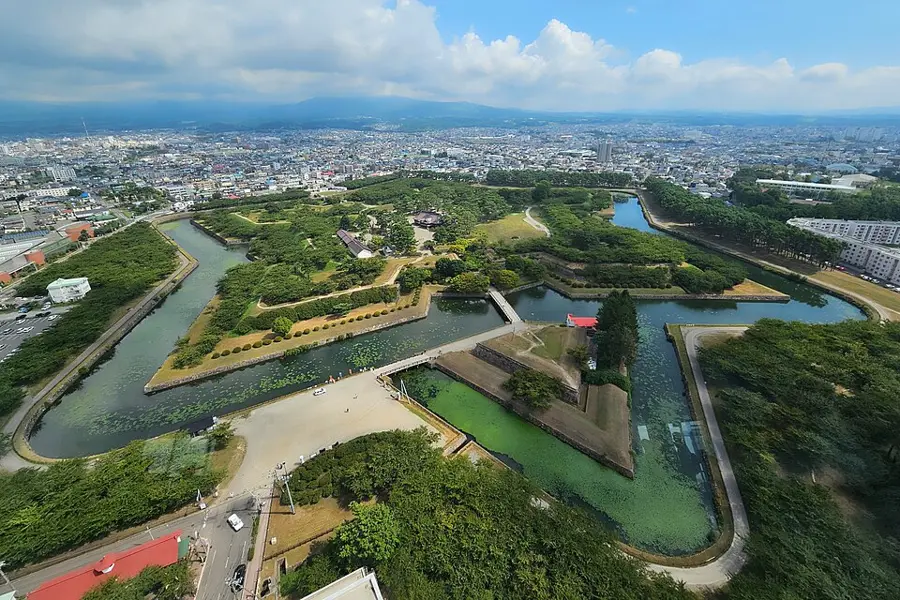
From the ground, Goryōkaku is a pleasant park with an unusual moat. From the tower beside it, the shape snaps into focus: a five-pointed star, 1.8 kilometres around, its earthworks five to seven metres high. Almost nobody saw it as a star until the first tower went up in 1964 — for a century after it was built, its defining feature was invisible to the people living beside it.
It was designed by Takeda Ayasaburō (1827–1880), a scholar of Dutch learning who had studied medicine, navigation and Western military architecture — including the work of the French engineer Vauban. Designed from 1855, begun in 1857, functional by 1864 and finished around 1866, it exists because cannon had made traditional Japanese castles obsolete.
The five projecting bastions do two things: they multiply the wall length available for gun emplacements, and they eliminate blind spots, so every face of the wall can be swept by fire from the bastion beside it. It was built to defend the Tsugaru Strait against modern warships — and to move the magistrate's office out of range of guns in the harbour.
On 4 October 1868, with the shogunate collapsing, its navy commissioner Enomoto Takeaki refused to surrender the fleet. He sailed north with four warships, four transports, and 180,000 gold ryō retrieved from Osaka Castle. By December his forces held Hakodate and Goryōkaku, and on 15 December 1868 in the old calendar — 27 January 1869 by ours — they proclaimed the Republic of Ezo, structured explicitly on the United States.
They then did something without precedent here: they voted. 856 ballots were cast. Enomoto received 156, the highest of anyone. In the separate ballot for president he took 155 votes against 14 for the runner-up. The cabinet — navy minister, army minister, magistrates — was elected the same way. Hijikata Toshizō, formerly vice-commander of the Shinsengumi, became assistant army minister.
The franchise was limited to the samurai class. Commoners could not vote — and the Ainu, whose island was being claimed, were excluded entirely.
That asterisk is not a footnote. Japan's first experiment with the ballot was held on land taken from people who were not permitted to touch it. Any honest telling of this story carries the other one beside it.
He had been the disciplinarian of the Shinsengumi, the shogunate's feared Kyoto police, and he came north to finish the war he had lost everywhere else. On 11 May 1869 (20 June by the Gregorian calendar), aged 34, he was leading troops forward on horseback near a checkpoint called the Ippongi Kanmon when a bullet shattered his lower back. He died at the barrier gate on the road — not inside the fort, as English accounts often have it.
Six days earlier he had summoned his sixteen-year-old page and entrusted him with a death poem, his katana, a letter, a photograph, and a few strands of his hair, to be carried to his family. The boy got them home.
Roughly seven thousand imperial troops arrived in April 1869. Enomoto surrendered on 18 May by the old calendar — 26–27 June by ours — and Goryōkaku was handed over. That is conventionally the end of the Boshin War and the end of the samurai era in Japan. No foreign power had ever recognised the republic; it lasted about five months.
Enomoto was imprisoned briefly, freed in 1872, and went on to become a Meiji government minister and Japan's ambassador to Russia. The rebel president finished as the establishment's diplomat. Later the same year, 1869, Ezo was renamed Hokkaido.
It opened to the public in 1914 and became a Special National Historic Site in 1952. Roughly 1,500 cherry trees trace the star — one of Japan's last major blossom sites, typically peaking in late April, with evening illumination. The reconstructed magistrate's office inside was completed in 2010. The present tower opened in 2006 at 107 metres, with observation decks at 86 and 90.
Go up the tower first. The fortress does not make sense from inside it.
Takeda Ayasaburō adapts Vauban's star-fort geometry for the Tsugaru Strait
Functional, though outer works continue to about 1866
Four warships, four transports, and 180,000 gold ryō
(27 Jan 1869 Gregorian) — and 856 ballots are cast
(20 June Gregorian) at the Ippongi checkpoint, aged 34
(26–27 June Gregorian) — the Boshin War, and the samurai era, end
And Enomoto later becomes ambassador to Russia
The star finally visible to everyone, 140 years after it was built
The tower is the whole point — the star is invisible from the ground. Guided history tours add the republic, which the site's plaques undersell.
It was designed in the 1850s on European trace italienne principles, following the French engineer Vauban. The projecting bastions multiply the wall available for guns and eliminate blind spots, so every stretch of wall can be covered by fire from the bastion beside it — a response to cannon that traditional Japanese castles could not survive.
A short-lived state proclaimed at Hakodate on 15 December 1868 (27 January 1869 by the Western calendar) by shogunate loyalists under Enomoto Takeaki, structured on the United States. It elected its president and cabinet by ballot — 856 votes were cast — and fell in June 1869 after five months, unrecognised by any foreign power.
It is widely described that way, and 856 ballots were genuinely cast, with Enomoto taking 155 votes to 14 for the runner-up in the presidential ballot. The crucial caveat is that only the samurai class could vote — commoners were excluded, and so were the Ainu, whose island was being claimed.
Because Japan used a lunar calendar until 1873. Hijikata died on 11 May 1869 in the old calendar, which converts to 20 June 1869 in the Western one. Japanese monuments and museums use the lunar date; English encyclopedias often use the Gregorian, and neither usually explains the difference.
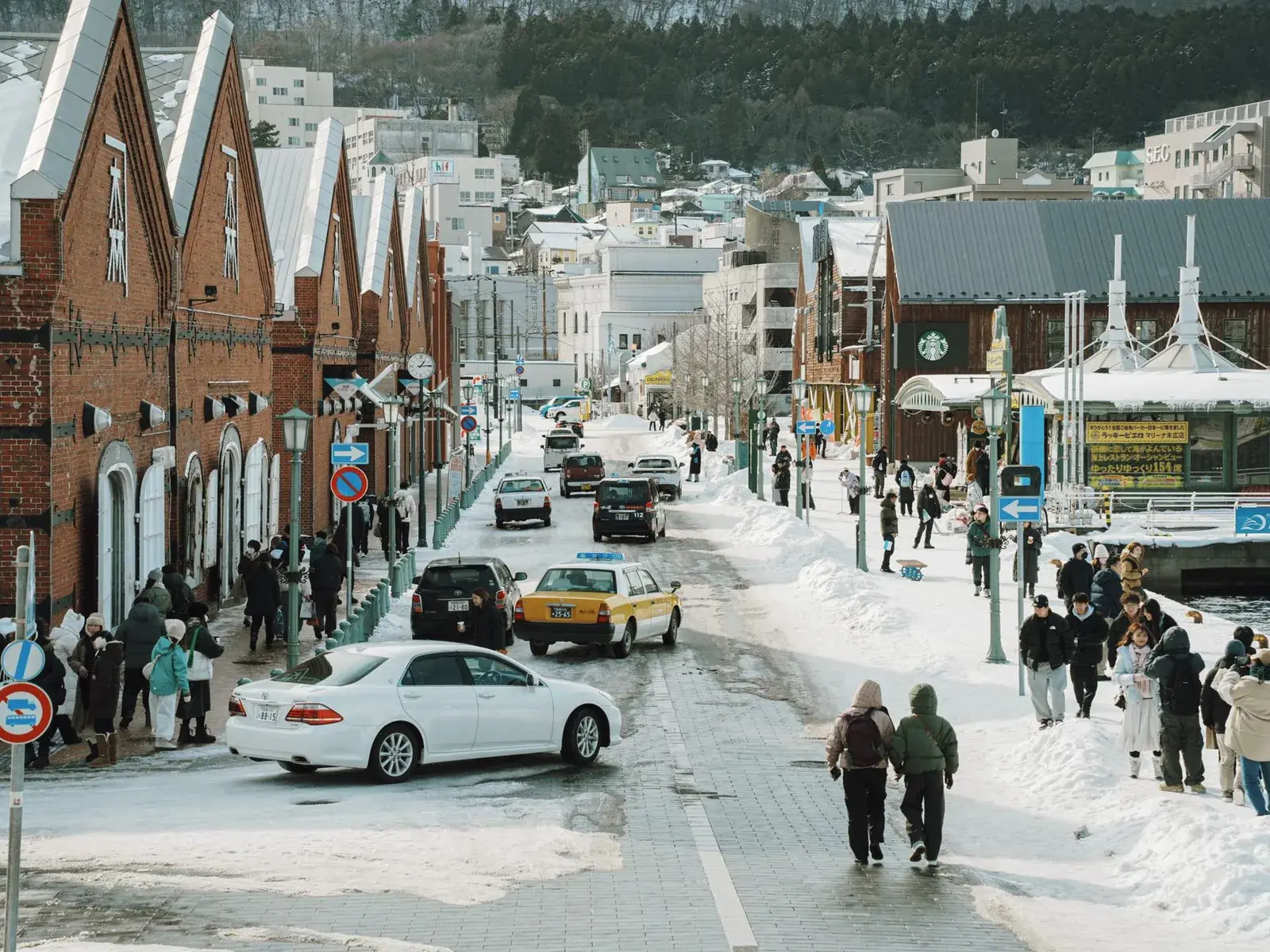
Why this city looks like nowhere else in the country
Read →
Whose island this was, and what a visitor should understand
Read →
Cold water, kelp, and the town that supplies Japan's flavour
Read →
Russian curry, a Bohemian sausage maker, and a burger chain that refuses to leave town
Read →No typing needed — jump straight in:
Just docked? — the gangway toolStart from your shipThe ride from every berthAsk the editorGlossary