Updated 1 October 2026 · 34 official and operator sources · Researched from official timetables, operators and the port authority · Takumi Yamada
Every cruise ship in Beppu ties up at the same place, No.4 Pier of the International Tourist Port on the north side of town. From there the day is simple. The seven boiling hells of Kannawa are 13 minutes away by the route 24 bus (¥260) or about 15 minutes by taxi, and a lunch you steam yourself in volcanic vapour is a few minutes' walk from the first hell. That fits easily into the usual 8-hour call, with an hour to spare. The one choice you have to make is what goes with the hells: the steam kitchen, a sand bath, or on a long call the Mt. Tsurumi ropeway. Yufuin over the hills needs a car and most of the day. Ignore the bus stop named after the port, because nothing leaves it in the middle of the day.
Your call, your day
What fits the time your ship gives you?
Pick your ship from the official Beppu schedule — or just the hours you have — and this page picks the plan and the tours that fit, with the hour before all-aboard already set aside.
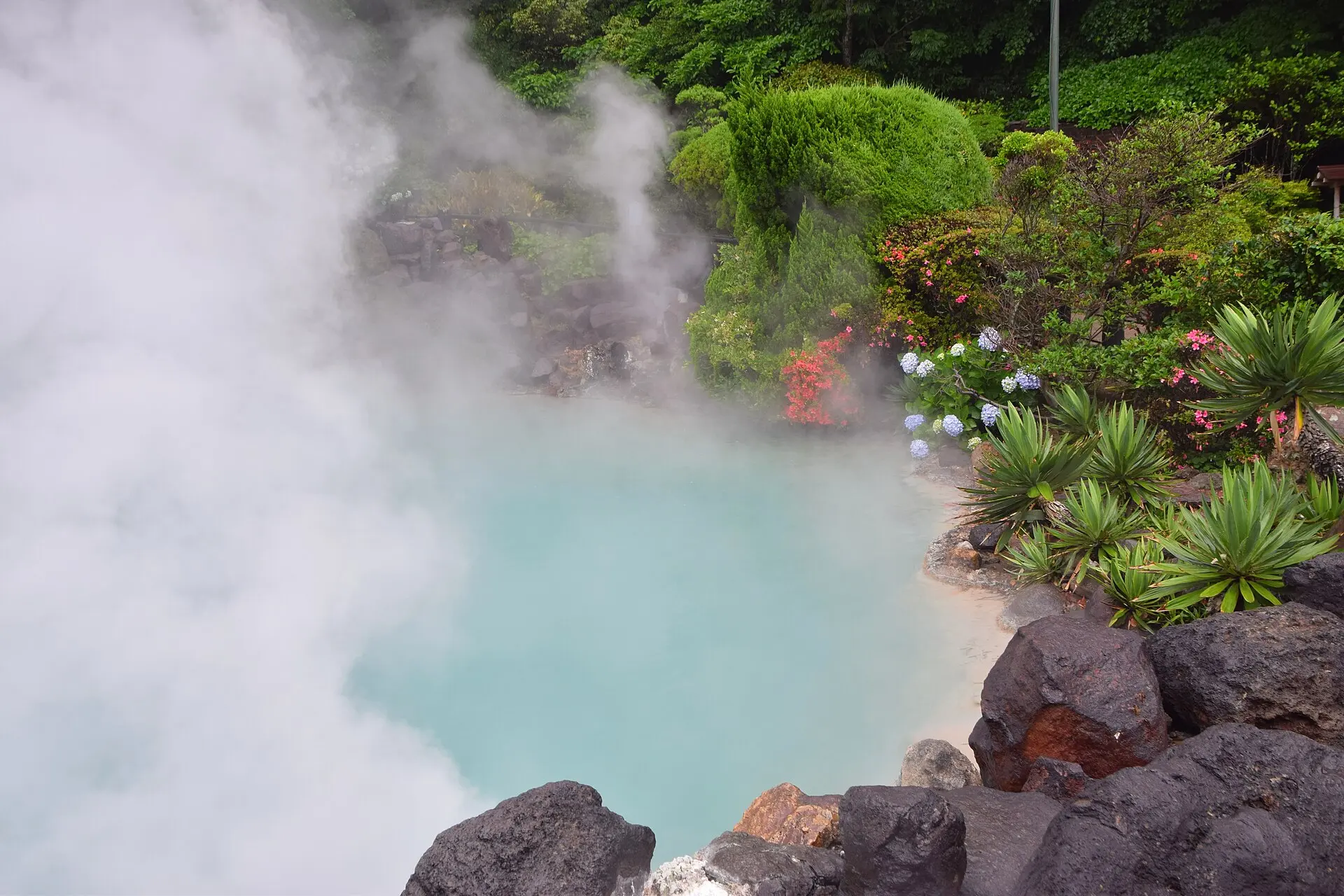
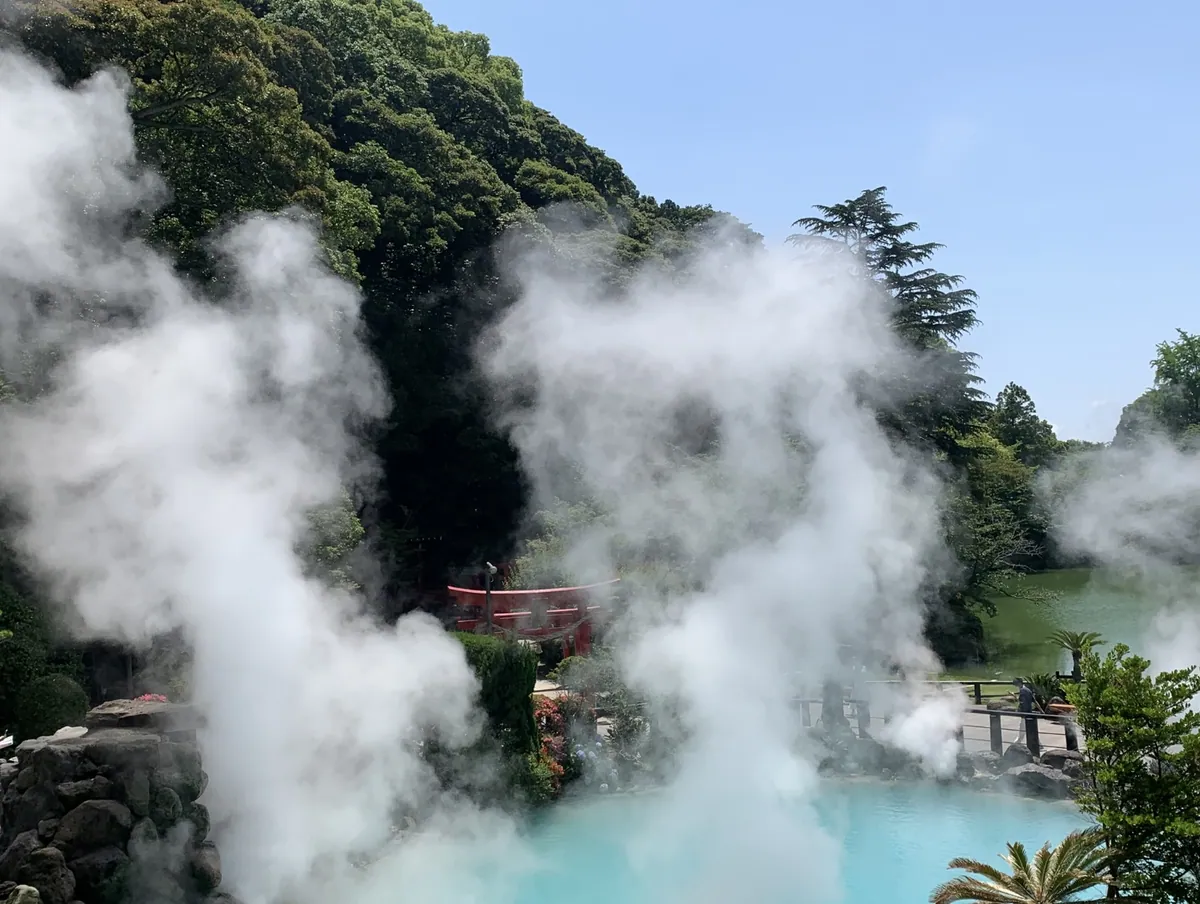
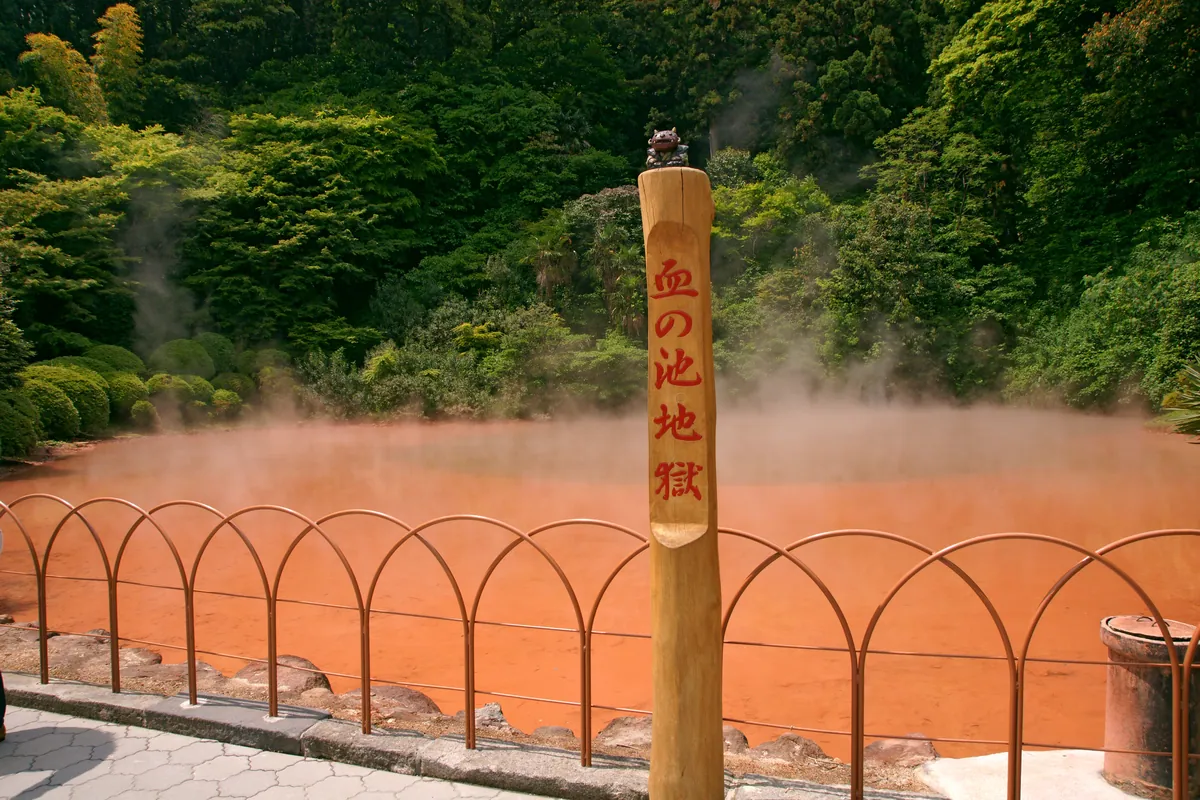
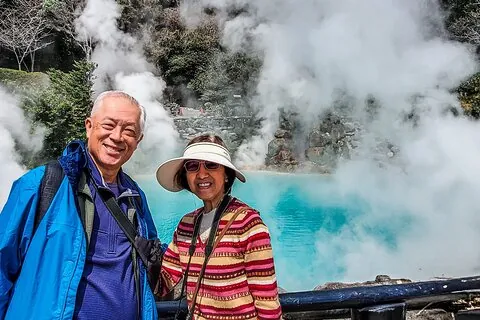
Seven boiling springs for looking at, not bathing in. There is the cobalt-blue pond of Umi Jigoku, bubbling grey mud at Oniishibozu, and the iron-red water of Chinoike. Five of them sit within walking distance of each other, and one ¥2,400 ticket covers all seven for two days.
From the shipWalk about 12 minutes to the Shiomicho stop, then the route 24 bus to Umi Jigoku-mae, 13 minutes and ¥260, at 19 minutes past most hours. A taxi takes about 15 minutes and costs from about ¥1,650.
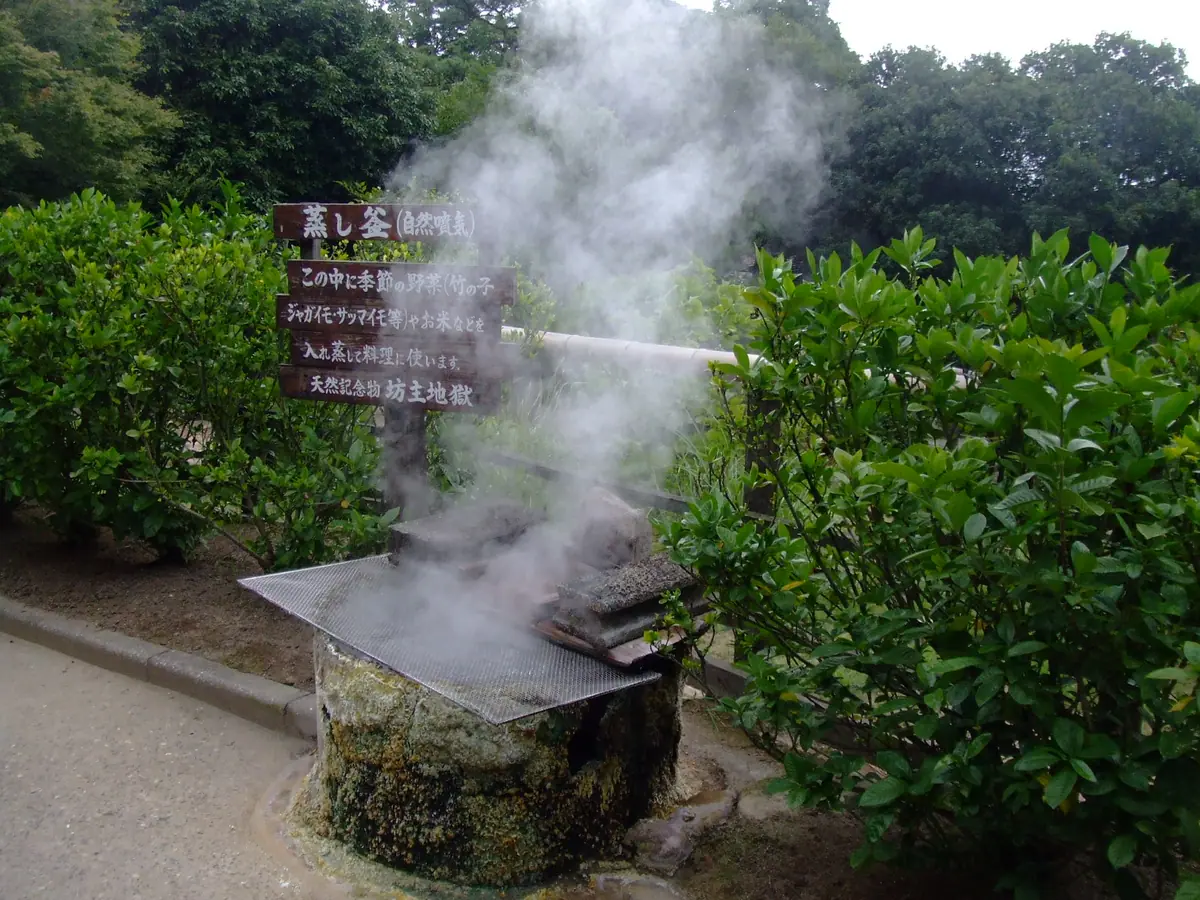
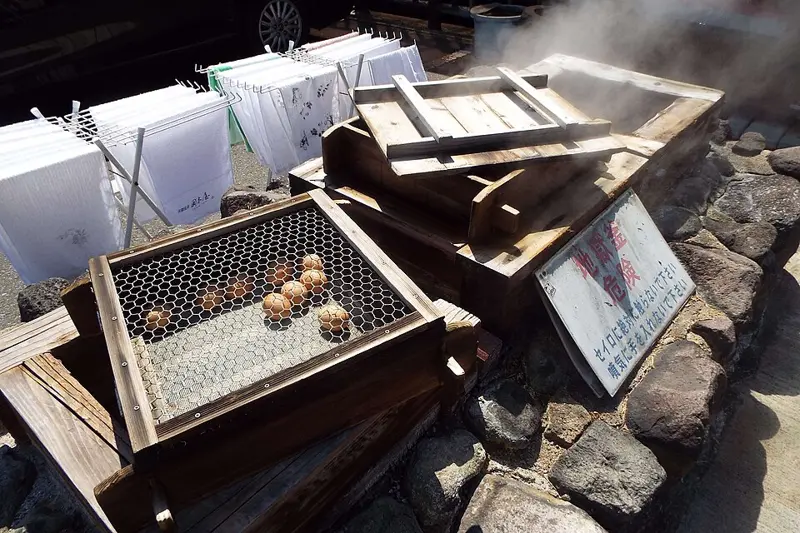
At Jigoku Mushi Kobo Kannawa, a city-run kitchen, you buy your ingredients on site and cook them over 98 °C steam from the ground. The steamer costs ¥400 for 15 minutes. You cannot book, so take a number and wait your turn. It is the one meal in Japan that comes out of a volcano.
From the shipIn Kannawa, a few minutes' walk from Umi Jigoku, so it fits into the hells trip. It opens at 10:00 and closes on the third Wednesday of each month; none of the calls listed from October 2026 falls on one.
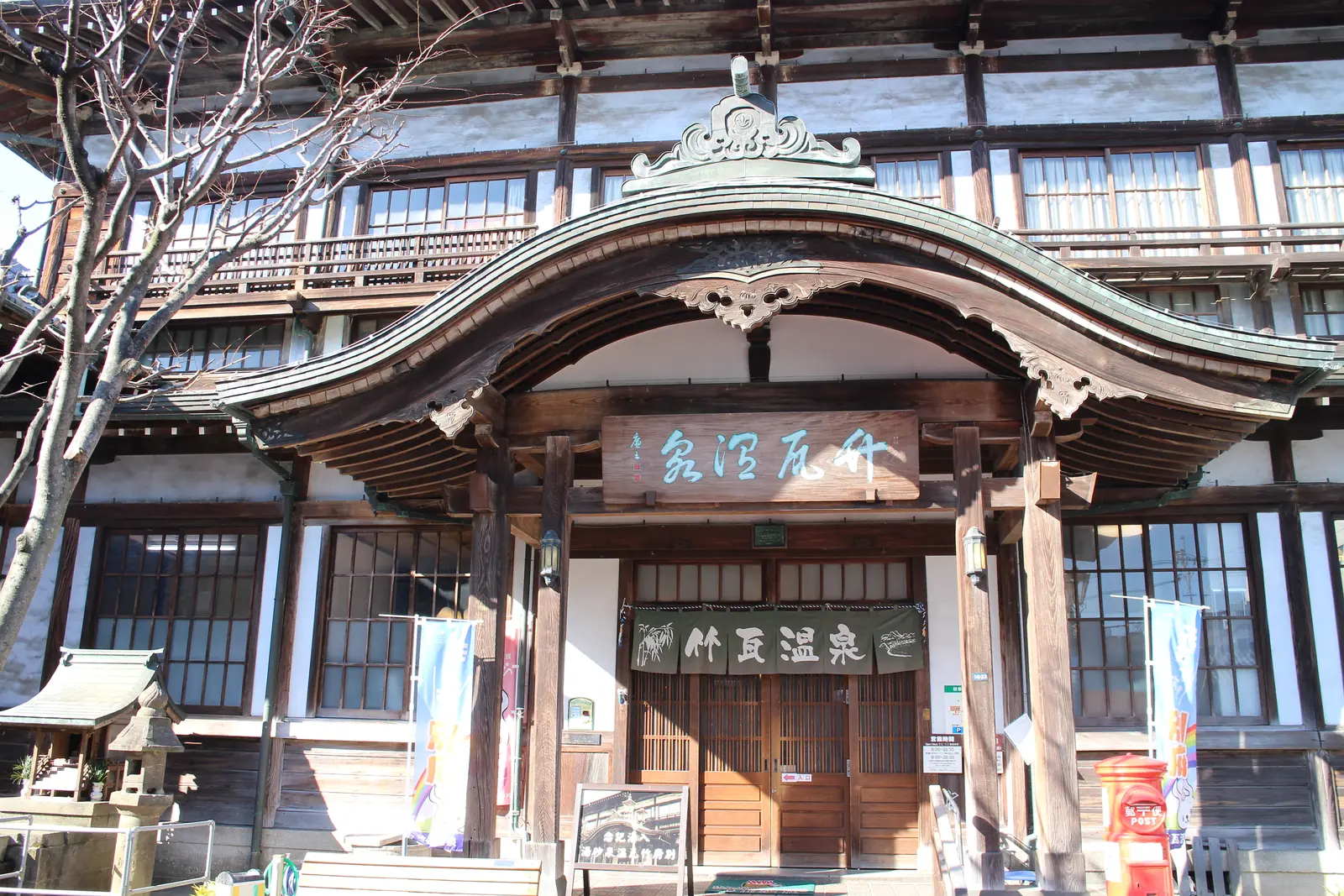
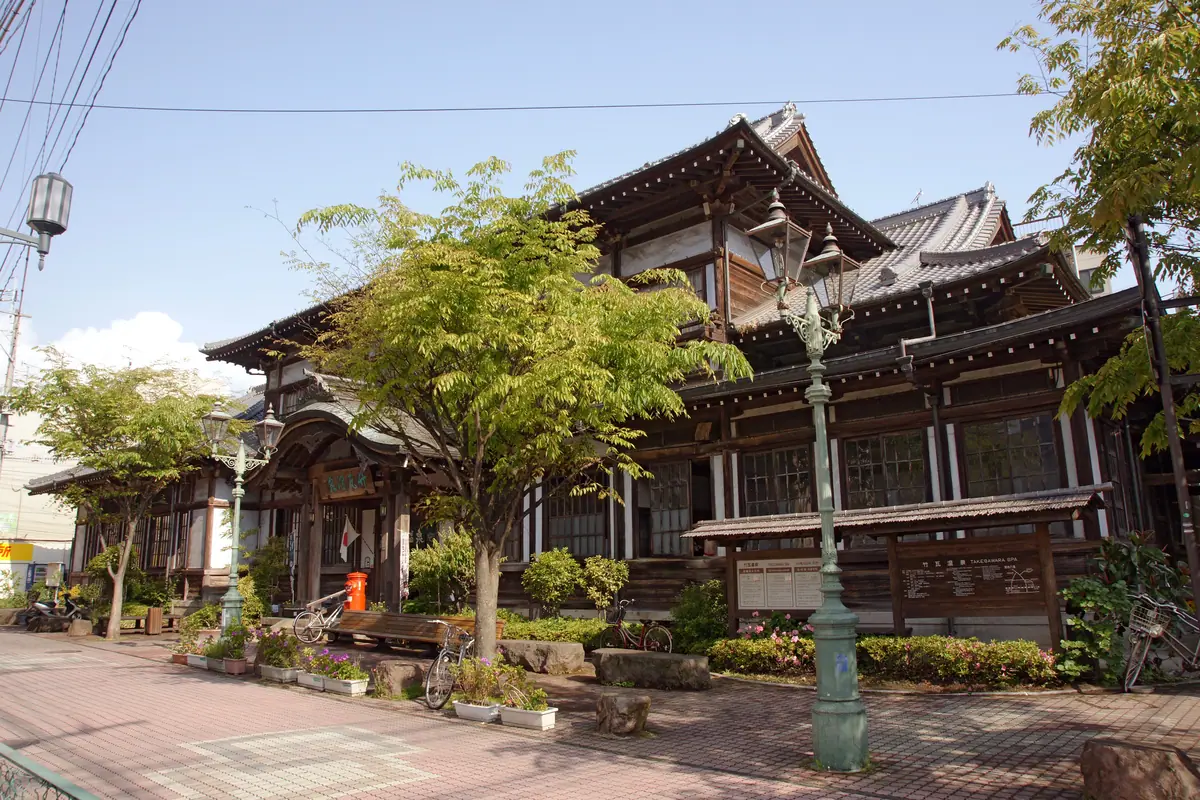
Beppu is Japan's hot-spring capital, and the way to feel it is to be buried to the neck in hot sand. You can do that at Takegawara Onsen, a wooden municipal bathhouse with a curved gable roof (sand bath ¥1,500), or at the seaside Beppu Beach Sand Bath at Shoningahama (¥2,500, yukata and towels included).
From the shipThe beach sand bath is the nearest bath to the ship: about 1.75 km, 5–10 minutes by taxi (from about ¥900). Takegawara is 2.8 km downtown: about 10 minutes and from about ¥1,150 by taxi, or a 35–40 minute walk.
Beppu is a town built on top of hot water. The steam you see rising between the roofs as the ship comes in is not smoke. It comes from the ground: from bath houses, inn kitchens and gutters, and from the hells, seven springs too hot, too coloured or too violent to bathe in. Umi Jigoku is a cobalt-blue pond. Chinoike is the red of rust. Oniishibozu is grey mud that rises in bubbles like shaved heads, which is where the name comes from. Tatsumaki is a geyser capped by a roof.
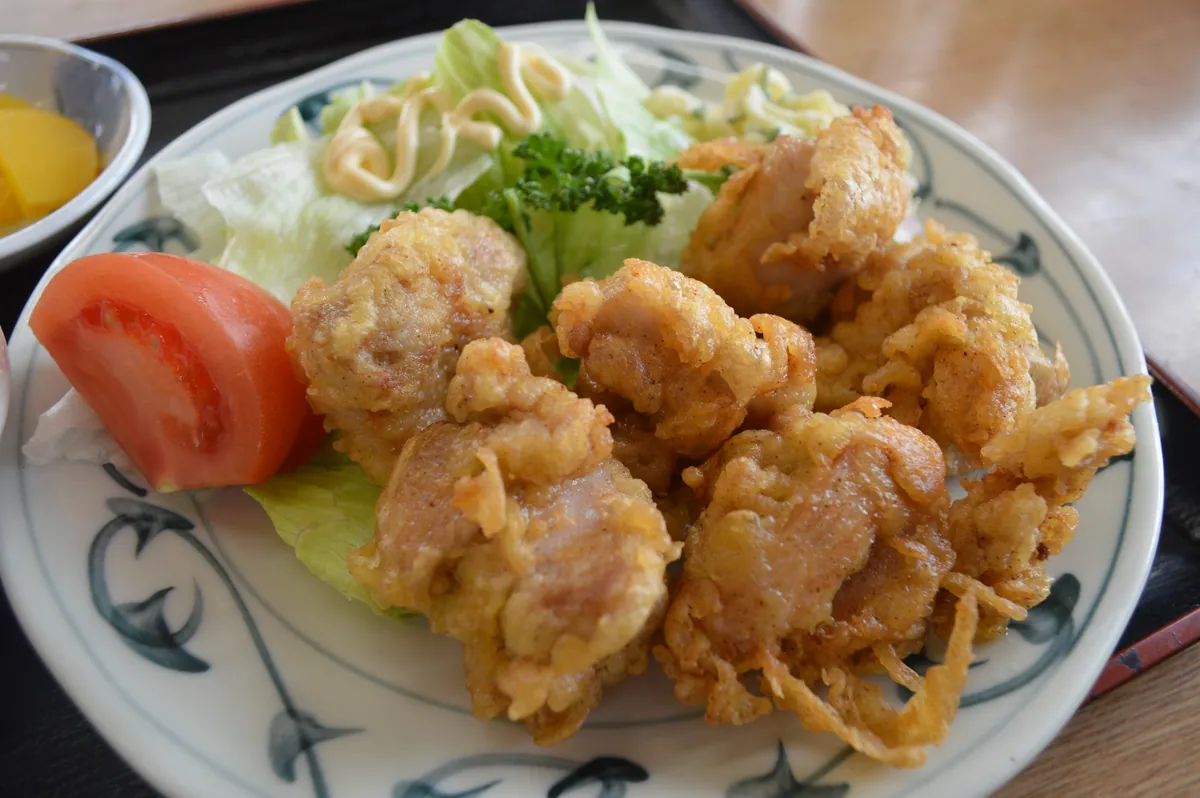
The rest of the day is about using that heat. In Kannawa, the district where most of the hells are, a city-run kitchen lets you steam your own lunch over volcanic vapour. Downtown, a 1938 bathhouse and a beach on the bay will bury you to the neck in hot sand. Beppu also invented toriten, chicken fried in tempura batter and eaten with ponzu, and the restaurant that started it is a 9-minute walk from the pier.
The hells, the steam kitchen and the baths all lie within about 7 km of a single cruise berth, and a cheap bus covers the main route. The hard part is the timetable: much of the advice online sends you to a stop with no midday buses, and to a bus home that does not exist. This guide is built from the city's own call list, the Kamenoi Bus timetables valid from March 2026, and the published hours and prices of the hells, the steam kitchen and the baths, all checked on 30 September 2026.
What Beppu is not: a temple-and-garden port. No.4 Pier is a working harbour beside the ferry terminal, and the town starts a walk, bus or taxi away.
First: which berth are you at?
Here the answer is easy. Every cruise ship uses No.4 Pier of Beppu International Tourist Port (別府国際観光港 第4埠頭), in the Ishigaki district on the north side of town. It opened in March 2011 as a pier built for cruise ships. All 48 calls in the city's 2025–26 record and all 34 in the 2026–27 list are there, and the list has no days with two ships.
No.4 Pier
Where
Ishigaki district, north Beppu, next to the Sunflower ferry terminal for Osaka
Size
A 280 m quay, enlarged in 2013. The largest ship on this season's list is Diamond Princess (about 116,000 tons, 290 m)
Terminal
Rebuilt larger in 2013 for cruise passengers. The city does not publish what is inside, so bring yen and do not count on an exchange desk
On foot
Toyoken (toriten) 650 m; Shiomicho and Mochigahama bus stops 0.9 km; beach sand bath 1.75 km; Takegawara and Beppu Station about 2.8 km
Public access
No public parking at the pier, so anyone meeting you comes on foot or by taxi
No shuttle bus from the pier is published by the city, the prefecture or the bus company. Some cruise lines run their own, so check the ship's daily programme; otherwise you walk 12 minutes to a bus stop or take a taxi.
Getting from No.4 Pier into Beppu
The local buses belong to Kamenoi Bus. They take cash, Suica-type IC cards and contactless credit cards. Drivers give no change and cannot break a ¥2,000, ¥5,000 or ¥10,000 note, so tap a card or carry coins. A one-day "mini free" pass costs ¥1,100; on a simple hells-and-back day, single fares are cheaper.
To
How
Time
Cost
Kannawa hells (Umi Jigoku)
Walk to Shiomicho, then route 24
12 min walk + 13 min bus
¥260
Kannawa hells (Umi Jigoku)
Taxi
about 15 min
from about ¥1,650
Beppu Station / Takegawara
Walk to Mochigahama, then any bus to the station
12 min walk + a short ride
¥190
Beppu Station / Takegawara
Taxi
about 10 min
from about ¥1,150–1,200
Beach sand bath (Shoningahama)
Taxi, or walk 1.75 km
5–10 min, or 23 min on foot
from about ¥900
Toyoken (toriten)
Walk
9 min
free
Chinoike and Tatsumaki
Taxi
15–20 min
from about ¥2,300
Beppu Ropeway
Taxi
20–25 min
from about ¥3,700
Yufuin
Taxi or private car
35–45 min
from about ¥7,700
Taxi fares are the floor of the official Beppu tariff for the distance: ¥550 for the first kilometre, then ¥50 for each 160 m. Slow traffic adds ¥50 a minute on top. The hells association quotes about ¥1,900 from Beppu Station to Umi Jigoku, which matches. Hourly hire is ¥2,660 per 30 minutes (¥5,320 an hour). Whether taxis wait at the pier on every call is not published, so if you plan to ride one, ask at the ship's tour desk the evening before.
The bus stop trap. The stop nearest the ship, Sunflower Terminal Beppu-mae, is timed to the Osaka ferries and has nothing in either direction between about 9:00 and 16:00 on weekdays. Ignore it. The stops that work are on the main road, about 0.9 km from the ship:
Shiomicho (汐見町): route 24 towards Kannawa, Umi Jigoku and Myoban. On weekdays it leaves at 8:19, 9:49, 10:19, then 11:19 and hourly to 15:19, then 17:19. At weekends it leaves at 7:59, 8:31, 9:46, then 11:19 and hourly to 15:19. There is no weekend 10:19.
Mochigahama (餅ヶ浜): several routes towards Kannawa, Chinoike and Beppu Station, including route 20 at 29 minutes past most hours. Weekday buses to the station run several times an hour (¥190).
From Beppu Station (if you are already downtown): routes 2, 5 and 41 leave the West exit for Kannawa and Umi Jigoku, about 20 minutes and ¥330.
Beppu port to the hells: what is actually possible
The seven hells come in two groups. Five sit together in Kannawa: Umi (sea), Oniishibozu (shaven-monk), Kamado (cooking pot), Oniyama (devil's mountain) and Shiraike (white pond). You can walk between them in a few minutes. Two lie about 3 km further on: Chinoike (blood pond) and Tatsumaki (the geyser). You need a taxi or a bus for those.
The honest options from No.4 Pier:
Bus both ways (¥520). Route 24 from Shiomicho to Umi Jigoku-mae takes 13 minutes. Back, it leaves Umi Jigoku-mae at 32 minutes past (11 minutes to Shiomicho) — weekdays 9:32, 11:32, 12:32, 13:32, 14:32, 16:32, with no 10:32 or 15:32; weekends from 11:32. Plan around the 13:32 or 14:32.
Taxi out, bus back. This is the answer for a 10:00 arrival or a weekend morning, when the route 24 gap is longest. A taxi takes about 15 minutes and costs from about ¥1,650.
Taxi both ways. At least about ¥3,300 a car. It is worth it for four people, or on a short call.
Adding Chinoike and Tatsumaki. Take a taxi from Kannawa (about 3 km, from about ¥1,200), then a taxi straight back to the ship (6.5 km, from about ¥2,300). Routes 16A, 26 and 26A also run from Kannawa towards Chinoike, but not every trip passes the hells: check the destination board.
The Jigoku Meguri sightseeing bus leaves Beppu Station at 9:20 and 14:00 for all seven hells: about 3 hours, ¥4,500 including admissions. It must be booked ahead by phone or online, includes about an hour on foot and is narrated in the Japanese bus-guide style, which makes it awkward for most cruise passengers.
The hells: tickets, hours and how long each takes
The hells are open 8:00–17:00 every day of the year. One combined ticket for all seven costs ¥2,400 for adults and ¥1,200 for children. It has been that price since 1 February 2025, it is sold at every hell, and it is valid on the day you buy it and the next day, with one entry per hell. Holders of a disability handbook pay ¥1,200. There is no senior discount, and the association no longer publishes single-hell prices, so the "about ¥450 each" you may read elsewhere cannot be relied on.
How long to allow is not published. Going by the sightseeing bus, which does all seven in about three hours including the driving, plan on about 40 minutes for Umi Jigoku and 15–25 minutes for each of the others.
Umi Jigoku is the one to see if you see only one. Iron sulphate dissolved in the water turns the pond cobalt blue. There is a lily pond where giant Victoria water lilies bloom from early May to early November, best in the morning. There is also a foot bath, with towels on sale from ¥250, and a shop selling eggs boiled in the spring (five for ¥450).
Oniishibozu is grey mud rising in round, slow bubbles, a few minutes' walk from Umi.
Kamado, Oniyama and Shiraike complete the walkable Kannawa cluster; each takes 15–25 minutes.
Chinoike is the red one, and the most photographed after Umi. It has a restaurant serving toriten and steamed set meals.
Tatsumaki is a geyser capped by a roof. It erupts at regular intervals and can shoot up to about 30 m. The exact interval is not published, so be ready to wait.
Crowds. No official figures are published, but the association handles coach groups at Umi and Chinoike, so expect tour buses there. The 9:49 bus from Shiomicho gets you to Umi Jigoku just after 10:00; the smaller Kannawa hells are likely to be quieter than Umi when the coaches arrive (our inference).
Access. Every hell has a wheelchair-accessible toilet. Loan wheelchairs cannot be booked ahead: three at Umi Jigoku, two at Kamado and one at each of the others. Card payment at the ticket windows is not published, so carry ¥2,400 a head in cash to be safe.
Jigoku Mushi Kobo Kannawa is a city facility a few minutes' walk from Umi Jigoku. You buy your ingredients there and cook them yourself in a steamer fed by 98 °C, 100 % geothermal vapour.
Hours: 10:00–19:00, last order 18:00 (since April 2023).
Closed: the third Wednesday of each month (the next day if that is a holiday). For the coming season that means 21 October, 18 November, 16 December, 20 January, 17 February and 17 March. None of the calls listed from October 2026 falls on one of those dates.
Price: the steamer costs ¥400 for up to 15 minutes and ¥200 for each extra 10 minutes. A large steamer is ¥600 (plus ¥300 per 10 minutes). Food is bought separately, and some food prices rose on 1 October 2026.
Booking: none. Take a numbered ticket and wait your turn. Arriving by 11:30, before the lunch crowd, is the safest plan on a port day.
Also there: a foot bath (10:00–18:00). The foot steamer was out of use when we checked.
Payment methods are not published. Carry cash for the basket.
Takegawara Onsen is the city's best-known public bath, a wooden building from 1938 with a curved karahafu gable roof, about 450 m from Beppu Station.
Plain bath: 6:30–22:30, ¥300.
Sand bath: 8:00–22:30 (last entry 21:30), ¥1,500 for anyone aged 6 or over. You lie buried in naturally heated sand. Up to eight people fit at once, so expect a wait at busy times. The bath takes no reservations at all, by phone or online, so just turn up; the advice to "book on arrival" does not apply.
Closed: the third Wednesday of the month, both baths. None of the calls listed from October 2026 falls on one.
Extras: towels, shampoo, soap and hairdryers cost extra. There is no parking.
Beppu Beach Sand Bath at Shoningahama is the seaside version and the nearest bath to the ship, about 1.75 km away. Adults pay ¥2,500 and children aged 6 to 12 pay ¥1,800, with a yukata, bath towel and face towel included; under-6s are not allowed. It is open 8:00–22:00 (last entry 21:00) from June to October and 8:00–18:00 (last entry 17:30) from November to March. It closes irregularly twice a month, and those dates are not published far ahead, so have Takegawara as the fallback.
Tattoos. Beppu's official tourism site marks both Takegawara and the Beppu Beach Sand Bath as tattoo-friendly. Other baths set their own rules, so ask before you pay.
Hyotan Onsen in Kannawa is the private option: a large bath (¥1,160), a sand bath and bookable family baths, open 9:00 to 1:00.
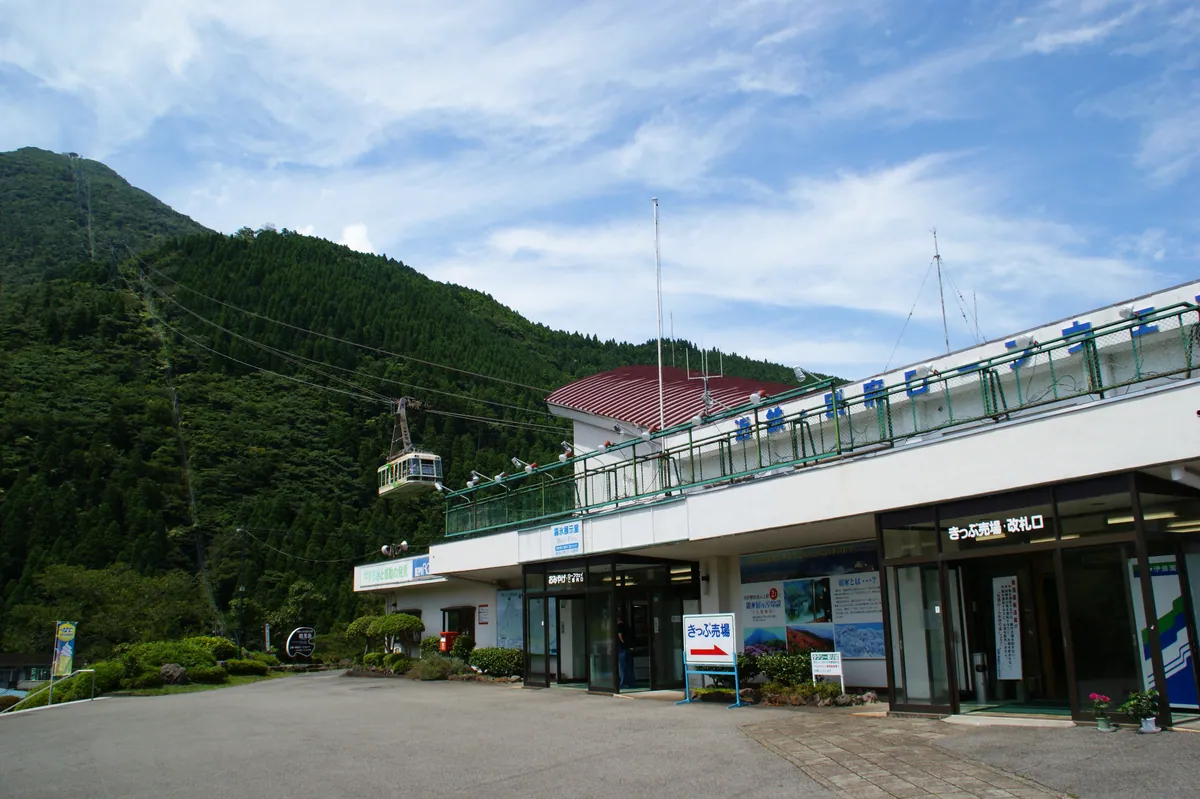
The Beppu Ropeway lifts 101-person cabins about 10 minutes up Mt. Tsurumi to the 1,300 m level. The summit itself is 1,375 m. From the top you see the bay and the steam of the town below. Cabins run every 20–30 minutes (every 15 when busy) from 9:00. The last ride up is 17:00 from 15 March to 14 November and 16:30 from 15 November. Fares are ¥1,800 return or ¥1,200 one-way for adults, and ¥1,700 return for those 70 and over. There is a stair lift for wheelchairs at the lower station. Bad weather stops it.
Getting there: a taxi from the ship takes 20–25 minutes and costs from about ¥3,700. Alternatively, take bus route 36 from Beppu Station West exit (platform 1). On weekdays it leaves at 9:10, 9:40, 10:10, 10:40, 11:10, 11:40, 12:10, 12:40 and 13:40, and takes about 23 minutes. Buses back to the station leave at 11:56, 12:40, 13:15, 13:45, 14:35, 15:05 and later. It works on a 6-hour call by taxi or an 8-hour call by bus; with the hells, about 9.5 hours.
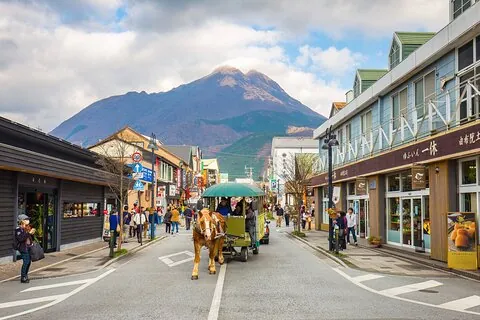
Yufuin is a hot-spring village under Mt. Yufu, about 24 km inland. The rapid Yufurin bus is suspended from 17 October 2026. That leaves route 36 from Beppu Station West (¥1,100) or a car: 35–45 minutes and from about ¥7,700 each way by taxi. Yufuin and the hells together need a car and a call of 9 hours or more. On a typical 8-hour call, choose one.
Takasakiyama's wild monkeys live on a wooded hill about 6.4 km south of No.4 Pier, just over the city line in Oita. Takasakiyama Natural Zoo is open 9:00–17:00 every day (last entry 16:30, with a few unscheduled closures a year), and adults pay ¥500; cards and IC cards are accepted. The feeding ground where the troops come down is a 6-minute walk from the gate, or ride the small Sarukko rail (¥160 return, every 8–10 minutes). The zoo says it is about 15–20 minutes from the port on an Oita Kotsu bus bound for Oita Station from the Minamisuga-iriguchi stop; a taxi is roughly 10–15 minutes and from about ¥2,250 (our estimate from the tariff). The Umitamago aquarium shares its car park: 9:00–17:00, ¥3,000 for adults and ¥2,500 for 70 and over. Monkeys and aquarium together should fit a 6-hour call, and with the hells about 8 hours (our estimate).
The best things to do in Beppu on a port day
Our full list, with the time each takes from the pier, is on the Beppu top 10, and ready-made itineraries are on Beppu plans. In brief:
The hells of Kannawa: five hells on foot around Umi Jigoku, about four hours from the ship and back by bus.
Yuzu-kosho and yunohana: the bath-salt huts of Myoban, a taxi ride above Kannawa (from about ¥2,400 from the ship). The shop's hours are not published online, so go only if you have spare time.
The hells and a steamed lunch: an 8-hour weekday call
Fits an 08:30–16:30 or 08:30–17:00 weekday call (Azamara Pursuit, Fri 9 Oct; Viking Orion, Fri 23 Oct). Weekend and 10:00 arrivals are covered in the note.
This is the classic Beppu day, done by public bus for ¥520 a head in fares. Times assume an 08:30 arrival and 16:30 departure, so all-aboard is about 16:00 and our target for being back at the gangway is 15:00. Walking times between the pier and the bus stop are our estimates from map routing.
09:00Off the ship. Walk about 0.9 km (12 minutes) to the Shiomicho stop on the main road. Do not wait at the Sunflower Terminal stop by the ferries.
09:49Route 24 towards Kannawa and APU. Pay ¥260 in cash or tap an IC card or contactless credit card.
10:02Off at Umi Jigoku-mae. Buy the ¥2,400 combined ticket at the first window; it covers all seven hells today and tomorrow.
10:05Umi Jigoku: the cobalt pond, the lily pond (giant water lilies bloom until early November) and a foot bath. Allow about 45 minutes.
10:50Walk to Oniishibozu Jigoku with its bubbling grey mud, and one more of the Kannawa cluster: Kamado, Oniyama or Shiraike.
11:30Jigoku Mushi Kobo Kannawa. Take a numbered ticket, buy your ingredients and steam them (¥400 per 15 minutes). Getting there before noon is the safer bet.
12:40The Kannawa steam lanes: vents rising between the inns, and the Kannawa Tourist Information office (open until 17:00) for Wi-Fi and help in English.
13:32Route 24 from Umi Jigoku-mae towards Beppu Station, ¥260. It reaches Shiomicho at 13:43; walk back about 12 minutes.
13:55Back at the gangway, about 65 minutes ahead of the 15:00 target. Transport cost for the day: ¥520 each.
A sand bath and Beppu's fried chicken: a 6.5-hour call
Fits the shortest call left on the list: Seabourn Encore, Sun 8 Nov (09:30–16:00). It also suits anyone who would rather bathe than look at boiling water.
Here you trade the hells for the other half of Beppu: a hot-sand bath in a 1938 municipal bathhouse, and lunch at the restaurant that invented toriten, Beppu's tempura-fried chicken. That restaurant happens to be 650 m from the ship. Times assume 09:30–16:00, all-aboard about 15:30, and a 14:30 target. Taxi times and fares are our estimates from the official tariff.
10:00Off the ship. Taxi to Takegawara Onsen, 2.8 km, about 10 minutes and from about ¥1,150. It is too far to walk comfortably on a short call.
10:15Takegawara sand bath (¥1,500; open from 8:00). You are buried to the neck in naturally heated sand. Up to eight people fit at once, so there may be a short wait. Towels are a paid extra.
11:15The bathhouse's wooden hall and curved gable roof from outside, then the old lanes between Takegawara and the station. Wander Compass, the tourist office a minute's walk from the station's east exit, changes money.
11:50Taxi to Toyoken in Ishigaki-higashi, about 3 km, roughly 15 minutes and from about ¥1,200 (our estimate).
12:05Toriten lunch at Toyoken, the restaurant where Beppu's chicken tempura began. Lunch is walk-in from 11:00, with last orders at 15:00, or earlier if the queue is long.
13:15Walk back to the pier, about 650 m and 9 minutes on flat streets.
13:25Back at the gangway, about 65 minutes ahead of the 14:30 target. Transport cost: about ¥2,350+ for the two taxi rides, shared.
Hells, ropeway and a sand bath: a long call
Fits calls of 9.5 hours or more, such as the 09:30–22:00 spring calls by Viking and Le Soléal. None of the calls listed for October and November 2026 is this long.
With most of a day you can add Mt. Tsurumi to the hells. The ropeway climbs to the 1,300 m level, where you look down on the bay and the steam plumes of the town. Times assume a 09:30 weekday arrival and a departure of 19:00 or later. The ropeway's last ride up is 17:00 until 14 November and 16:30 from 15 November.
10:00Off the ship; walk about 12 minutes to Shiomicho.
10:19Route 24 to Umi Jigoku-mae (¥260), arriving about 10:32. Buy the ¥2,400 combined ticket.
10:35Umi Jigoku, Oniishibozu and Kamado, the heart of the Kannawa cluster. Allow about an hour.
11:40Steamed lunch at Jigoku Mushi Kobo Kannawa (steamer ¥400 per 15 minutes).
12:50Taxi from Kannawa to the Beppu Ropeway lower station, about 15–20 minutes (our estimate).
13:15Beppu Ropeway: ¥1,800 return (¥1,700 for 70 and over). The cabins run every 20–30 minutes and take about 10 minutes to the top. Allow an hour up there.
15:05Route 36 bus from the ropeway stop to Beppu Station, about 25 minutes (our estimate from the outbound timing). Earlier buses leave at 13:45 and 14:35.
15:40Takegawara Onsen, about 450 m from the station: sand bath ¥1,500 or the plain bath ¥300.
16:50Taxi back to No.4 Pier, about 10 minutes and from about ¥1,150. You are at the gangway around 17:00, hours before the target on a 22:00 departure.
How to think about your hours
Work backwards from the ship. Your all-aboard time is usually 30 minutes before departure (check the daily programme). You want to be back at the gangway an hour before that, and the first half hour after arrival goes on getting off. So the time you can actually use is the call length minus about two hours. In Beppu, also check whether your call is on a weekday or at the weekend, because the route 24 timetable changes.
Call
Usable
What fits from No.4 Pier
4 hours
about 2
Toriten lunch at Toyoken (9 minutes' walk), or the beach sand bath by taxi. Not the hells: an hourly bus and the walks leave too little time.
6–7 hours
about 4–5
Either Kannawa (taxi out, bus or taxi back: four hells and a steamed lunch) or Takegawara's sand bath, downtown and Toyoken. Not both.
8–9 hours
about 6–7
The Kannawa hells and a steamed lunch by bus, with Chinoike and Tatsumaki by taxi or a sand bath on the way back. Yufuin only by car, and then without the hells.
9.5 hours+
about 7½+
The hells, a steamed lunch, and the ropeway or Yufuin by car; or all seven hells and a Takegawara sand bath.
The 2026–27 list has 34 calls, and the middle one is 8½ hours: four of 6½ hours, two of 7, four of 7½, six of 8, seven of 8½ and the rest longer, up to 12½. None is an overnight. The eight calls from October 2026 run 6½ to 8½ hours, between 4 October and 21 November.
Tours worth booking, by how many hours you have
Every pick opens our own page first — what the operator actually includes, who should skip it, and which upcoming Beppu calls it fits. Prices are the operator's "from" price as of 26 Sep 2026.
4h+One quiet hour downtown, for a short call
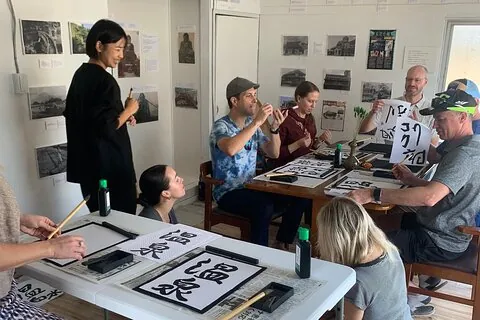
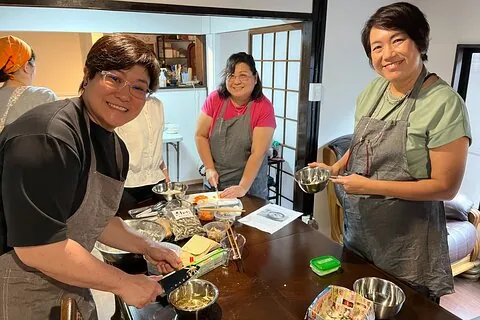
These are classes, not tours. They are held in a century-old house downtown, and you take a taxi there and back (about 10 minutes, from about ¥1,150 each way). They work best on a short call, or as an addition to a bath morning.
The hells are easy to do on your own: a 13-minute bus ride and one ticket. A guide adds the back lanes and the stories. You get yourself to the meeting point, and route 24 from Shiomicho is the bus to take, not route 20.
Yufuin is a hot-spring village under Mt. Yufu, about 24 km away. With the Yufurin bus suspended, a private car is the realistic way to get there on a port day.
Tours are booked through Viator (a Tripadvisor company). If you book, we may earn a small commission at no extra cost to you. It never decides what we recommend — which is why each tour page has a "think twice" note.
About the return to the ship. None of the eight Beppu tours on Viator says in its listing that it will get you back to the ship on time, and only one, the Yufuin private tour, even mentions cruise passengers. Most of the rest are classes or walks you get to yourself. That actually makes the return easier to control: a taxi from Kannawa to No.4 Pier takes about 15 minutes. For the private car tours, confirm pickup at No.4 Pier in writing, tell the driver your all-aboard time when you meet, and agree to be back at the gangway an hour before it.
Money, cards and the practical stuff
Beppu is only partly card-friendly. The buses are the easy part. For most other places, payment methods are not published, so carry cash.
Place
Pay with
Kamenoi buses
Cash (no change, no large notes), IC card or contactless credit card
Hells combined ticket (¥2,400)
Not published: carry cash
Steam kitchen
Not published: carry cash
Takegawara Onsen
Card payment listed by the city tourism site; carry coins for the ¥300 bath
Beppu Beach Sand Bath
Card payment listed by the city tourism site (¥2,500)
Takasakiyama monkey park
Credit cards, IC cards and QR payment
Beppu Ropeway
Not published: carry cash for ¥1,800
Toyoken
Not published at the table: carry cash
Taxis
Not published: carry cash for the fare
Changing money. Wander Compass Beppu, the tourist office a minute's walk from the east exit of JR Beppu Station, changes currency and is open 8:45–18:00 every day. It also lends wheelchairs and stores bags. The Kannawa Tourist Information office (9:00–17:00) has Wi-Fi and bag storage. No ATM by the pier is published. Tipping is not expected in Japan, in taxis or restaurants. 7-Eleven and Japan Post machines generally accept foreign cards, but we have not checked where the nearest one is, so bring some yen ashore.
Opening days against your date. Toyoken closes on the second Tuesday of the month, and the steam kitchen and Takegawara on the third Wednesday. None of the calls listed from October 2026 falls on those days. Toyoken's lunch service runs 11:00–15:30 with last orders at 15:00, and it closes the door early when the queue is long. A 30-minute wait means no new diners after 14:30. Chinoike Jigoku's restaurant is the toriten fallback if you are already out at the hells.
When to go: seasons and crowds
Beppu's cruise season peaks in April (12 of the 34 calls) and in October–November (8). The 2026–27 list has no calls in December–March yet, although Beppu did host ships in every winter month of 2025–26. A few December and March itineraries name Beppu, but those calls are not on the city's list yet.
Autumn (October–November). Highs average 23 °C in October and 18 °C in November in nearby Oita, and November is the driest month of the season. The maples in Oita usually colour in late November, earlier on Mt. Tsurumi. Late November is also when the steam shows best: it is most visible on cold mornings, which favours the Diamond Princess (20 Nov) and Eastern Venus (21 Nov) calls.
Winter. Highs of 11–13 °C and little rain. The ropeway's shorter winter hours run from 15 November to 14 March.
Spring. Cherry blossom normally opens around 24 March and is in full bloom around 4 April, just as the busiest month of calls begins. The long 12½-hour calls are in April and May.
Summer. August highs average 32 °C, and June (314 mm of rain) is the wettest month. Do the hells early, before the heat.
Typhoons reach northern Kyushu about four times a year, most often in August and September. Calls do get cancelled for weather: Diamond Princess lost its October 2025 call to a typhoon.
Rain plan: the Takegawara sand bath and Hyotan Onsen are indoors, the steam kitchen has a covered cooking area, and the hells are short outdoor walks. The ropeway stops in bad weather.
What other guides get wrong about Beppu
Things you will read about Beppu elsewhere — in older port guides, forum posts and some cruise-line pages — set against what the official source says today.
You may read
What the official source says
Source
Cruise ships berth at the 12 m-deep Ishigaki No.3 wharf, built for ocean liners.
Every one of the 34 calls on the city's FY2026 list uses No.4 Pier of Beppu International Tourist Port, which opened in March 2011 as a cruise-only pier (280 m). Plan your walk from No.4: about 12 minutes to the Shiomicho bus stop.
The Jigoku Meguri circuit is seven hells: Umi, Oniishibozu, Kamado, Oniyama and Shiraike in Kannawa, plus Chinoike and Tatsumaki about 3 km away. One combined ticket covers all seven: ¥2,400 adult since 1 February 2025, open 8:00–17:00 every day.
Kamenoi Bus's 1-day Mini Free pass is ¥1,100 for adults (¥900 is the student price). The usual hells trip from Shiomicho is ¥260 each way, so the pass only pays off if you add at least two more rides.
Buses from the port to the hells come every 30 minutes.
The stop by the port, Sunflower Terminal Beppu-mae, has no bus towards Kannawa in the middle of the day. From Shiomicho, a 12-minute walk, route 24 runs about once an hour at 19 minutes past (weekdays 9:49, then 10:19 to 15:19), 13 minutes to Umi Jigoku-mae, ¥260.
Waiting at the bus stop named after the port.Sunflower Terminal Beppu-mae serves the Osaka ferries. On weekdays it has nothing towards Kannawa before 16:34 and nothing towards Beppu Station between 8:20 and 16:15. Walk about 12 minutes to Shiomicho (route 24 to the hells) or Mochigahama (routes to the hells and Beppu Station).
Following old advice to take route 20.Many pages, including older versions of ours, send cruise passengers to route 20 from the port. The bus that works in the middle of the day is route 24 from Shiomicho, at 19 minutes past most hours, 13 minutes to Umi Jigoku-mae, ¥260.
Assuming Takegawara is a short walk.It is 2.8 km from No.4 Pier, about 35–40 minutes on foot. Take a taxi (about 10 minutes, from about ¥1,150). The places you really can walk to from the ship are Toyoken (650 m) and, at a push, the beach sand bath (1.75 km).
Waiting for a 15:32 bus back from the hells.On weekdays route 24 has no 10:32 or 15:32 departure from Umi Jigoku-mae, so after 14:32 the next bus is 16:32. At weekends nothing leaves before 11:32. If you miss the 14:32, take a taxi (about 15 minutes, from about ¥1,650).
Turning up at the steam kitchen at 9:00.Jigoku Mushi Kobo opens at 10:00, not 9:00, and closes at 19:00. You cannot book, so take a numbered ticket. The hells open at 8:00, so do them first.
Budgeting with old prices.The combined ticket for all seven hells is ¥2,400 since February 2025. Many pages still say ¥2,000 or ¥2,200, and single-hell prices are no longer published.
Planning on the Yufurin bus.The rapid tourist bus from Beppu to the ropeway and Yufuin is suspended from 17 October 2026. Route 36 still runs to the ropeway, but Yufuin and the hells together on an 8-hour call needs a car.
Researched from official timetables, operators and the port authority. Every time and fare in this guide was checked against the sources listed above on 1 October 2026; where we had to estimate (a walk, a taxi in traffic), the text says so. Timetables change — if you find one that has, tell us and we will fix it.
Quick answers
Beppu cruise port questions
Where do cruise ships dock in Beppu?
At No.4 Pier of Beppu International Tourist Port, in the Ishigaki district on the north side of town, which opened as a cruise-only pier in 2011. Every call in the 2025–26 record (48) and the 2026–27 list (34) is there, so there is no second berth to worry about. The overnight ferries to Osaka use the Sunflower terminal next door; do not confuse the two.
Which cruise ships call at Beppu in 2026?
Eight calls are listed from October 2026, all at No.4 Pier: Viking Venus (Sun 4 Oct), Azamara Pursuit (Fri 9 Oct), Viking Orion (Fri 23 Oct), Seven Seas Explorer (Thu 29 Oct), Seabourn Encore (Sun 8 and Thu 12 Nov), Diamond Princess (Fri 20 Nov) and Eastern Venus (Sat 21 Nov). They run 6½ to 8½ hours. The city's 2026–27 list has 34 calls in all, 12 of them in April, and none yet for December to March, although ships did call in every winter month of 2025–26.
Is there a shuttle bus from the Beppu cruise pier?
No public shuttle is published by the city, the prefecture or the bus company. Some cruise lines may run their own, so check your ship's daily programme. Without one, walk about 12 minutes to the Shiomicho or Mochigahama bus stops, or take a taxi.
How far are the Beppu hells from the cruise port?
Umi Jigoku, the first of the Kannawa hells, is about 4.5 km from No.4 Pier: 13 minutes on the route 24 bus from Shiomicho (¥260, after a 12-minute walk), or about 15 minutes by taxi from about ¥1,650. Chinoike and Tatsumaki are about 3 km beyond Kannawa, 15–20 minutes and from about ¥2,300 by taxi from the ship.
Which bus goes from the Beppu cruise port to the hells?
Route 24 from the Shiomicho stop, about 0.9 km (12 minutes' walk) from the pier, at 19 minutes past most hours on weekdays (8:19, 9:49, 10:19, 11:19 and hourly to 15:19). It takes 13 minutes to Umi Jigoku-mae and costs ¥260. Return buses leave Umi Jigoku-mae at 32 minutes past, but on weekdays there is no 10:32 or 15:32. The stop named after the port, Sunflower Terminal, has no midday buses. From Beppu Station West exit, routes 2, 5 and 41 reach Kannawa in about 20 minutes (¥330).
How much is a taxi from the Beppu cruise port?
On the official Beppu tariff the first kilometre is ¥550, then ¥50 for each 160 m, plus time charges in slow traffic. From No.4 Pier that makes, at least, about ¥900 to the beach sand bath, ¥1,150 to Takegawara Onsen, ¥1,200 to Beppu Station, ¥1,650 to Umi Jigoku, ¥2,300 to Chinoike, ¥3,700 to the ropeway and ¥7,700 to Yufuin. Hourly hire is ¥2,660 per 30 minutes. Whether taxis wait at the pier on every call is not published, so ask at the ship's tour desk the evening before.
Can I walk from the Beppu cruise port to Beppu Station and downtown?
It is about 2.8 km to Beppu Station and Takegawara Onsen: 35–40 minutes on foot, about 10 minutes by taxi (from about ¥1,150–1,200), or a 12-minute walk to the Mochigahama stop and a ¥190 bus. Closer to the ship, Toyoken, the restaurant where toriten began, is 650 m away, 9 minutes on flat streets, and the Beppu Beach Sand Bath is 1.75 km. The Kannawa hells, over 4.5 km away, are too far to walk.
What can I do in Beppu on a 4-, 6- or 8-hour cruise stop?
Subtract about two hours for getting off and being back early. On a 4-hour call (about 2 usable hours), have toriten at Toyoken, 9 minutes' walk from the pier, or a beach sand bath by taxi. On 6–7 hours, choose either the Kannawa hells with a steamed lunch or the Takegawara sand bath and downtown, not both. On 8–9 hours, do the hells and lunch by bus for ¥520 in fares, plus Chinoike and Tatsumaki or a sand bath. From about 9½ hours you can add the Mt. Tsurumi ropeway or Yufuin by car.
How much does it cost to see the Beppu hells?
¥2,400 for adults and ¥1,200 for children for one ticket covering all seven hells, sold at each of them and valid on the day of purchase and the next day. Holders of a disability handbook pay ¥1,200. There is no senior discount and no published single-hell price. The hells are open 8:00–17:00 every day of the year.
Which Beppu hell is best if I only have time for one or two?
Umi Jigoku, the stop the route 24 bus is named after. Allow about 40 minutes for its cobalt-blue pond, the lily pond (giant water lilies until early November), the foot bath and the eggs boiled in the spring (five for ¥450). Oniishibozu, with its bubbling grey mud, is a few minutes' walk away and takes 15–25 minutes. There is no published single-hell price, so you pay ¥2,400 for the all-seven ticket either way. Umi Jigoku has an accessible toilet and three loan wheelchairs, which cannot be booked.
Can I see all seven hells on a port day?
Yes, on an 8-hour call. Five hells are walkable around Umi Jigoku; Chinoike and Tatsumaki are about 3 km away by taxi (from about ¥1,200) or bus. Allow about 40 minutes for Umi Jigoku and 15–25 minutes for each of the others. The Kamenoi sightseeing bus covers all seven in about 3 hours for ¥4,500 including admissions, but it must be booked ahead and is narrated in the Japanese bus-guide style.
How does the steam-cooking lunch at Kannawa work?
At Jigoku Mushi Kobo Kannawa you take a numbered ticket, buy ingredients there, and cook them in a steamer fed by 98 °C volcanic steam. The steamer costs ¥400 for up to 15 minutes, plus ¥200 per extra 10 minutes, or ¥600 for the large one. It is open 10:00–19:00 (last order 18:00), closed on the third Wednesday of the month, and takes no reservations. Some food prices rose on 1 October 2026.
Can you bathe at the Beppu hells?
No. The hells are boiling and are only for viewing, though Umi Jigoku has a foot bath. To bathe, go to Takegawara Onsen downtown (¥300 plain bath, ¥1,500 sand bath), the Beppu Beach Sand Bath at Shoningahama (¥2,500, the nearest bath to the ship) or Hyotan Onsen in Kannawa (¥1,160).
How does a Beppu sand bath work, and can I book one?
At Takegawara Onsen, the 1938 municipal bathhouse 2.8 km from the pier, the sand bath costs ¥1,500 (age 6 and over, from 8:00). You lie buried to the neck in naturally heated sand. The city takes no reservations at all, and eight people fit at once, so you may wait. The Beppu Beach Sand Bath at Shoningahama, 1.75 km from the ship, costs ¥2,500 with yukata and towels and closes irregularly twice a month, so keep Takegawara as the fallback. Takegawara closes on the third Wednesday; no call listed from October 2026 falls on one.
Can I use the Beppu sand baths and onsen with tattoos?
Yes at the two baths most cruise passengers use. Beppu's official tourism site marks both Takegawara Onsen (plain bath ¥300, sand bath ¥1,500) and the Beppu Beach Sand Bath at Shoningahama (¥2,500) as tattoo-friendly. Other baths, inns and hotels in Beppu set their own rules, so check each one before you pay. The seven hells are for viewing only, so the question does not arise there.
Where can I eat near the Beppu cruise port?
Toyoken, 650 m (9 minutes' walk) from No.4 Pier, is the restaurant where toriten, Beppu's tempura-fried chicken with ponzu, began. Lunch is walk-in from 11:00 to 15:30 with last orders at 15:00, or earlier when the queue is long. It closes on the second Tuesday of the month, and no call listed from October 2026 falls on one. Out at the hells, steam your own lunch at Jigoku Mushi Kobo Kannawa (from 10:00, steamer ¥400) or eat toriten and steamed set meals at Chinoike Jigoku's restaurant.
How do I get from the Beppu cruise port to the Mt. Tsurumi ropeway?
By taxi it is 20–25 minutes and from about ¥3,700. By bus, take route 36 from Beppu Station West exit (platform 1), about 23 minutes, at 9:10, 9:40 and every half hour to 12:40, then 13:40 on weekdays. The Beppu Ropeway takes about 10 minutes to the 1,300 m level and costs ¥1,800 return (¥1,700 for 70 and over). The last ride up is 17:00 until 14 November and 16:30 from 15 November, and it stops in bad weather. It fits a 6-hour call by taxi or an 8-hour call by bus.
Can I visit Yufuin from the Beppu cruise port?
Only with a car on a call of about 8 hours or more. Yufuin is about 24 km away, 35–45 minutes by taxi (from about ¥7,700 each way). The rapid Yufurin bus is suspended from 17 October 2026, and the alternative, route 36 from Beppu Station West, is slow to fit into a port day. A private tour such as 5522712P1, which offers port pickup, is the simplest way.
Can I see the Takasakiyama monkeys from the Beppu cruise port?
Yes. Takasakiyama Natural Zoo is about 6.4 km south of No.4 Pier: roughly 10–15 minutes and from about ¥2,250 by taxi (our estimate), or 15–20 minutes on an Oita Kotsu bus bound for Oita Station from the Minamisuga-iriguchi stop. It opens 9:00–17:00 daily (last entry 16:30); adults pay ¥500, and cards are accepted. The monkey feeding ground is a 6-minute walk from the gate, or ride the Sarukko rail (¥160 return). The Umitamago aquarium (¥3,000; ¥2,500 for 70 and over) shares its car park.
Do I need cash in Beppu?
Carry some. Kamenoi buses take cash, IC cards and contactless credit cards but give no change on board and cannot change ¥2,000, ¥5,000 or ¥10,000 notes. Beppu's tourism site lists card payment at Takegawara and the beach sand bath; at the hells, the steam kitchen and in taxis it is not published. The Wander Compass tourist office, a minute's walk from JR Beppu Station's east exit, changes money (8:45–18:00). No ATM at the pier is published. Tipping is not expected in Japan.
What is the best tour from the Beppu cruise port?
For most couples the best plan is no tour: the hells by route 24 bus cost ¥520 in fares plus ¥2,400 admission. If you want a guide, the three-hour Kannawa stroll (419742P18) meets beside Umi Jigoku. For a group of six, the per-group private car tour (5586685P3) works out at about $87 each. For limited mobility or Yufuin, 5522712P1 is wheelchair-accessible and offers port pickup. None promises in writing to return you to the ship.
What is the weather like for a Beppu cruise call?
In October, highs average about 23 °C (73 °F) and in November 18 °C (64 °F) in nearby Oita, and November is the driest month of the autumn season. August averages 32 °C, and June, with 314 mm, is the wettest month. Typhoons reach northern Kyushu about four times a year, mostly in August and September, and calls do get cancelled for weather. If it rains, the Takegawara sand bath and the covered steam kitchen still work, but the ropeway stops in bad weather.