Updated 1 October 2026 · 31 official and operator sources · Researched from official timetables, operators and the port authority · Takumi Yamada
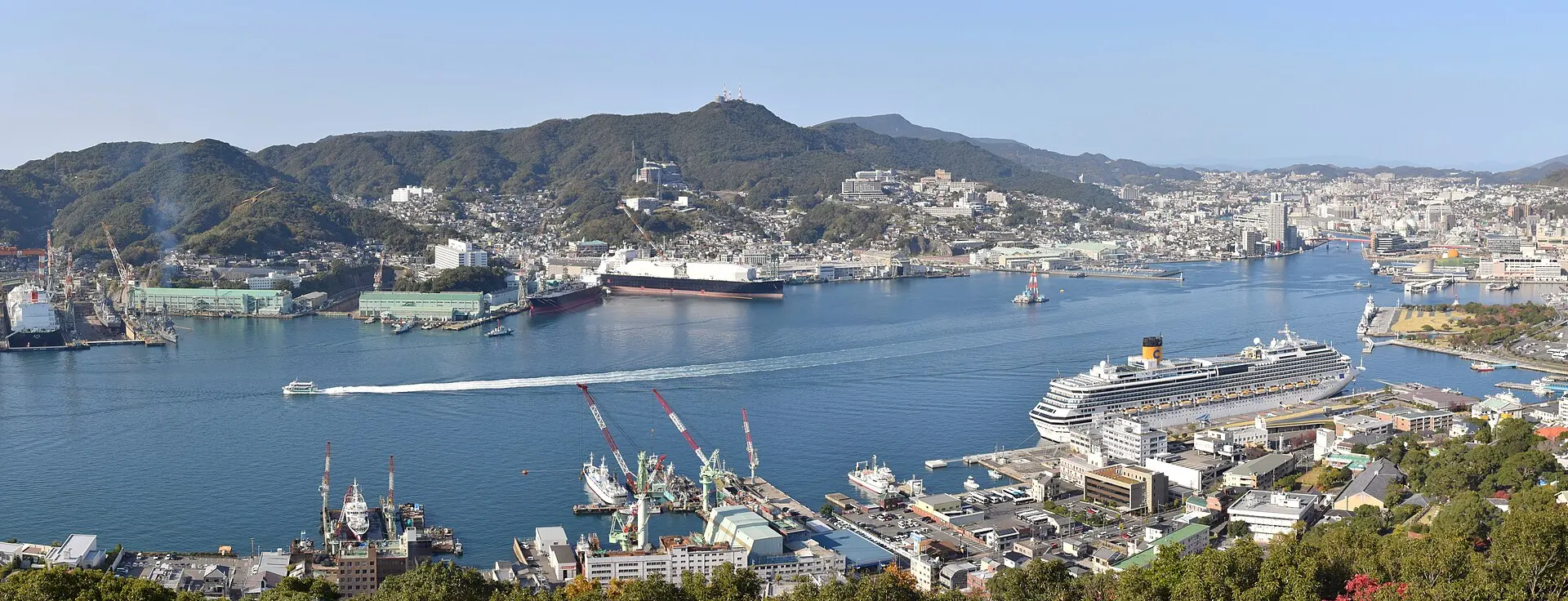
Nagasaki is the rare Japanese port where you step off the ship into the city. Nine ships in ten tie up at Matsugae, directly below Glover Garden and Oura Cathedral, and the Atomic Bomb Museum and Peace Park are about 40–50 minutes away by tram with one change. On the commonest call, 07:00–16:00, both fit if you start at the museum at opening and do the hillside after lunch. The decision to make before you sail is Gunkanjima, Battleship Island: its boats check in 150 m from the gangway and the morning trip is back by about 13:05–13:15, but it must be booked online in advance and it takes the Peace Park's place on a 9-hour call.
Your call, your day
What fits the time your ship gives you?
Pick your ship from the official Nagasaki schedule — or just the hours you have — and this page picks the plan and the tours that fit, with the hour before all-aboard already set aside.
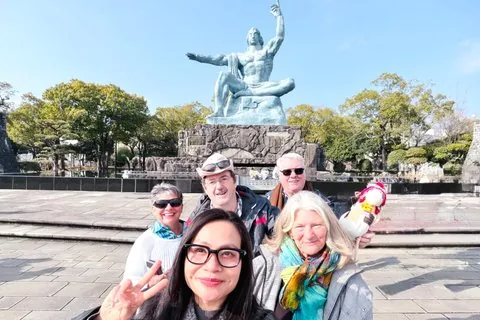
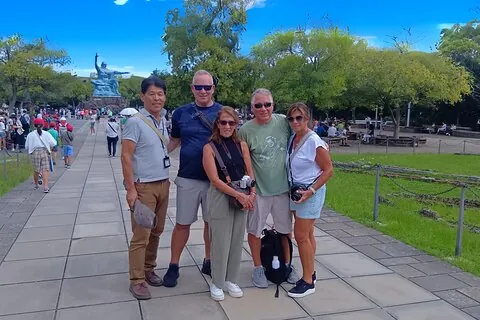
On 9 August 1945 the second atomic bomb fell on the Urakami valley in the north of the city. The museum, the hypocentre marker and the Peace Park with its great statue tell that story in a single walk, and for most passengers they are the reason Nagasaki is on the itinerary. Allow two to two and a half hours on site.
From the shipTram from Oura-kaigan-dori, 5–7 minutes' walk from the gangway: Line 5 to Shinchi Chinatown, change to Line 1, 25 minutes riding, about 40–50 minutes door to door, ¥150 with a card. Taxi about 15 minutes, from about ¥2,270. From Dejima wharf, Line 1 runs direct in 18 minutes.
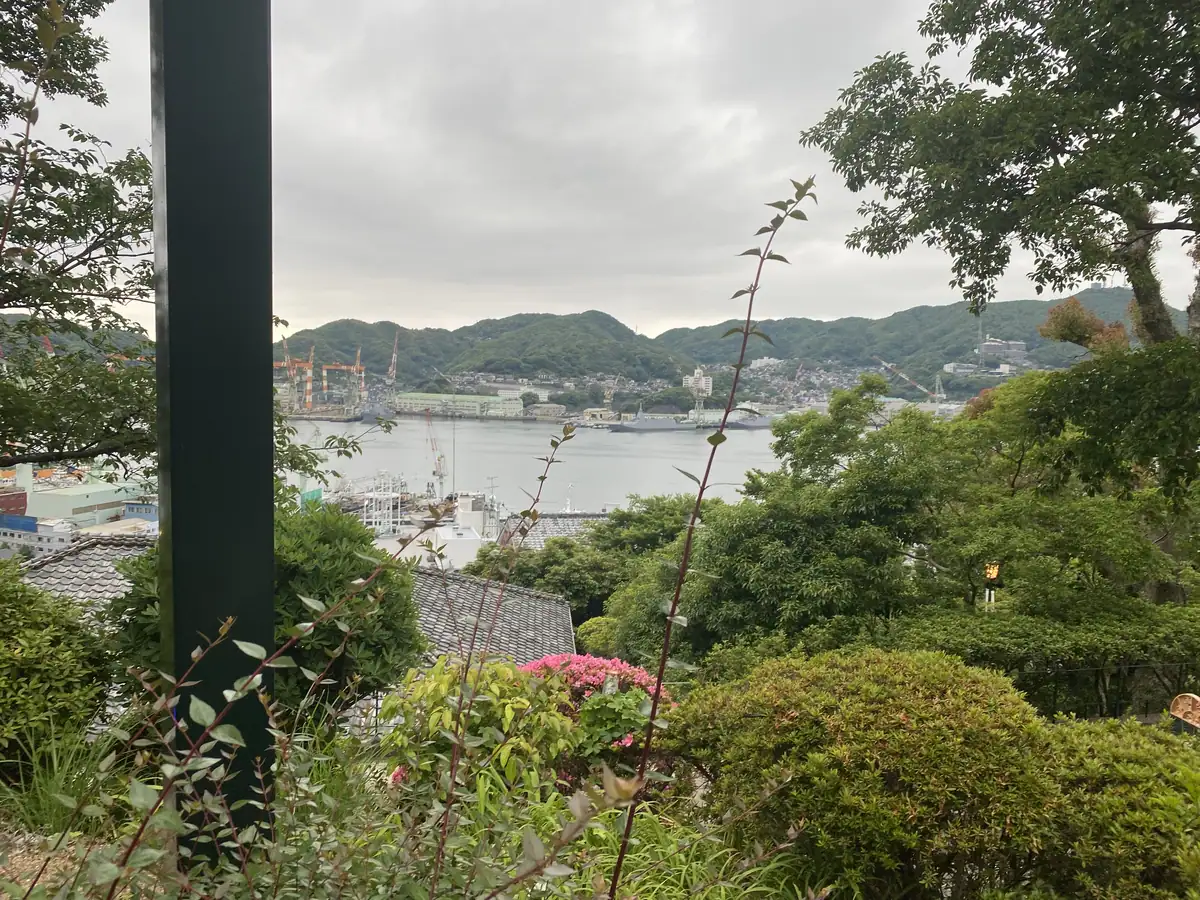
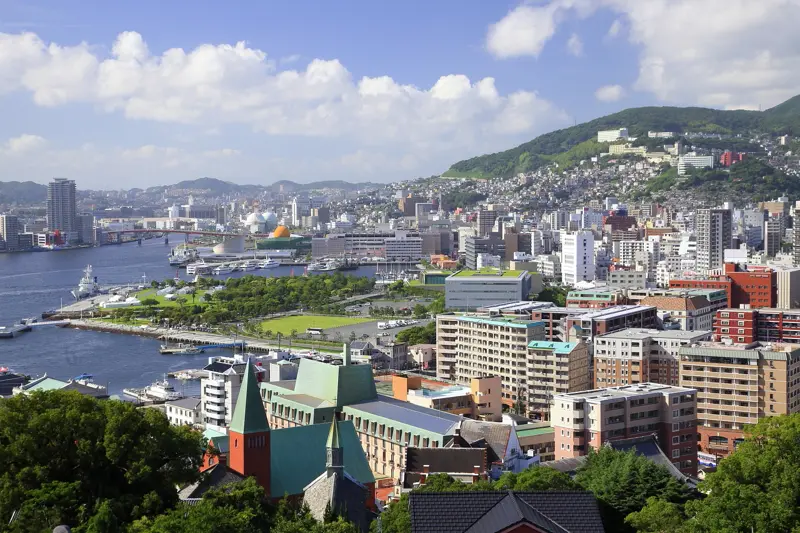
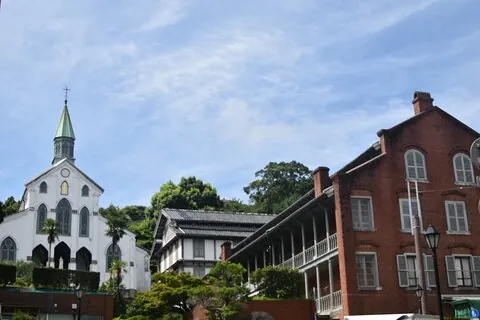
Merchant houses from the 1860s on the hillside over the harbour, with the cruise ships below, and next to them Oura Cathedral, a National Treasure and a World Heritage site. They are the reason a short call in Nagasaki is still a good call.
From the shipOn foot from Matsugae: about 5 minutes to Oura Cathedral and 7–10 minutes, uphill at the end, to Glover Garden's lower gate. Entry ¥1,300 (Glover) and ¥1,000 (Oura).
03
Gunkanjima, Battleship Island
An abandoned mining island crowded with concrete buildings, now part of a World Heritage listing. The boat circles it and, when the sea allows, lands you for about three-quarters of an hour. It is the one sight here that needs booking before you sail.
From the shipGunkanjima Concierge checks in at its Digital Museum, 150 m from the Matsugae gangway. Morning boat sails about 10:30 and is back about 13:05–13:15. ¥5,500 on weekdays, ¥6,000 at weekends, plus ¥650 island fee.
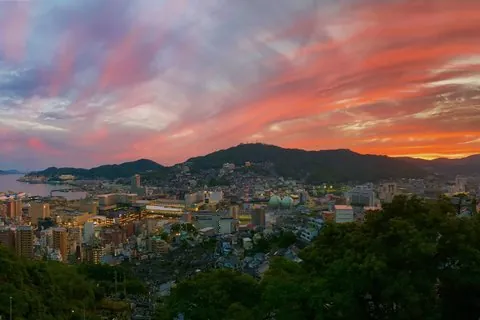
Nagasaki is the port where the city begins at the gangway. The Matsugae berth sits at the foot of the hill that carries Glover Garden and Oura Cathedral; Chinatown and Dejima, the island through which Japan traded with Europe for two closed centuries, are a short walk or tram ride along the waterfront. It was Japan's busiest port for foreign cruise ships in 2025, with 194 calls, and it earns them.
The day has one fixed point. On 9 August 1945 the second atomic bomb exploded over the Urakami valley, north of the centre, and the Atomic Bomb Museum and the Peace Park are where most passengers want to spend the heart of their morning. They are 5 km from the ship — not a walk, but an easy tram ride. Offshore lies the third reason to come: Gunkanjima, the abandoned mining island known as Battleship Island, whose boats leave from beside the berth.
What Nagasaki is not: flat, or fast. The city climbs steep hillsides, the trams change at Shinchi Chinatown, and since February 2026 they run less often than they used to. The plans below are built from the prefecture's own call schedule, the tram operator's stop-to-stop times and timetables, and the museums' and boat operators' published hours, all checked on 30 September 2026.
First: which berth are you at?
Nagasaki has two cruise berths, both in the city, about 1 km apart along the east side of the harbour.
Matsugae (almost every ship)
Dejima wharf (second ship on two-ship days)
Where
Matsugae-machi, below the Glover Garden hillside
Dejima-machi, beside Dejima and the waterfront restaurants
Dejima and Shinchi Chinatown about 7 min each, Dejima tram stop 5 min
Best for
Glover Garden, Oura, Shikairo, the Gunkanjima Concierge boats
The Peace Park (direct tram), Dejima, Chinatown
The prefecture's schedule for 1 October 2026 to 31 March 2027 lists 72 named calls: 65 at Matsugae and 7 at Dejima wharf. All seven Dejima calls fall on days when another ship already has Matsugae — Star Seeker on 1 and 21 October, Azamara Pursuit on 11 October, Luminara on 12 November, Eastern Venus on 23 November, Nautica on 16 March and Le Soléal on 25 March 2027. That is our reading of the schedule rather than a published rule, but it has held for every Dejima call in the 2026–27 files. Check your berth in the ship's daily programme the night before.
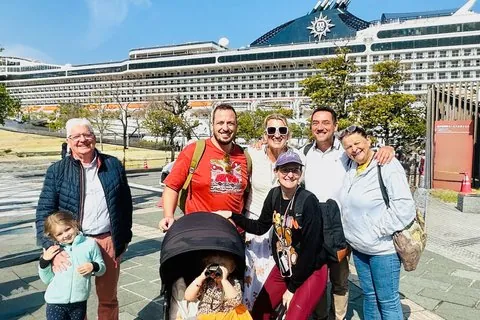
The Matsugae quay takes one ship of the 160,000-tonne class; Spectrum of the Seas, at 169,379 tonnes, is the biggest in this season's schedule. A second large-ship berth is being built there for completion by 2032, so nothing changes for 2026–27. The terminal building opens two hours before the ship berths and closes an hour after it leaves, and has a barrier-free toilet and a lift to its roof deck.
There is no port shuttle bus at either berth, and you will not miss one.
Getting from Matsugae into Nagasaki
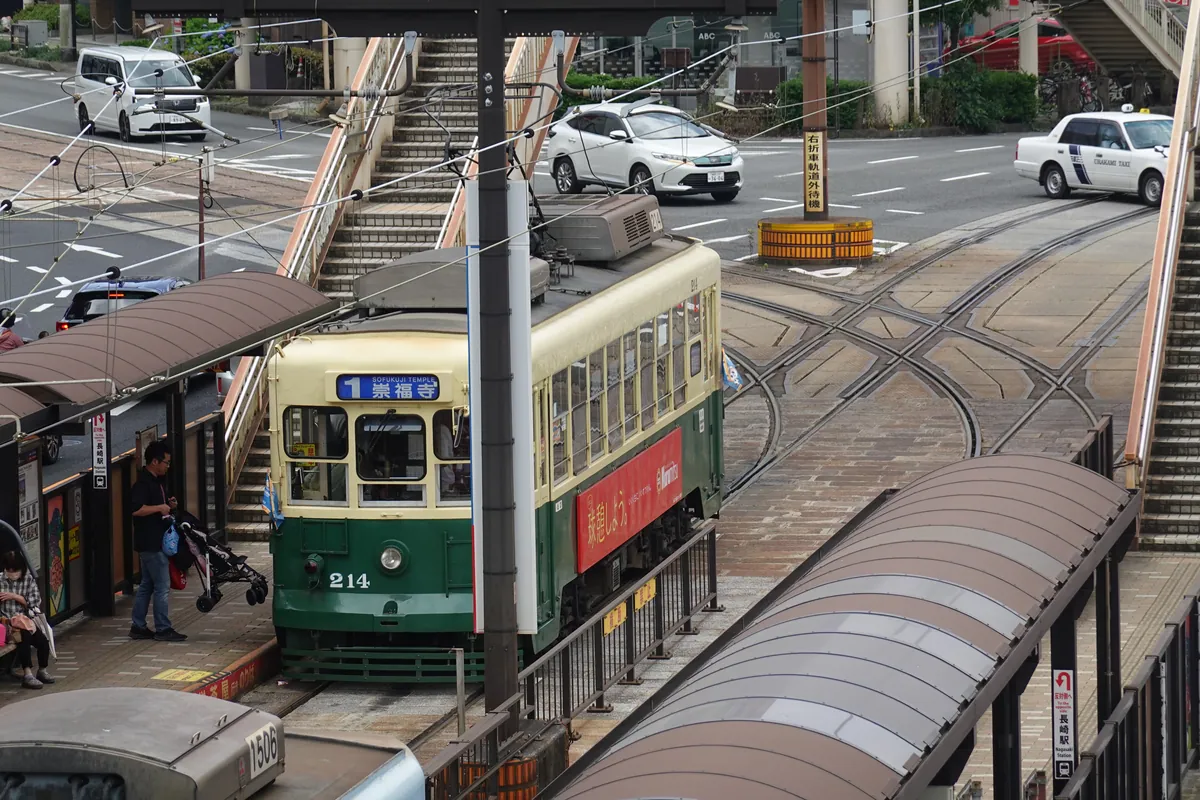
The tram is the answer for everything beyond the hillside. Every ride costs ¥150, any distance. You can pay with any Japanese transit IC card, a contactless Visa, Mastercard, JCB, Amex, Diners, Discover or UnionPay card, a phone, or cash — but the fare box gives no change, so use the change machine first.
Two rules make the difference between ¥150 and ¥300 a journey:
Change for free, cashless only. The pier line (Line 5) does not go to the Peace Park or the station. You change at Shinchi Chinatown, and the second tram is free if you board it within 30 minutes of getting off — provided each person taps their own card. One card paying for two people loses the free change; cash riders pay twice.
Tap on and tap off. Contactless cards are read when you board and again when you get off.
Since 18 February 2026 a driver shortage has thinned the service: in the daytime Line 1 runs about every 7 minutes, Line 3 about every 10 and Line 5, the pier line, about every 11. Line 4 is suspended.
To
How
Time
Cost
Oura Cathedral, Glover Garden
Walk, or Line 5 one stop to Oura Tenshudo
5–10 min on foot
Free, or ¥150
Shinchi Chinatown
Line 5 towards Hotarujaya, or walk
4 min, or about 15 min on foot
¥150
Dejima
Line 5 to Shinchi, change to Line 1, one stop
7 min riding, or about 18 min on foot
¥150 by card
Megane-bashi (Spectacles Bridge)
Line 5 towards Hotarujaya, direct
10 min
¥150
Nagasaki Station
Line 5 to Shinchi, change to Line 1
13 min riding
¥150 by card
Atomic Bomb Museum, Peace Park
Line 5 to Shinchi, change to Line 1 towards Akasako
25–26 min riding; 40–50 min door to door (estimate)
¥150 by card, ¥300 cash
Atomic Bomb Museum by taxi
From the terminal
about 15 min (estimate)
from about ¥2,270
Mt. Inasa ropeway
Bus route 4 from the Matsugae Kokusai Terminal stop to Ropeway-mae
Taxis work on the Nagasaki tariff that took effect on 3 August 2026: for a regular car, at most ¥770 for the first kilometre, then ¥100 for every 263 m, plus time charges in slow traffic. Our fares above are the distance-only floor from map routing, so treat them as the least you will pay; tour-bus traffic on ship days may add a third to a half to the time (our estimate). Hourly hire is up to ¥2,950 per 30 minutes, which four people sharing a car for the museum and back may find worth it.
A one-day tram pass costs ¥600 and is sold in the terminal building, not on board. With the free change, a return trip to the Peace Park costs ¥300, so the pass only pays off if you make five or more separate rides. The last Line 5 trams back to Oura-kaigan-dori run after 22:30, so the tram is never what limits a late sailing.
From Dejima wharf
Dejima wharf is better placed for the Peace Park than Matsugae. Walk about 5 minutes to the Dejima stop and take Line 1 towards Akasako: 18 minutes to the Atomic Bomb Museum stop, 19 to the Peace Park, with no change. Nagasaki Station is 6 minutes on the same line. For the hillside, take Line 1 towards Sofukuji to Shinchi Chinatown and change to Line 5 for Oura Tenshudo, about 9 minutes' riding. A taxi to the museum costs from about ¥1,770. There is a 24-hour Lawson about 150 m from the wharf.
The Atomic Bomb Museum and the Peace Park: how to do them well
The museum stands on the hill above the hypocentre, where a black pillar marks the point over which the bomb exploded; the Peace Park and its Peace Statue are about 480 m north. The tram stops for the two — Genbaku Shiryokan and Heiwa Koen — are a minute apart.
Hours: 8:30–17:30 (last entry 17:00) from September to April; 8:30–18:30 from May to August. Closed 29–31 December, when no ships call. Admission: ¥200 for everyone 15 and over, with no reduction for seniors; the multilingual audio guide is ¥160. The counter takes cash, credit cards, e-money and QR payments; web tickets let you skip the ticket queue, but no reservation is needed.
Crowds: the museum itself warns that in the school-trip seasons — May to June and September to November — it is crowded around 12:00 and after 16:00. Autumn is also Nagasaki's busiest cruise season. Arrive at 8:30.
Renewal to March 2027. For its 80th-anniversary renewal, parts of the galleries are behind screens: part of Corner A until 10 October 2026, Corner C from 24 November 2026 to March 2027, part of Corner B from the end of December and the video room from January to March 2027 (the later dates are the museum's plans). The museum says most of Corner B, where the bomb artefacts are displayed, can be seen as usual.
Resident volunteers explain the exhibits free from 10:00 to 16:00 (not 29 December to 3 January); ask at the entrance desk whether an English speaker is available. The museum also lends one electric-assist wheelchair for the route between the museum and the Peace Park, 9:00–17:00 in two-hour slots, booked in advance, until 31 March 2027. Allow an hour and a half for the museum and another hour for the hypocentre and the park.
Glover Garden and Oura Cathedral: the hill above the ship
Glover Garden gathers the old Western merchants' houses on the slope over the harbour, with your ship in the view. It opens at 8:00 and closes at 18:00, with evening openings in autumn: to 20:00 from 12 October to 31 December (and 21:30 until 11 October). Last entry is 20 minutes before closing. Admission is ¥1,300 for adults since April 2026 (it was ¥620), with no senior rate. Moving walkways and ramps carry you up the hill; the paths are mostly stone and sloping, and free electric wheelchairs are lent after a short instruction. The upper gate (Gate 2) takes no cards; every gate takes cash. Allow 75–90 minutes, and enter at the top, then walk down to leave by the lower gate beside Oura Cathedral.
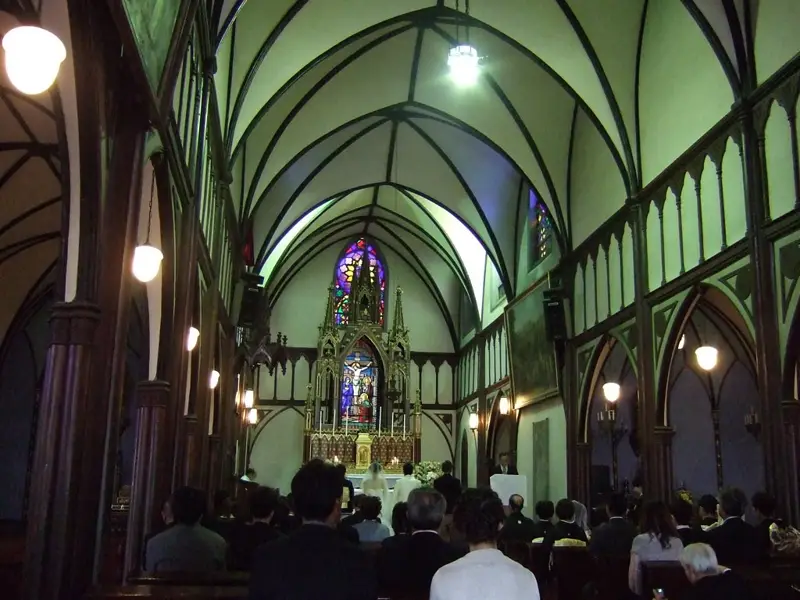
Oura Cathedral, a National Treasure, stands at the foot of the garden. It is open 8:30–18:00 from March to October (last entry 17:30) and 8:30–17:30 from November to February (last entry 17:00), and may close for church events. Admission is ¥1,000, including the Christian museum beside it; there is no senior rate. The only way in is a long stairway with handrails, and photography inside is not allowed. The church does not publish which payment methods it takes, so carry cash. Allow 30–45 minutes.
The two sell a joint ticket only through online booking platforms. On foot from the Matsugae gangway, Oura is about 5 minutes and Glover's lower gate 7–10 minutes, uphill at the end.
Gunkanjima, Battleship Island: what is actually possible
Hashima is an abandoned mining island crowded with concrete buildings, now part of a World Heritage listing; a tour spends about two and a half to three hours on the water, landing included. Two boat companies run tours, and for a cruise passenger they are not equal.
Gunkanjima Concierge
Gunkanjima Cruise
Check-in
Gunkanjima Digital Museum, 150 m from the Matsugae gangway
Office at Motofuna, 1.8 km north (taxi from about ¥1,170)
Morning
Check-in 9:00–10:10, sails about 10:30, back about 13:05–13:15
Check-in 8:10–8:50, sails 9:10, back about 12:10
Afternoon
Check-in 12:00–13:20, sails about 13:40, back about 16:10–16:30
Check-in 13:00–13:40, sails 14:00, back about 17:10
Fare
¥5,500 weekdays, ¥6,000 weekends and holidays, Digital Museum included
¥3,600 online
Island fee
¥650
¥650, refunded if no landing
Payment
Card online; full refund if the sailing is cancelled
Cash on the day
If it only circles
A circle-only price
No refund of the boat fare
From Matsugae the Concierge morning tour is the one to book. It fits any call that arrives by about 09:30 and sails at about 15:00 or later — which includes the common 07:00–16:00 calls, where you are back at the gangway about 13:15–13:25. The operator's timetable gives the return as "about 13:05" in one place and 13:15 in another, so plan on the later one. The afternoon boat needs a sailing at about 18:00 or later. Tours are reservation-only, with no waiting list, and children under three are not taken.
Landing depends on the sea. Under the city's rules the island's pier closes when the wind exceeds 5 m/s, the waves exceed 0.5 m or visibility falls to 500 m; the boat then only circles the island. The Concierge operator reports a landing rate of 94% up to March 2020. A landing lasts from about 11:35 to 12:20 on the morning tour, with stairs at the landing; wheelchair users need a companion. There are no toilets on the island: the Concierge asks you to use the ones at its waiting area or on board before landing, and it does not sell seasickness tablets, so bring your own if you need them.
On a 9-hour call, Gunkanjima takes the Peace Park's place: the morning boat plus the hillside is a full day. On 10 hours or more you can have the island and either the Peace Park or the hillside — see the model days below.
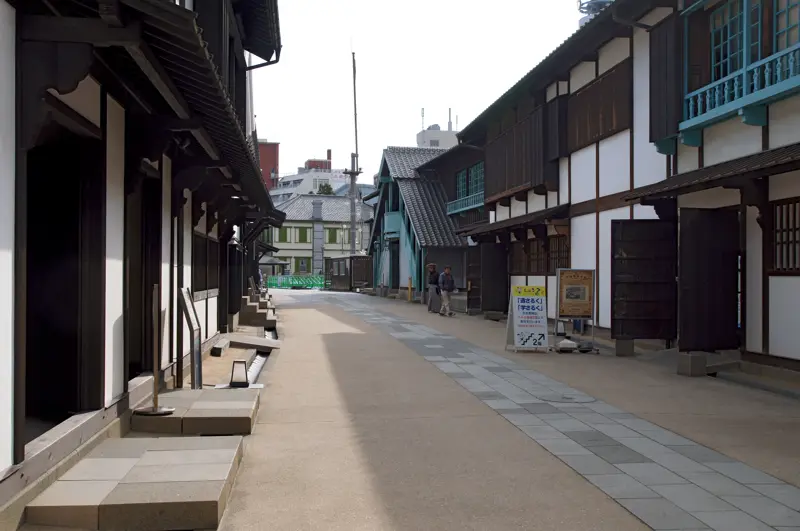
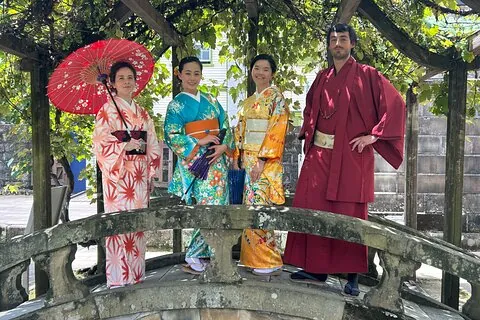
Dejima was the fan-shaped artificial island where the Dutch traded with Japan through the closed centuries; 16 of its buildings have been restored so far. It is open 8:00–21:00 every day (last entry 20:40) through the Omotemon bridge gate; the Water Gate closes at 18:00. Admission is ¥1,100 for adults, with no senior or group reduction, and no re-entry. The current Japanese page lists cash, cards, e-money and QR payments; the English page still says cash and two Chinese wallets only. A restaurant inside serves lunch until 14:30. Allow 60–90 minutes.
Shinchi Chinatown is 5–7 minutes' walk from Dejima: champon, sara-udon and kakuni buns in a compact grid. Megane-bashi, the stone Spectacles Bridge, is 10 minutes from the pier on Line 5.
Mt. Inasa is for late sailings. The Nagasaki Ropeway runs 9:00–22:00 every 15–20 minutes (last ride up 21:00), ¥1,900 return, and stops in bad weather; queues build after dusk. A free evening loop bus runs from central hotels, with reservations. Nine calls this season sail at 21:00 or later: Asuka III on 7 October, Star Seeker on 11 October and 25 March, Dream on 16 December, 1 January and 7, 12 and 17 February, and Le Soléal on 27 March.
Beyond the city, Unzen and the Shimabara peninsula are a 7–10-hour private car day, and Huis Ten Bosch is in Sasebo: neither fits a normal call on your own.
The best things to do in Nagasaki on a port day
Our full list, with the time each takes from the berth, is on the Nagasaki top 10. In brief:
The Peace Park and the hillside: a 9-hour call at Matsugae
Fits 07:00–16:00 at Matsugae, the commonest pattern here (Diamond Princess, Sapphire Princess, Star Navigator: 13 calls). Weekday timetable; shift every time by your arrival.
Both of Nagasaki's heavyweights on the shortest common call, by tram and on foot, for ¥300 in fares. It works because the museum opens at 8:30 and Glover Garden is downhill from the gangway on the way back. All-aboard around 15:30; target back at the gangway 14:30.
07:30Off the ship. Buy nothing yet: an IC card or a contactless bank card each is all you need. Walk 5–7 minutes to the Oura-kaigan-dori tram stop.
08:05Tram Line 5 towards Hotarujaya (08:05 is a timetabled departure), 4 minutes to Shinchi Chinatown. Tap on and tap off.
08:15Change to Line 1 towards Akasako (about every 7 minutes) — free with the same card within 30 minutes. Off at Genbaku Shiryokan (Atomic Bomb Museum) at about 08:36.
08:40Atomic Bomb Museum, ¥200. The first hour is the quiet one; in autumn school groups peak around noon. Give it an hour and a half; the audio guide is ¥160.
10:10Hypocentre Park, then walk up to the Peace Park and the Peace Statue, about 480 m north of the museum.
11:00Line 1 towards Sofukuji from the Peace Park stop, 22 minutes to Shinchi Chinatown; change to Line 5 towards Ishibashi (about every 11 minutes), 4 minutes to Oura-kaigan-dori, about 11:35.
11:40Champon at Shikairo, 4 minutes from the stop: the restaurant opens 11:30, takes no bookings and closes on some Wednesdays — check its monthly notice for your date.
12:35Oura Cathedral, ¥1,000, about 5 minutes up the lane. The only way in is a long stairway; no photos inside.
13:05Glover Garden, ¥1,300, next door. Moving walkways take you up; walk down through the houses and leave by the lower gate. If you buy your ticket at the upper gate (Gate 2), pay in cash — it takes no cards.
14:20Back at the gangway, about 10 minutes downhill: 10 minutes ahead of target. Fares for the day ¥300 each with a card, ¥600 in cash.
Battleship Island and Glover Garden: a 10-hour call at Matsugae
Fits 08:00–18:00 or 08:00–19:00 at Matsugae (Celebrity Millennium, Luminara, Costa Serena, Eastern Venus). On 07:00–17:00 (Norwegian Jade), see the note.
Nagasaki's other great sight, starting 150 m from the ship. Book the Gunkanjima Concierge morning tour online before you sail — there is no waiting list. Times assume an 08:00–18:00 call: all-aboard 17:30, target back at the gangway 16:30.
08:30Off the ship, and a 2–3 minute walk to the Gunkanjima Digital Museum at Matsugae-machi 5-6.
09:00Check in at the automatic kiosk with your booking QR code (morning check-in 9:00–10:10). Your ticket includes the Digital Museum; spend the wait in it.
10:10Walk 3 minutes to Tokiwa pier.
10:30Sail. The boat circles Hashima and, if the wind is under 5 m/s and the waves under 0.5 m, lands you from about 11:35 to 12:20. The landing involves stairs; the ¥650 island fee is paid separately.
13:05Back at Tokiwa pier about 13:05 (about 12:15 if there was no landing). One version of the operator's timetable says 13:15, so allow for it.
13:20Shikairo for champon, 4 minutes away; last entry for lunch is 14:00. If it is closed or full, Shinchi Chinatown is 4 minutes by Line 5.
14:10Oura Cathedral, ¥1,000, half an hour.
14:40Glover Garden, ¥1,300: the houses, the harbour view and your ship below. Leave by the lower gate.
16:10Back at the gangway, 20 minutes ahead of target — or 80 minutes ahead on a 19:00 sailing. Costs for the day: ¥5,500–6,000 for the boat, ¥650 island fee, ¥2,300 entries.
The whole city: an 11-hour call at Matsugae
Fits 08:00–19:00 or longer at Matsugae — 19 calls depart at 19:00 (Luminara, Navigator of the Seas, Celebrity Millennium, Costa Serena, Spectrum of the Seas).
The Peace Park, Dejima, Chinatown and the hillside in one unhurried loop, for ¥450 in tram fares. Times assume 08:00–19:00: all-aboard 18:30, target back at the gangway 17:30.
08:30Off the ship; walk 5–7 minutes to Oura-kaigan-dori.
08:45Line 5 to Shinchi Chinatown, change free to Line 1 towards Akasako, off at the Atomic Bomb Museum stop about 09:15.
09:15Atomic Bomb Museum (¥200), the hypocentre and the Peace Park — two hours, unhurried.
11:20Line 1 towards Sofukuji from the Peace Park stop, 19 minutes to the Dejima stop.
11:45Dejima, ¥1,100: the rebuilt Dutch trading post, 16 buildings in all. No re-entry, so see it in one go.
13:00Lunch in Shinchi Chinatown, 5–7 minutes' walk: champon, sara-udon or a kakuni bun.
13:50Line 5 towards Ishibashi from Shinchi Chinatown, 6 minutes to Oura Tenshudo.
14:05Oura Cathedral (¥1,000), then Glover Garden (¥1,300) from 14:40, leaving by the lower gate.
16:25Back at the gangway, about 65 minutes ahead of target — time for Megane-bashi (10 minutes on Line 5) or castella from Fukusaya's Matsugae shop, which closes at 17:00 and on Tuesdays.
How to think about your hours
Work backwards from the ship. Your all-aboard time is usually 30 minutes before departure (check the daily programme), you want to be back at the gangway an hour before that, and the first half hour after arrival goes on getting off. So the time you can actually use is the call length minus about two hours.
Call
Usable
From Matsugae
From Dejima wharf
4 hours
about 2
Glover Garden and Oura Cathedral on foot, or Glover and a champon lunch. The Peace Park only by taxi both ways, for about 80 minutes on site.
Dejima and Chinatown on foot, or the Peace Park by direct tram with about an hour there.
6 hours
about 4
One heavyweight: the Peace Park and museum, or the hillside plus Shikairo and Dejima.
The Peace Park, or Dejima, Chinatown and Glover Garden.
8–9 hours
about 6–7
The Peace Park and the hillside with lunch — or Gunkanjima's morning boat and the hillside.
The Peace Park, Dejima and Chinatown.
10 hours+
about 8
The whole city, or Gunkanjima plus the hillside or the Peace Park.
Everything in the city; the hillside by tram.
Nagasaki's calls from October 2026 to March 2027 are mostly 9 or 10 hours (19 and 22 of 72), with 23 of 11–13 hours and only seven shorter; the shortest is Adora Mediterranea's 7-hour call on 15 March 2027. The single most common pattern is 07:00–16:00. There are no overnight calls this season. If you sail at 21:00 or later, add Mt. Inasa at dusk, Glover Garden's evening opening or Dejima, open to 21:00.
Tours worth booking, by how many hours you have
Every pick opens our own page first — what the operator actually includes, who should skip it, and which upcoming Nagasaki calls it fits. Prices are the operator's "from" price as of 26 Sep 2026.
4h+Short call, or an hour in silk at Dejima
On a short call the hillside above the berth needs no guide. If you want one organised thing, this is the one that fits.
Tours are booked through Viator (a Tripadvisor company). If you book, we may earn a small commission at no extra cost to you. It never decides what we recommend — which is why each tour page has a "think twice" note.
About the return to the ship. None of the Nagasaki tours we list promises in writing to get you back on time. The closest words are the Top Sites Tour's: on shorter port calls "some free sites may be omitted to maintain a comfortable pace and ensure a timely return to your ship" — and it adds that emergency or early-return trips to the ship are not included. Three habits protect you: choose a tour that meets you at the terminal, tell the guide your all-aboard time when you meet, and agree to be back at the gangway an hour before it. Because Nagasaki's sights are so close to the pier, you can also do all of this yourself and pay only for the guide's knowledge.
Money, cards and the practical stuff
Nagasaki's trams and taxis are card-friendly; some of its sights are not.
Place
Pay with
Trams
IC card, contactless credit or debit card, phone, or cash (no change)
Taxis
Credit cards accepted
Atomic Bomb Museum
Cash, cards, e-money or QR at the counter; web tickets online
Glover Garden
Cash at every gate; no cards at the upper gate
Oura Cathedral
Payment methods not published; carry cash
Dejima
Cash, cards, e-money, QR
Gunkanjima Concierge
Card, online
Gunkanjima Cruise
Cash on the day
Cash machines. From the Matsugae terminal: Nagasaki Kosone post office about 130 m, a FamilyMart about 190 m and a 24-hour FamilyMart about 270 m, and a 7-Eleven about 350 m. From Dejima wharf, a 24-hour Lawson about 150 m. 7-Eleven and Japan Post machines generally accept foreign cards, and the prefecture's tourism site says you can also withdraw yen at Lawson and FamilyMart. The terminal building has currency exchange and free Wi-Fi, and there is free Wi-Fi at every tram stop, Glover Garden and the Peace Park.
Tipping. Not expected. Japan's national tourism organisation says tips are not customary in restaurants, cafés, taxis or hotels; a private guide used to overseas visitors may accept one as thanks, given discreetly in an envelope.
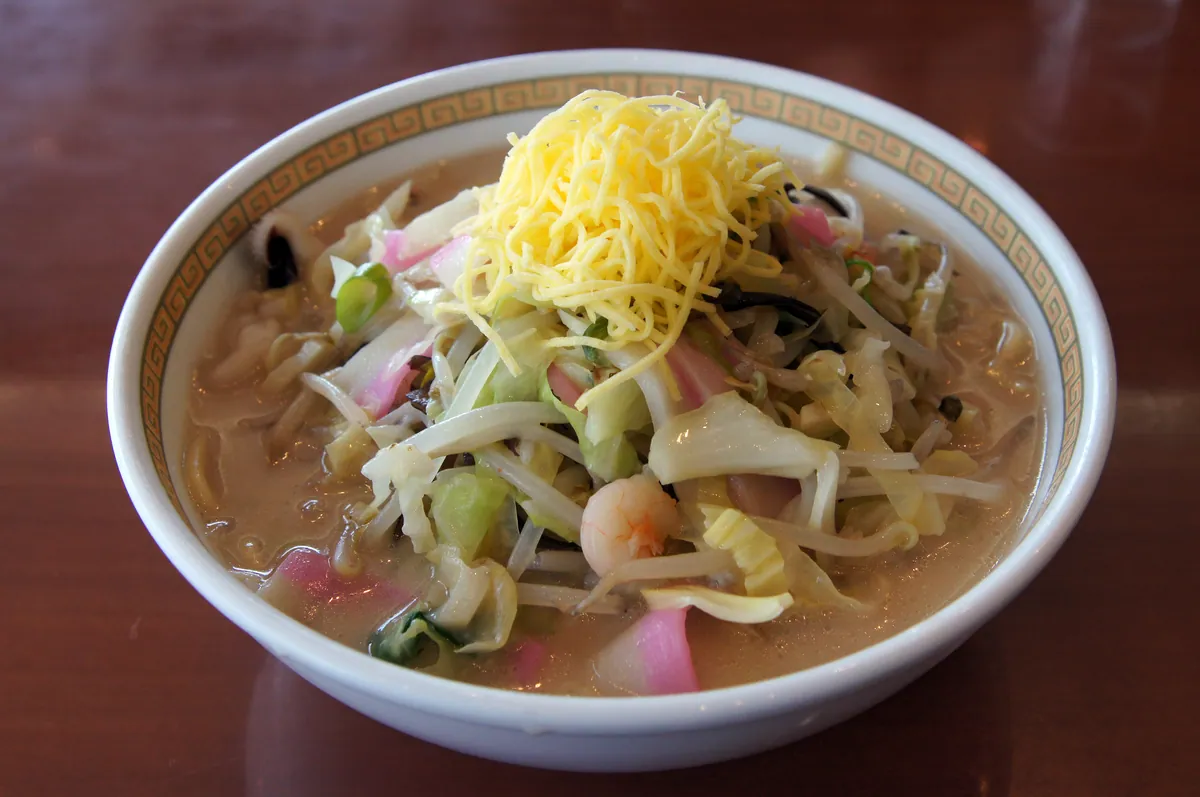
Shikairo, where champon was created in 1899, is 4 minutes from the Matsugae gangway. Lunch is 11:30–15:00 with last entry at 14:00 (earlier when busy), and there are no reservations. It has lifts to every floor and an accessible toilet. It publishes its closed days month by month, usually Wednesdays: in October 2026, the 14th and the 28th — Westerdam's call day. From November, check the notice for Wednesday calls such as Diamond Princess (18 November), Star Navigator (25 November and 27 January) and Dream (16 December and 17 February).
Fukusaya, the castella makers since 1624, has a shop in Matsugae-machi near the berth, open 9:30–17:00 and closed on Tuesdays — which catches Viking Venus (6 October), Navigator of the Seas (20 October), Seven Seas Explorer (27 October) and several March 2027 calls. The main store in Funadaiku-machi is also open 9:30–17:00.
Tsuruchan, the 1925 café that serves toruko rice, is open 9:00–21:00 daily near the Shianbashi tram stop; its payment rules are not published, so bring cash.
Dejima's restaurant serves lunch 11:00–14:30 (with Dejima admission), and the Atomic Bomb Museum has a café with a vegan menu.
When to go: seasons and crowds
Autumn (October–November) is the busiest cruise season, with 22 calls in October alone, and the most comfortable weather: average highs of 24 °C in October and 18.5 °C in November. It is also school-trip season at the museum, so arrive at opening.
Nagasaki Kunchi, 7–9 October, the Suwa Shrine festival held since 1634, falls on Asuka III (7 October), Diamond Princess (8 October) and Adora Mediterranea (9 October). The paid seats are at four venues, but the dance groups also perform free in the streets around the centre on all three days; maps are handed out at the station and tourist offices. Expect road closures — both Gunkanjima operators have posted traffic notices for those days.
Winter (December–February). Highs of 11–13 °C. Maples colour late here, normally around 7 December, so the 14 December call is the one closest to the peak. The Lantern Festival is held around Chinese New Year (6 February 2027), so February's nine calls may coincide — its 2027 dates had not been announced when we checked.
Spring (March). Highs of 15 °C, and 21 calls in March 2027. Cherry blossom normally opens on 23 March and is full on 2 April, so late-March ships may just catch the first flowers.
Summer is hot (31.9 °C in August), and June is by far the wettest month.
Typhoons approach northern Kyushu nearly four times a year, most often from July to September, with a smaller risk in October and none from November to April.
Rain plan: the Atomic Bomb Museum, Dejima (mostly under roofs), Shikairo and its champon museum, and the Gunkanjima Digital Museum are all indoors. Oura Cathedral is indoors but reached by an open stairway. Gunkanjima landings and the ropeway depend on the weather.
What other guides get wrong about Nagasaki
Things you will read about Nagasaki elsewhere — in older port guides, forum posts and some cruise-line pages — set against what the official source says today.
You may read
What the official source says
Source
The Peace Park is a 20–25 minute walk from the cruise terminal.
The Atomic Bomb Museum and Peace Park are about 5 km north of Matsugae, not a walk. By tram it is Line 5 to Shinchi Chinatown (4 minutes), then Line 1 for 21–22 minutes: about 40–50 minutes door to door.
The Peace Park is too far for trams: you need a taxi or a tour.
Trams go there for ¥150: one change at Shinchi Chinatown from Matsugae, free within 30 minutes if each person taps their own IC or contactless card; Line 1 runs direct from Dejima wharf.
Nagasaki trams don't take credit cards, so bring coins.
Contactless Visa, Mastercard, JCB, Amex, Diners, Discover and UnionPay cards, phones and watches work on every tram. Tap when you board and again when you get off.
Thinking the Peace Park needs a taxi or a tour.Some cruise pages say so. Trams go there for ¥150: one change from Matsugae, none from Dejima wharf. A taxi (about ¥2,270 and 15 minutes) is the answer only when you are short of time.
Believing it is 20 minutes away.The tram ride alone is 25–26 minutes from Oura-kaigan-dori, plus the walk to the stop and a change at Shinchi Chinatown. Plan on 40–50 minutes door to door each way.
Sharing one card, or paying cash.The free change at Shinchi Chinatown only works cashless, one card per person, within 30 minutes. Pay cash and you pay ¥150 twice, with no change given from the fare box.
Tapping only once.One passenger review complains that contactless 'worked only once'. Tap your card on the reader when you board and when you get off.
Turning up at the pier for Gunkanjima.The Concierge tours are sold online only, with no waiting list, and in wind over 5 m/s or waves over 0.5 m the boat only circles the island. Book before you sail and have a plan B.
Using out-of-date prices.Older guides quote ¥130 trams, a ¥500 pass and Glover Garden at ¥620. Today it is ¥150, ¥600 and ¥1,300; Dejima rose to ¥1,100 in April 2026.
Underestimating the hills.Nagasaki is built on slopes. Oura Cathedral is reached only by stairs; Glover Garden has moving walkways going up, so walk down.
Arriving at the museum at noon in autumn.The museum warns that from September to November school groups crowd it around 12:00 and after 16:00. Be there at 8:30.
Researched from official timetables, operators and the port authority. Every time and fare in this guide was checked against the sources listed above on 1 October 2026; where we had to estimate (a walk, a taxi in traffic), the text says so. Timetables change — if you find one that has, tell us and we will fix it.
Quick answers
Nagasaki cruise port questions
Where do cruise ships dock in Nagasaki?
At Matsugae International Tourist Ship Wharf, below the Glover Garden hillside: 65 of the 72 calls from October 2026 to March 2027, including every Diamond Princess, Celebrity Millennium, Spectrum of the Seas and Norwegian Jade call. On the seven days when two ships are in port, the second, smaller ship uses Dejima wharf, about 1 km north — this season Star Seeker, Azamara Pursuit, Luminara, Eastern Venus, Nautica or Le Soléal, most of which use Matsugae on other days. Both berths are in the city, and you can walk into town from either. Check your berth in the daily programme.
What is at the Nagasaki cruise terminal building?
The Matsugae International Terminal, at Matsugae-machi 7-16, opens 2 hours before your ship berths and closes 1 hour after it sails. Inside are immigration, free Wi-Fi, tourist information, currency exchange and the ¥600 one-day tram pass, plus a barrier-free toilet and a lift to the roof deck. The nearest cash machines are at a post office about 130 m away and a FamilyMart about 190 m away. At Dejima wharf arrangements vary by call, so follow your ship's instructions.
Is there a shuttle bus, or can I walk from the Nagasaki cruise terminal?
There is no official shuttle from either berth, and you do not need one. From Matsugae, Oura Cathedral is about 5 minutes on foot and Glover Garden 7–10 minutes, uphill at the end; Shinchi Chinatown is about 15 minutes and Dejima about 18. The Oura-kaigan-dori tram stop is 5–7 minutes away, and the Dejima stop about 5 minutes from Dejima wharf. Only the Atomic Bomb Museum, 5.4 km away, needs the tram or a taxi.
Can I see Nagasaki on my own, without a ship's excursion?
Yes — it is one of Japan's easiest ports to do alone. Glover Garden and Oura Cathedral are 5–10 minutes' walk from Matsugae, and the ¥150 tram reaches the Peace Park in about 40–50 minutes door to door with one change. The one thing to arrange before you sail is Gunkanjima, whose boats are booked online only. Whatever you do, plan to be back at the gangway an hour before all-aboard.
How do I get from the Nagasaki cruise port to the Peace Park?
Walk 5–7 minutes to Oura-kaigan-dori, take tram Line 5 to Shinchi Chinatown (4 minutes), and change to Line 1 towards Akasako for the Atomic Bomb Museum stop (21 minutes) or the Peace Park stop one further. ¥150 with your own IC or contactless card, ¥300 in cash; about 40–50 minutes door to door. A taxi takes about 15 minutes and costs from about ¥2,270. From Dejima wharf, Line 1 runs direct in 18 minutes.
How do I get from the Nagasaki cruise port to Dejima, Chinatown or Nagasaki Station?
From Matsugae, Shinchi Chinatown is about 15 minutes' walk or 4 minutes on tram Line 5. Dejima is about 18 minutes' flat walk (1.3 km), or Line 5 to Shinchi Chinatown and Line 1 one stop. Nagasaki Station is 13 minutes' riding with the same change, ¥150 by card, or a taxi from about ¥1,470. From Dejima wharf, Dejima and Chinatown are about 7 minutes on foot and the station is 6 minutes on Line 1.
How much is a taxi from the Nagasaki cruise port?
From about ¥2,270 to the Atomic Bomb Museum (about 15 minutes), about ¥1,970 to the Mt. Inasa ropeway, ¥1,470 to Nagasaki Station and ¥970 to Dejima from Matsugae. These are distance-only floors from the Nagasaki tariff in force since 3 August 2026 (¥770 for the first kilometre, then ¥100 per 263 m); slow traffic adds time charges. Taxis take credit cards, and hourly hire costs up to ¥2,950 per 30 minutes.
How much is the tram in Nagasaki?
¥150 per ride, any distance. IC cards, contactless Visa, Mastercard, JCB, Amex and phones all work: tap on and off. Cash gives no change. A one-day pass is ¥600, sold at the cruise terminal building but not on board; it pays off only at five or more separate rides.
What can I see in Nagasaki on a short port call?
Take the call length minus about two hours as your usable time. With about 2 hours, do Glover Garden and Oura Cathedral on foot from Matsugae, or Dejima and Chinatown from Dejima wharf. With about 4 hours, pick one heavyweight: the Peace Park and Atomic Bomb Museum by tram, or the hillside plus a champon lunch and Dejima. The shortest call from October 2026 to March 2027 is 7 hours, so most ships allow more.
Can I see the Peace Park and Glover Garden on a 9-hour call?
Yes. On a 07:00–16:00 call, be at the museum when it opens at 8:30, take the tram back by 11:00, have lunch near the pier and do Oura Cathedral and Glover Garden in the afternoon: you are back at the gangway about 14:20, ten minutes before a sensible target of 90 minutes before departure.
Can I visit Gunkanjima (Battleship Island) from a cruise ship?
Yes, if you book online before you sail. Gunkanjima Concierge checks in at its Digital Museum 150 m from the Matsugae gangway; the morning boat sails about 10:30 and returns about 13:05–13:15, so it fits calls that arrive by about 09:30 and sail at about 15:00 or later. It costs ¥5,500 on weekdays or ¥6,000 at weekends plus a ¥650 island fee, and you only land if the wind and waves allow. If the sea cancels the sailing, the Concierge refunds you in full; if the boat can only circle the island, a lower circle-only price applies.
How much is the Nagasaki Atomic Bomb Museum, and how long should I allow?
¥200 for everyone 15 and over, with no senior concession; the audio guide is ¥160. It opens at 8:30 and closes at 17:30 from September to April (entry to 17:00), 18:30 from May to August. Allow about 90 minutes in the museum and another hour for the hypocentre and the Peace Park, 480 m north. Parts of the galleries are closed for renewal until March 2027, but most of the hall with the bomb artefacts stays open.
How much do Glover Garden and Oura Cathedral cost?
Glover Garden is ¥1,300 for adults since April 2026 and Oura Cathedral ¥1,000, including its Christian museum; neither has a senior rate. Glover opens at 8:00 and closes at 20:00 from 12 October to 31 December and at 18:00 from January to March, last entry 20 minutes before. Oura opens 8:30–17:30 from November to February and to 18:00 from March. Glover's upper gate takes cash only, and Oura does not publish its payment methods.
Is Nagasaki manageable with limited mobility or a wheelchair?
Partly. Glover Garden has moving walkways, ramps and free electric wheelchairs, but Oura Cathedral can be entered only by a long stairway. The Atomic Bomb Museum lends one electric-assist wheelchair for the route to the Peace Park, booked in advance, until 31 March 2027. Only nine low-floor trams a day leave Oura-kaigan-dori in each direction; the rest have steps. The terminal has a barrier-free toilet, and Shikairo has lifts. A private car tour from the terminal (5606621P5) avoids the trams.
Do I need cash in Nagasaki?
Some. Trams and taxis take cards and Dejima's Japanese page lists cards and e-money, but Glover Garden's upper gate is cash only, Gunkanjima Cruise takes cash on the day, and Oura Cathedral does not publish its payment methods. There are cash machines at a post office about 130 m and a FamilyMart about 190 m from the Matsugae terminal.
Should I tip in Nagasaki?
No. Japan's national tourism organisation says tipping is not customary in restaurants, cafés, taxis or hotels, and the tram fare box gives no change for extra. The one exception it notes: a private guide used to overseas visitors may accept a tip as thanks, and if you give one, put it discreetly in an envelope. None of this is expected.
Where can I try champon near the Nagasaki cruise port?
At Shikairo, 4 minutes' walk from the Matsugae gangway, where champon was created in 1899. Lunch runs 11:30–15:00 with last entry at 14:00, there are no reservations, and it closes on some Wednesdays — 14 and 28 October 2026, for example — so check its monthly notice. If it is shut or full, Shinchi Chinatown is 4 minutes away on tram Line 5, with champon and sara-udon at many of its restaurants.
Which cruise ships call at Nagasaki?
Nagasaki was Japan's busiest port for foreign cruise ships in 2025, with 194 calls. From October 2026 to March 2027 the prefecture lists 72 named calls, 22 of them in October and 21 in March, and fewer in winter. Regulars include Diamond Princess, Sapphire Princess, Spectrum of the Seas, Celebrity Millennium, Norwegian Jade, Star Seeker and Dream. Most calls last 9 or 10 hours, and the commonest pattern is 07:00–16:00.
What is the weather like in Nagasaki for a cruise call?
Average highs are 24 °C in October, 18.5 °C in November, 11–13 °C from December to February and 15 °C in March; August peaks at 31.9 °C, and June is by far the wettest month. Typhoons approach northern Kyushu nearly four times a year, mostly from July to September, rarely in October and never from November to April. For a wet day, the Atomic Bomb Museum, Dejima and Shikairo are all under cover.
What are the best things to do in Nagasaki on a cruise stop?
The Atomic Bomb Museum and Peace Park come first: about four hours with the tram both ways. Next are Glover Garden and Oura Cathedral, 5–10 minutes' walk from the Matsugae berth, and Gunkanjima, Battleship Island, by boat from beside the pier if booked ahead. Dejima, the rebuilt Dutch trading island, Shinchi Chinatown and champon at Shikairo fill the gaps, and Mt. Inasa's night view suits ships sailing at 21:00 or later.
Can I go up Mt. Inasa from the cruise ship?
Only on a late sailing if you want the night view. The ropeway runs 9:00–22:00 with the last ride up at 21:00, ¥1,900 return; bus route 4 from the terminal stop takes about 20 minutes, a taxi from about ¥1,970. Ships sailing at 21:00 or later include Asuka III, Star Seeker and Dream.
What is the best tour from the Nagasaki cruise port?
For a couple on a 9–10-hour call, the private half-day by tram (5606621P8), then Glover Garden on foot. For limited mobility, the private car tour from the terminal (5606621P5). For four or more on a 10-hour call, the Top Sites Tour, whose guide meets you in front of the terminal exit (5528408P1). None promises an on-time return in writing, so keep an hour's margin.